
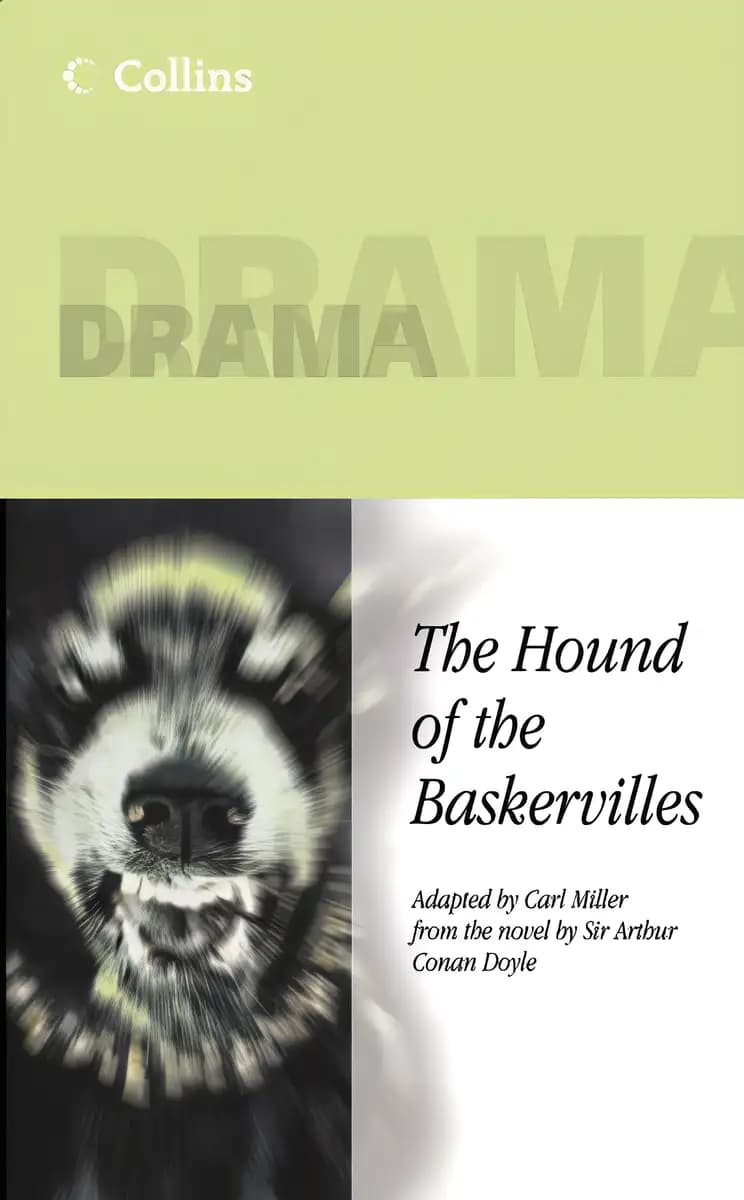
"Hound of the Baskervilles" (Collins Drama)
#5 in The Sherlock Holmes Children’S Collection: Creatures, Codes And Curious Cases (Easy Classics) Series
on Goodreads (367,862)
What’s inside...
A hugely enjoyable dramatisation of the Conan Doyle detective classic. Holmes and Watson try to unravel the mystery of the death of Sir Charles Baskerville, the only clue left being the 'footprints of a gigantic hound'. The legend of the hound which has brought terror to the Baskerville family for generations brings Sherlock Holmes up against a formidable adversary and sends Dr Watson to a bleak and lonely moor where it is all too easy to believe that something not of this world is intent on driving his friend to a foul and hideous death. Carl Miller's inventive and entertaining adaptation for the stage of Conan Doyle's classic is perfect for use in English and Drama lessons. The teacher resources provide a wealth of ideas for further study with reading, writing and speaking and listening activities.
Character compass
Sherlock Holmes
Sir Henry Baskerville
Miss Beryl Stapleton
John Barrymore
Dr. James Mortimer
Dr. John Watson
Mrs. Barrymore
Mr. Jack Stapleton
Henry Baskerville
James Mortimer
Eliza Barrymore
Mr. Perkins
Mr. Frankland
Jack Stapleton
Beryl Stapleton
James Desmond
Mr. Selden
Laura Lyons
Charles Baskerville
John Clayton
John Watson
Discussion points
How do you think Sherlock Holmes solves mysteries using his observations and deductions?
What feelings did you experience while following the suspense in the story?
If you were in Dr. Watson's place, how would you have reacted to the mysteries of the Baskerville Hall?
Why do you think the setting of the moor important to the story’s atmosphere?
What lessons can we learn about bravery and fear from the characters in the book?
Tip: Role play these questions
Start by sharing your own thoughts about the book to encourage open communication.
Ask your child to describe their favorite scene and explain why they chose it – this helps deepen their comprehension and recall.
Discuss the historical setting of the story and how it influences the characters and plot, providing a subtle way to integrate a history lesson.
Encourage them to imagine alternative endings, boosting their creativity and critical thinking.
Link the themes of the book to real-life situations, helping your child apply literary lessons to the world around them.
Key lessons
Example Lesson: Critical thinking and problem-solving
Explanation: Throughout 'Hound of the Baskervilles,' Sherlock Holmes exemplifies the power of observation and deduction to solve mysteries.
Real-World Application: Children can apply these skills by analyzing situations in their everyday life to make rational decisions and solve problems efficiently.
Example Lesson: The importance of courage
Explanation: The characters often face fearful and mysterious circumstances, yet their bravery helps them to confront and overcome their fears.
Real-World Application: This encourages children to face their own fears and understand that courage can help them overcome obstacles.
Example Lesson: The value of friendship
Explanation: The collaboration between Sherlock Holmes and Dr. Watson shows the strength of teamwork and loyalty.
Real-World Application: Children learn the importance of supporting friends and working together to achieve common goals.
Example Lesson: Scientific inquiry
Explanation: Holmes uses scientific methods and logical reasoning to understand complex scenarios, demonstrating the importance of a scientific approach.
Real-World Application: This can inspire children to approach their questions about the world methodically and think critically about the information they receive.