
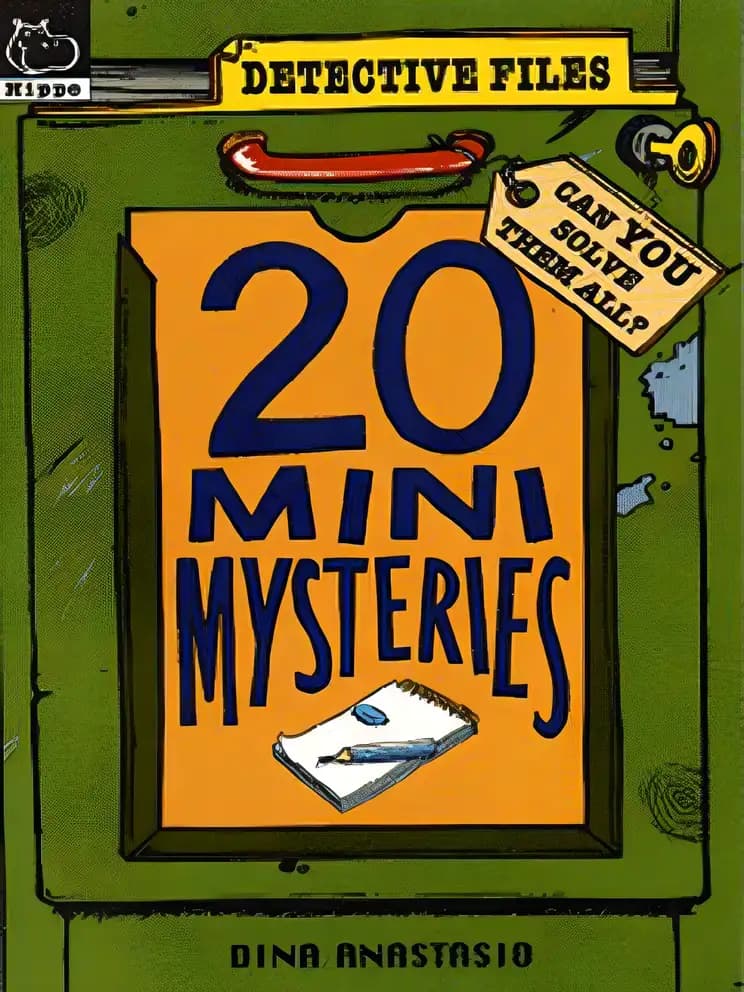
20 Mini-mysteries (Detective Files)
DOA Detective Files Series
on Goodreads (4)
What’s inside...
The stories in these Detective Files will need to be read with eagle eyes to spot the clues and track down the culprits. Test your powers of detection with 20 Mini Mysteries.
Series reading
Non-Sequential
Age
8-12
Length
112 pages
Text complexity
Discussion points
What do you think motivated the detective to solve the mystery?
How would you solve the mystery differently if you were the detective?
What clues did you find most intriguing or helpful in solving the mysteries?
How do the characters in the story demonstrate teamwork or problem-solving?
What have you learned about observing details and making conclusions?
Tip: Role play these questions
Encourage your child to think like a detective by asking them to predict the solution before finishing each mini-mystery.
Discuss the importance of attention to detail and how it helps in solving mysteries and daily challenges.
Relate the problem-solving techniques in the book to real-life situations to help your child apply these skills beyond the book.
After reading each mini-mystery, ask your child to summarize the story to enhance their comprehension and recall abilities.
Celebrate successful mystery solving from the book to build confidence and encourage a positive attitude towards challenges.
Key lessons
Example Lesson: Problem-solving skills
Explanation: Each mini-mystery in the book requires the young reader to pay attention to details and use logical reasoning to solve the mystery.
Real-World Application: Children can apply these problem-solving skills in their daily life when facing puzzles or complex situations, helping them make decisions and find solutions more effectively.
Example Lesson: Attention to detail
Explanation: The mysteries are crafted in a way that small clues are key to solving them, encouraging readers to focus and notice subtle details.
Real-World Application: This skill can help children in academic settings, such as noticing important information in instructions or texts, and in personal settings, like observing environmental cues.
Example Lesson: The importance of critical thinking
Explanation: Readers are urged to think critically and not take things at face value to solve the mysteries.
Real-World Application: This lesson can be applied in a child’s everyday life by encouraging them to question information and think deeply before making judgments or decisions.
Example Lesson: Teamwork and collaboration
Explanation: Some mysteries involve characters working together to solve the case, highlighting the benefits of collaboration.
Real-World Application: Children learn the value of working with others to achieve common goals, which is beneficial in school projects, sports, and other social activities.