
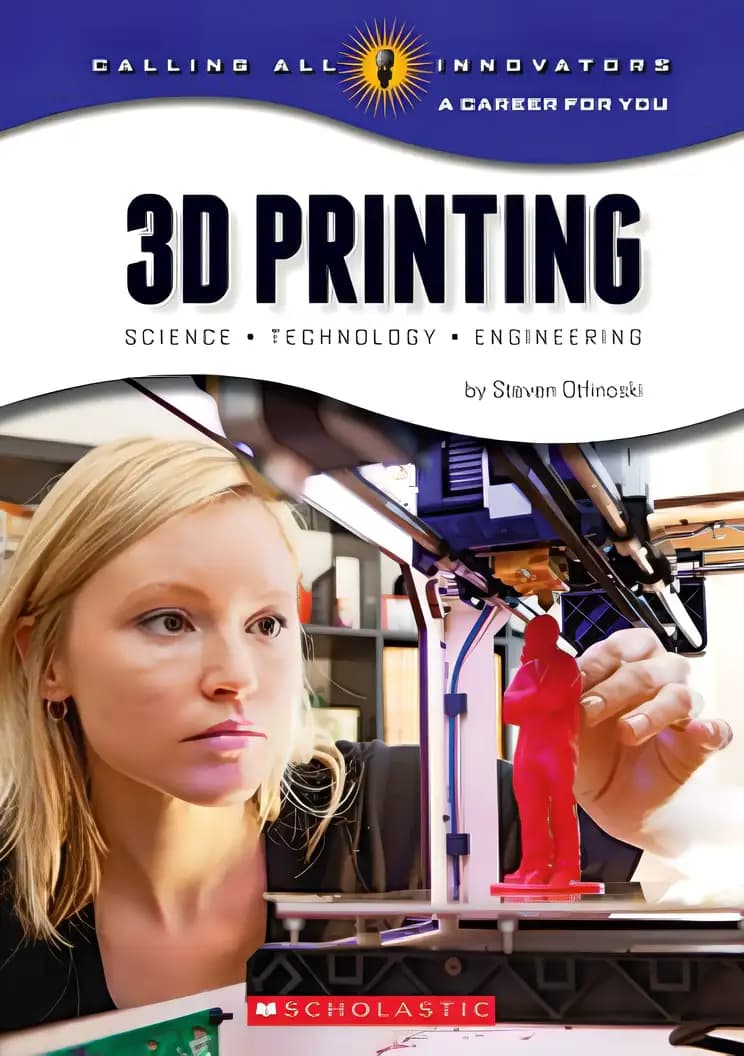
3D Printing: Science, Technology, and Engineering (Calling All Innovators: A Career for You)
Calling All Innovators: A Career For You Series
on Goodreads (5)
What’s inside...
Discover how today's innovators are finding ways to make 3D printers smaller, easier to use, and more affordable than ever. The Calling All Innovators series introduces students to careers in science and technology. The complex text allows readers (Grades 5-8) to determine the main idea and explain how it is supported by key details. The idea of downloading and printing out a three-dimensional physical object using a personal computer might seem like something out of a science fiction story. However, the latest 3D printing technology is making this incredible dream into a reality. Readers will learn how 3D printing is changing the way we manufacture aircraft, treat injuries, and more.
Series reading
Non-Sequential
Age
10-13
Length
64 pages
Text complexity
Discussion points
What do you think are the possibilities of creating something new with 3D printing?
How do you think 3D printing could change the way we solve everyday problems?
Can you think of any career opportunities that 3D printing might open up in the future?
How do you think 3D printing impacts environmental sustainability?
What kind of things would you like to design using 3D printing technology?
Tip: Role play these questions
Encourage your child to think creatively and critically by brainstorming real-life applications of 3D printing technology. Ask them to imagine how this technology could enhance different aspects of daily life or solve particular challenges. Help them connect the dots between scientific concepts in the book and practical outcomes, prompting them to think about the broader implications of technological advancements.
Key lessons
Example Lesson: Innovation and Creativity
Explanation: The book showcases various ways 3D printing is revolutionizing industries, encouraging children to think outside the box and envision novel uses for technology.
Real-World Application: Children can apply this lesson by engaging in creative projects or problem-solving tasks at school or home, using unconventional methods or tools to find solutions.
Example Lesson: Technology's Impact on Society
Explanation: Various chapters highlight how 3D printing contributes to sectors like healthcare and environment, helping children understand the societal implications of technological advances.
Real-World Application: This lesson helps children assess the effects of different technologies they encounter, promoting an awareness that can influence responsible usage and advocacy for tech that benefits society.
Example Lesson: Career Exploration in STEM
Explanation: The book profiles professionals working in the field of 3D printing, providing insights into their roles and the skills required, which can inform and inspire children about careers in science, technology, engineering, and mathematics.
Real-World Application: Students can explore related educational paths and extracurricular activities that align with careers in STEM fields, promoting early interest and engagement in these areas.
Example Lesson: Problem Solving Through Technology
Explanation: Examples of challenges overcome by 3D printing, such as creating prosthetic limbs, illustrate the problem-solving potential of technology.
Real-World Application: Children learn to think critically about how technology can be used to address everyday problems, fostering a mindset that emphasizes innovation in problem-solving.
Example Lesson: The Importance of Interdisciplinary Learning
Explanation: The book demonstrates how 3D printing intersects with various fields like biology, chemistry, and design, showing the value of a multidisciplinary approach to innovation.
Real-World Application: This encourages children to draw connections between different subjects they learn in school, understanding how combined knowledge can lead to new discoveries and solutions.