
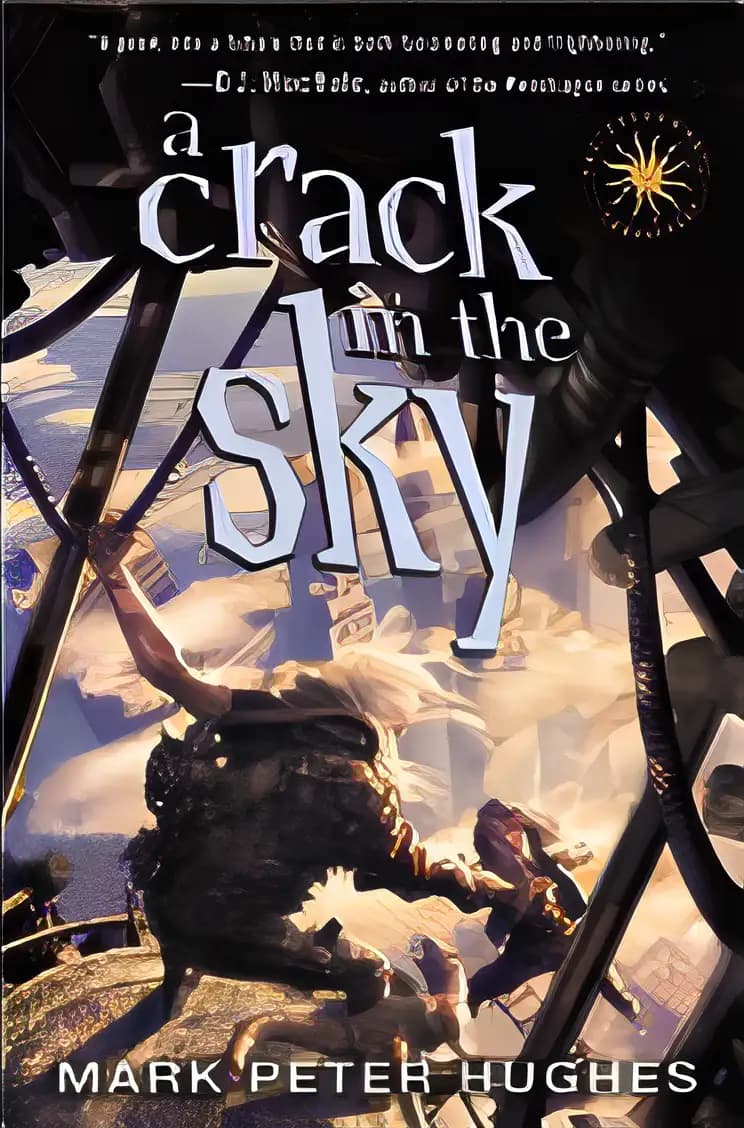
A Crack in the Sky (Greenhouse Chronicles Book 1)
#1 in Greenhouse Chronicles Series
on Goodreads (583)
What’s inside...
Thirteen-year-old Eli Papadopoulos is worried despite being a part of the most powerful family and his grandfather founding InfiniCorp, which runs everything in the dome-cities. Eli notices issues with the artificial sky and excessive heat, contrary to InfiniCorp's reassuring ads. Raised to trust InfiniCorp, he starts questioning things when contacted by a group of terrorists, the Friends of Gustavoor Foggers, who claim to have the truth. As he digs deeper, he faces dire consequences and is sent to the Tower, where he meets Tabitha, a former Internship top student now a slave. Together with Eli's pet mongoose, Marilyn, they plan an escape to the wilderness outside the domes. This eco-thriller is reminiscent of Disney/Pixar's Wall*E and Lois Lowry's The Giver but offers a unique fantasy perspective on societal structure and environmental issues.
Character compass
Eli Papadopoulos
Tabitha
Discussion points
What do you think life would be like if we lived in a world similar to the one described in 'A Crack in the Sky'?
How did the characters' actions help or hinder their survival in the story?
What role does the environment play in the book, and how does it affect the characters' decisions?
If you could give advice to the main character, what would you tell them and why?
How do you think the story would change if it was set in today's world?
Tip: Role play these questions
Encourage your child to compare the world in the book with our current environment, discussing any similarities or differences.
Ask your child to think about what they would do in the main character's position, promoting empathy and critical thinking.
Discuss the importance of the environment and our responsibilities toward it, drawing parallels to the book's themes.
Create a friendly debate about the decisions made by characters in the book to enhance analytical thinking.
Suggest your child to imagine an alternative ending to the story, enhancing their creativity and deepening their understanding of the narrative.
Key lessons
Example Lesson: Environmental stewardship
Explanation: The book portrays a world ravaged by environmental degradation, highlighting the responsibility we have towards caring for our planet.
Real-World Application: Children can learn the importance of recycling, conserving water, and other eco-friendly practices to protect the environment.
Example Lesson: Resilience and perseverance
Explanation: The protagonist faces numerous challenges in a dystopian world, showing determination and resilience in overcoming them.
Real-World Application: This lesson can teach children to stay determined during difficult times in their education or personal lives.
Example Lesson: Critical thinking and problem-solving
Explanation: As the characters navigate a complex world, they employ critical thinking and creative problem-solving strategies.
Real-World Application: Children can use these skills to approach their own challenges in innovative and effective ways.
Example Lesson: The importance of hope
Explanation: Despite the bleak circumstances, the book conveys a strong message of hope and the possibility of a better future.
Real-World Application: This can encourage children to remain optimistic and hopeful even in tough situations.
Example Lesson: Teamwork and collaboration
Explanation: Characters must work together to survive and find solutions, emphasizing the value of teamwork.
Real-World Application: Children can learn to cooperate with others, whether in school projects or family activities.