
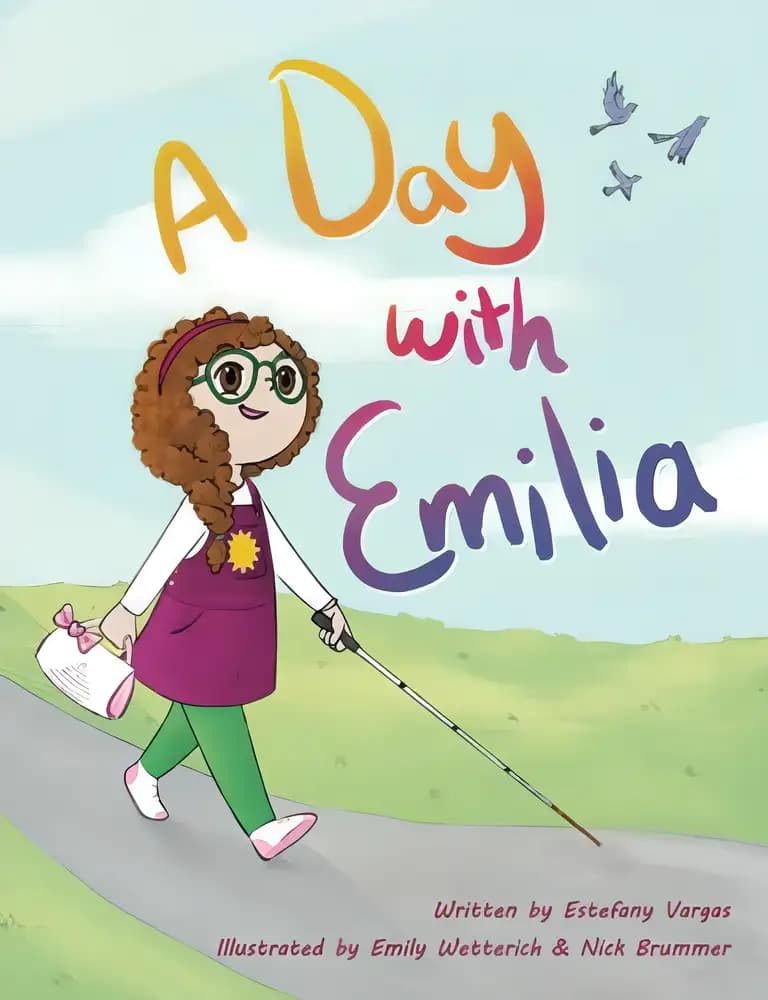
A Day with Emilia
What’s inside...
Like most of her friends, five-year-old Emilia loves to learn, play, and discover, but there seems to be something a little different about her. She uses glasses, magnifiers, and a white cane. What these tools do, she will gladly explain. Read to learn how extra support allows Emilia to happily explore and so much more! A story introducing how a child with a visual impairment may experience the world.
Age
5-7
Length
30 pages
Text complexity
Discussion points
How do you think Emilia felt when she discovered the hidden garden?
What would you do if you found a place like Emilia's hidden garden?
Why is it important to have a special place where you feel safe and happy?
How did Emilia change from the beginning of the book to the end?
What was your favorite part of Emilia's day?
Tip: Role play these questions
Keep the conversation light and fun by smiling and showing interest in your child's responses.
Encourage your child to elaborate on their answers by asking follow-up questions like 'Why do you think that?' or 'Can you tell me more about that?'
Relate the book's themes or Emilia's experiences to your child’s own life to make the discussion more personal and meaningful.
Praise your child's insights and ideas, reinforcing their confidence to express themselves and engage in discussions.
Consider revisiting the book after some time to see if your child’s thoughts or feelings about the story have evolved.
Key lessons
Example Lesson: The importance of sharing
Explanation: In 'A Day with Emilia', Emilia learns the joy of sharing her toys with her friends during playtime.
Real-World Application: Children can apply this lesson by sharing their own toys or snacks with classmates to foster a generous and cooperative environment.
Example Lesson: Valuing friendship
Explanation: Throughout the story, Emilia discovers that spending time and engaging in activities with her friends enriches her day.
Real-World Application: Kids can nurture their friendships by actively participating in group activities and showing interest in their friends’ lives.
Example Lesson: Embracing curiosity
Explanation: Emilia explores her backyard, asking questions and learning about nature from her surroundings.
Real-World Application: Children are encouraged to explore their own environments, ask questions, and learn from the world around them, enhancing their understanding and appreciation of nature.
Example Lesson: Problem-solving skills
Explanation: When Emilia faces challenges, such as building a fort, she thinks critically and creatively to find solutions.
Real-World Application: This lesson can be mirrored in children’s daily activities where they are encouraged to think through problems and come up with innovative solutions, whether it be in their studies or in social scenarios.
Example Lesson: Resilience and perseverance
Explanation: In the story, Emilia tries multiple times to fly a kite, and despite initial failures, she persists until she succeeds.
Real-World Application: Children can learn to not give up easily in the face of difficulties, whether it be in learning new skills, handling personal projects, or dealing with setbacks in school.