
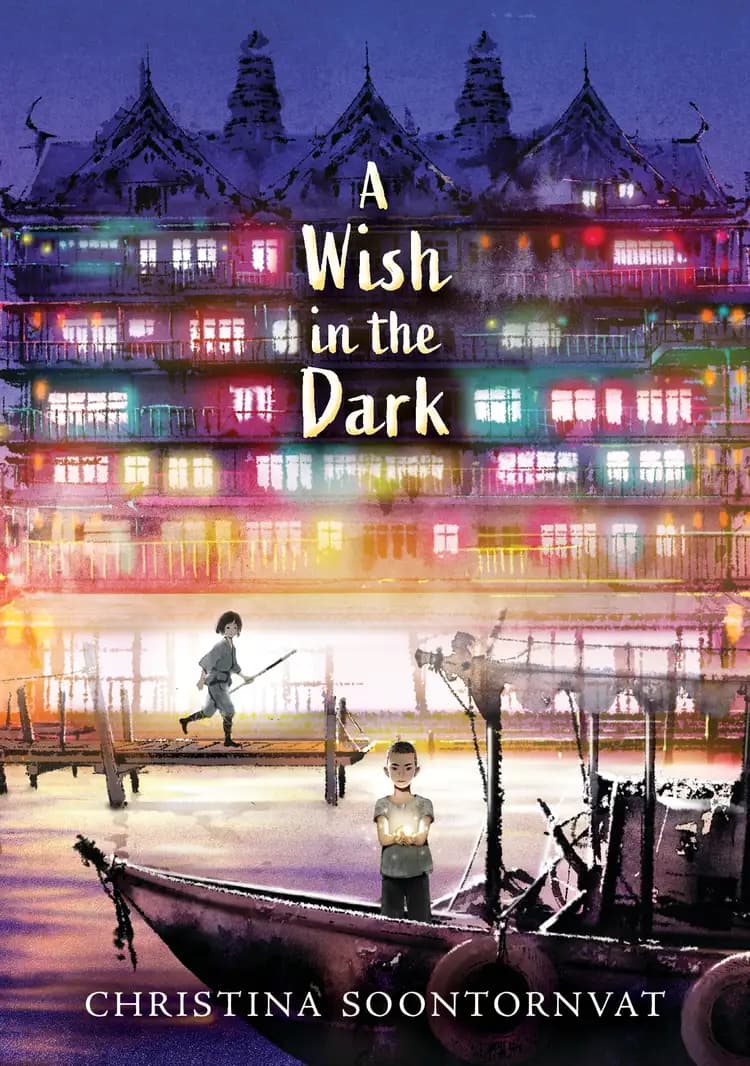
A Wish in the Dark
on Goodreads (7,177)
What’s inside...
A boy named Pong escapes from Namwon Prison, where he was born, and dreams of living freely under the magical lights of Chattana, created by the Governor after the Great Fire. Outside, he discovers a world of inequality, where the wealthy enjoy bright orb light while the poor toil in darkness, and his prison tattoo marks him as a fugitive forever. Nok, the prison warden’s perfect daughter, is determined to find Pong and restore her family’s honor. As she chases him through the city, Nok uncovers unsettling secrets and starts to question the truths she once believed. Inspired by Victor Hugo’s Les Misérables, this Thai-inspired fantasy world explores themes of privilege, protest, and justice, and is a 2021 Newbery Honor Book.
Age
8-12
Length
384 pages
Text complexity
Character compass
Pong
Nok
Somkit
Father Cham
The Governor
Discussion points
How do you think Pong felt when he was living at the temple, and how do those feelings change throughout the story?
What similarities and differences can you see between the world in the book and our world?
What does the light symbolize in this story, and why do you think it's important to the characters?
How do the characters in the story decide what is right or wrong? Can you think of a time when you had to make a similar decision?
What would you wish for if you were in Pong’s situation and why?
Tip: Role play these questions
Before diving into discussion, encourage your child to recount the story in their own words to ensure understanding and enhance retention.
Use empathetic listening. Show interest in your child’s thoughts and feelings about the story, providing a safe space for them to express themselves.
Link discussions to real-life scenarios. Ask your child how they would react in similar situations as the characters, fostering deeper connections with the book.
Encourage critical thinking by asking them what they might have done differently than the characters and why.
Highlight the importance of themes like freedom, justice, and compassion, discussing how these themes play a role in our daily lives.
Key lessons
Example Lesson: The importance of justice and fairness
Explanation: In 'A Wish in the Dark', the protagonist Pong escapes from prison to seek justice in a society where light dictates social class. His journey reflects the fight against societal inequities and the quest for fairness.
Real-World Application: Children can learn to identify fairness and advocate for equality in their own environments, whether it's sharing equally with friends or understanding the importance of rules that apply to everyone.
Example Lesson: Resilience and perseverance
Explanation: Throughout the book, Pong faces numerous challenges but never gives up on his quest for justice. His resilience in overcoming obstacles serves as a powerful example for young readers.
Real-World Application: This lesson teaches children the value of persistence in difficult situations, whether in solving a tough academic problem or standing up for what they believe in during conflicts.
Example Lesson: The power of friendship and trust
Explanation: Pong’s friendships, especially with Somkit and Nok, play a crucial role in his journey. These relationships are built on trust and mutual support, highlighting the importance of reliable friends.
Real-World Application: Children learn the significance of building trusting relationships and how teamwork and collaboration can help overcome challenges.
Example Lesson: Understanding and empathy
Explanation: As Pong travels and meets different people affected by the unjust social system, he grows in empathy and understanding, seeing life from diverse perspectives.
Real-World Application: This encourages children to be empathetic towards peers and others who may have different life experiences, promoting a more inclusive and understanding community.
Example Lesson: Courage to challenge the status quo
Explanation: Pong’s journey is not just a physical one but also an ideological battle against an unfair system, demonstrating the courage required to challenge and change outdated norms.
Real-World Application: Children can be inspired to question and critically think about societal norms and take brave steps towards positive change, even in small ways in their schools and communities.