
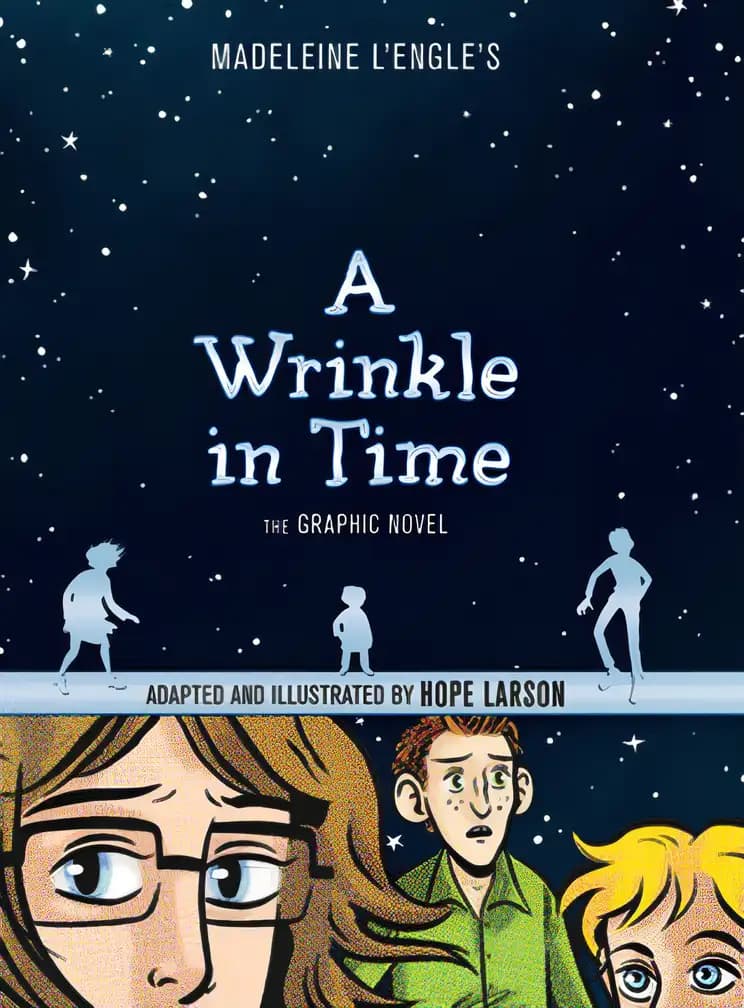
A Wrinkle in Time: The Graphic Novel
#1 of 5 in The Time Quintet Series
What’s inside...
Meg Murry, her small brother Charles Wallace, and their friend Calvin O'Keefe, travel through space and time to save Meg's father from the forces of evil that hold him prisoner on another planet. Along the way, they are aided by a trio of supernatural beings and must confront the darkness within themselves and the universe. NEWBERY MEDAL WINNER; Late one night, three otherworldly creatures appear and sweep Meg Murry, her brother Charles Wallace, and their friend Calvin O'Keefe away on a mission to save Mr. Murry, who has gone missing while doing top-secret work for the government. They travel via tesseract — a wrinkle that transports one across space and time — to the planet Camazotz, where Mr. Murry is being held captive. There they discover a dark force that threatens not only Mr. Murry but the safety of the whole universe. Never before illustrated, A Wrinkle in Time is now available in a spellbinding graphic novel adaptation. Hope Larson takes the classic story to a new level with her vividly imagined interpretations of Mrs Whatsit, Mrs Who, Mrs Which, the Happy Medium, Aunt Beast, and the many other characters that readers have loved for the past fifty years. Winner of the 1963 Newbery Medal, A Wrinkle in Time is the first book in Madeleine L'Engle's Time Quintet.
Character compass
Meg Murry
Calvin O'keefe
Charles Wallace Murry
Mrs. Which
Mrs. Who
Mrs. Whatsit
Dr. Kate Murry
Dr. Alex Murry
It
The Man With Red Eyes
Discussion points
How do you think Meg felt when she was struggling with school, and have you ever felt the same way?
What did you learn about the importance of being brave and taking risks from Meg's adventures?
Why do you think understanding and accepting differences in others is a key theme in this book?
How do you think the characters' relationships with each other help them overcome the challenges they face?
If you could have one of the abilities the characters gained, which one would you choose and why?
Tip: Role play these questions
Draw parallels between Meg's feelings and any personal experiences your child might have had, making it easier for them to relate and reflect.
Discuss the concept of bravery in everyday life, not just in big heroic moments, and ask your child about a time they had to be brave.
Highlight the theme of embracing diversity and ask your child about a time they learned something valuable from someone who was different from them.
Talk about the power of teamwork and how friends and family can help us deal with difficult situations, encouraging your child to share personal examples.
Encourage your child to think about how they use their unique strengths to help others, just like the characters in the book.
Key lessons
Example Lesson: Importance of individuality
Explanation: Meg, the protagonist, struggles with self-acceptance and learns to acknowledge and embrace her unique qualities throughout the story.
Real-World Application: Children can be encouraged to value their own distinct traits and understand that differences contribute to their personal strength and character.
Example Lesson: The power of love
Explanation: Meg defeats the antagonist not through physical strength or aggression, but by expressing her love for her brother Charles Wallace, highlighting the profound strength of love over evil.
Real-World Application: This can teach children the importance of expressing love and kindness in overcoming conflicts and challenges in their relationships with family and friends.
Example Lesson: Courage to confront challenges
Explanation: The characters face numerous challenges on their journey to rescue Meg's father. Despite fear and uncertainty, they continue persevering, demonstrating bravery.
Real-World Application: Children learn the value of facing fears and the importance of persistence in overcoming obstacles in school or while interacting with peers.
Example Lesson: The significance of teamwork
Explanation: Meg, Charles Wallace, and Calvin, all work together to solve problems and support each other, showcasing effective collaboration and reliance on each other’s strengths.
Real-World Application: Encourages children to appreciate collaborative efforts and to seek collective solutions in group tasks or sports.
Example Lesson: Importance of critical thinking
Explanation: Throughout their adventures, the characters employ critical thinking to solve puzzles and dilemmas, an essential skill in navigating their challenges.
Real-World Application: This lesson can be applied to encourage children to think critically when faced with decisions or problems in their educational journey and personal life.