
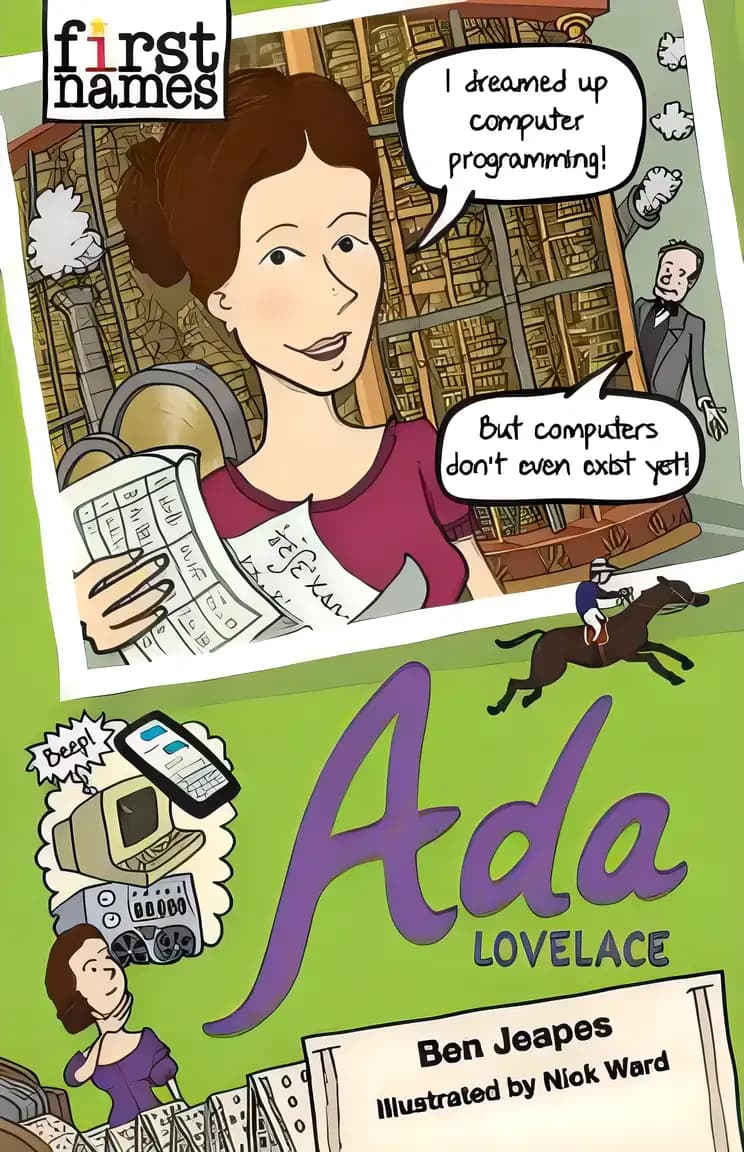
ADA: (Lovelace)
First Names Series
What’s inside...
Meet ADA LOVELACE, the fast-thinking mathematician who predicted the power of computers long before they were even invented. Discover why her mother kept her away from her mega-famous celebrity dad, why she was fascinated by mesmerism, and learn about her plans for a MASSIVE machine that weighed four tons and had 20,000 moving parts. Get to know ADA on First Name terms. Before she was a famous mathematician and the first computer programmer, Ada Lovelace (1815–1852) was the daughter of well-known poet Lord Byron. Byron died when Ada was very young, and Ada’s mother encouraged her interest in mathematics in an attempt to prevent Ada from turning into a melancholy poet like her father. Ada grew up and married a count, and as a countess, she was given access to some of England’s greatest scientists and authors, including Charles Babbage, who was working to develop an analytical engine. Seeing the potential in computers, Ada partnered with Charles and used her mathematical skills to create an algorithm that could make such a machine possible. Fascinating and lively, Ada Lovelace tells the story of the woman who helped pioneer computing! It includes a timeline, bibliography, glossary, and index.
Series reading
Non-Sequential
Age
8-12
Length
144 pages
Text complexity
Discussion points
Why do you think Ada was so passionate about mathematics and science?
How do you think Ada felt when she worked on the Analytical Engine with Charles Babbage?
What challenges did Ada face in her life, and how did she overcome them?
If you could talk to Ada Lovelace, what would you ask her?
How can we use Ada's story to inspire us in our studies or projects?
Tip: Role play these questions
Encourage your child to express their thoughts freely, showing genuine interest in their perspectives. Make connections between Ada’s experiences and your child’s personal endeavors in learning or problem-solving. Discuss the historical context of Ada’s achievements, highlighting the significance of her contributions to today’s technology. Use Ada's perseverance as a launching point to talk about the importance of determination and creativity in overcoming obstacles. Celebrate Ada's curiosity and passion, encouraging similar traits in your child’s approach to education.
Key lessons
Example Lesson: Perseverance
Explanation: Ada Lovelace faces numerous challenges in her journey to become a pioneer in computing. Despite societal expectations and personal setbacks, she persists in following her passion for mathematics and science.
Real-World Application: Children can learn the importance of persisting through difficulties in their studies or when learning new skills, understanding that challenges are part of any worthwhile endeavor.
Example Lesson: Innovation
Explanation: Ada's work on Charles Babbage’s analytical engine introduces children to the concept of pioneering new ideas and innovative thinking, showcasing how her contributions helped lay the groundwork for modern computing.
Real-World Application: This encourages children to think creatively and introduce new ways of thinking or solving problems in their day-to-day activities, sparking a lifelong curiosity and inventiveness.
Example Lesson: Breaking Gender Stereotypes
Explanation: As a female mathematician and scientist during a time when most such roles were dominated by men, Ada Lovelace serves as a role model in breaking gender barriers.
Real-World Application: This can help children understand the importance of equality and encourage girls particularly to pursue their interests in STEM (science, technology, engineering, and mathematics) fields without feeling confined by societal expectations.
Example Lesson: The Power of Education
Explanation: Throughout the book, the importance of education is highlighted through Ada’s endless curiosity and dedicated study, showing how knowledge can open doors to new opportunities and innovations.
Real-World Application: This serves as a motivation for children to value and embrace their education, seeing it as a tool that empowers them to shape their future and make significant contributions.
Example Lesson: Collaboration
Explanation: Ada Lovelace’s partnership with Charles Babbage illustrates the power of collaboration. Working together, they were able to achieve more than either could have alone, highlighting the value of teamwork.
Real-World Application: Children learn the importance of working with others, sharing ideas, and respecting different perspectives to achieve a common goal, skills that are essential in both academic and social settings.