
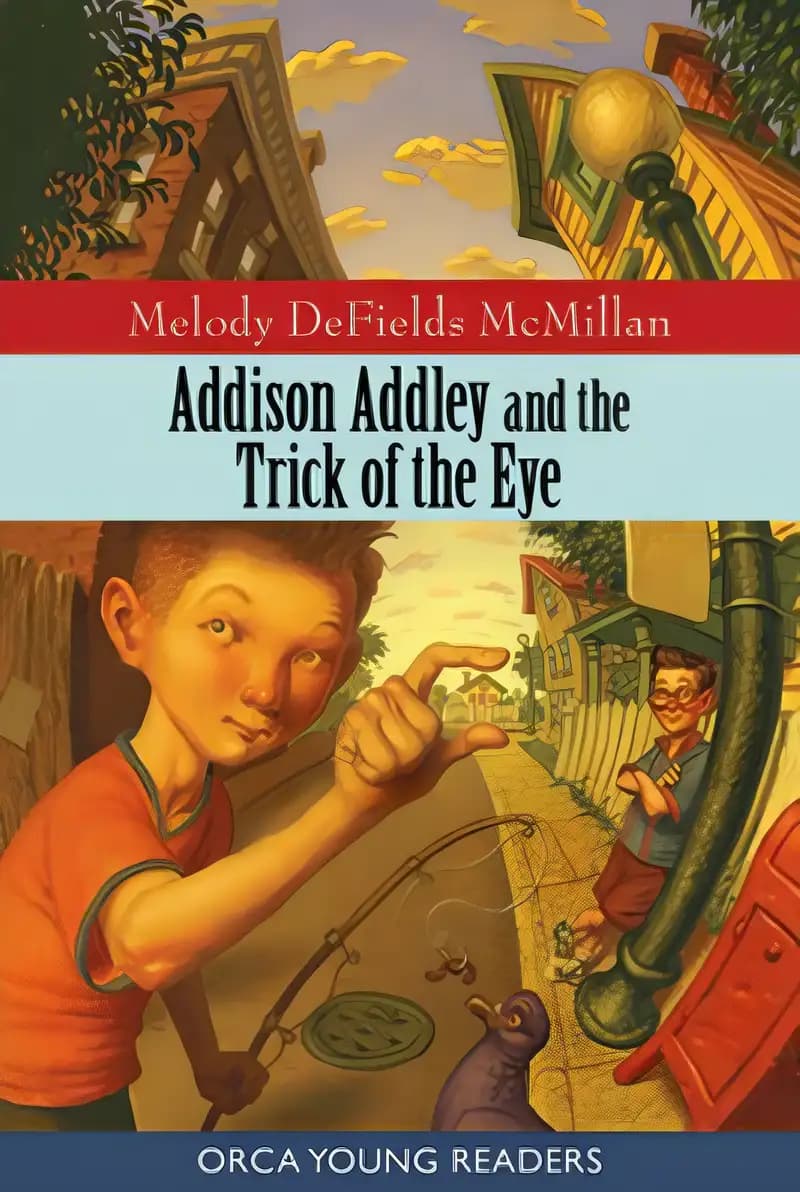
Addison Addley and the Trick of the Eye (Orca Young Readers)
Orca Young Readers Series
on Goodreads (6)
What’s inside...
Addison's mother wants to sell their comfortable old house and move into a townhouse in a new development across town—a shoe box near a shoe factory, Addison calls it. As usual, Addison's brain goes into overdrive as he tries to solve two problems: first he must get his mother to see their old house in a new light, and then he must figure out who is responsible for a rash of neighborhood break-ins that make his mother feel unsafe. With the help of his friend Sam, he puts his own unique spin on optical illusions (and home decor) and ends up surprising everyone, even himself.
Series reading
Non-Sequential
Age
9-12
Length
96 pages
Text complexity
Character compass
Addison Addley
Sam
Addison'S Mother
Addison'S Teacher
Discussion points
What do you think motivated Addison to solve the mystery?
How did Addison change from the beginning to the end of the story?
What would you have done differently if you were in Addison's shoes during his adventures?
How do the illustrations help you understand the story better?
What lessons did you learn from Addison's experiences?
Tip: Role play these questions
Encourage your child to think about the motives behind characters' actions to deepen their understanding of character development.
Discuss the growth of Addison throughout the book to help your child understand the concept of character arcs.
Invite your child to imagine alternative endings or different choices the characters could make, enhancing their creative and critical thinking skills.
Point out specific illustrations that reflect important parts of the story, asking your child how those images help to tell the story.
After finishing the book, ask your child to summarize what they have learned from Addison’s adventures, reinforcing their comprehension and recall abilities.
Key lessons
Example Lesson: Problem-solving through creativity
Explanation: Addison Addley uses his inventive thinking to tackle the challenge of the school geography fair, demonstrating that creative solutions can solve real-world problems.
Real-World Application: Children can apply creative thinking when they encounter obstacles in school projects or daily life, encouraging innovative approaches rather than feeling stuck.
Example Lesson: Importance of persistence
Explanation: Throughout the book, Addison faces various setbacks but consistently perseveres. His determination exemplifies how sticking with a problem can eventually lead to success.
Real-World Application: This lesson teaches children the value of continued effort and resilience in achieving goals, whether in their academic pursuits or personal endeavors.
Example Lesson: Value of teamwork
Explanation: Addison learns to collaborate with his peers to enhance his geography fair project, showing that teamwork can lead to better outcomes than working alone.
Real-World Application: Children will see the importance of working with others to enhance their projects or solve problems, valuing different perspectives and strengths in group settings.
Example Lesson: Learning from mistakes
Explanation: The protagonist’s journey includes moments where things don’t go as planned, but he learns from these experiences rather than giving up.
Real-World Application: Kids can learn that mistakes are opportunities for growth and should not deter them from trying new things or taking risks in their learning process.