
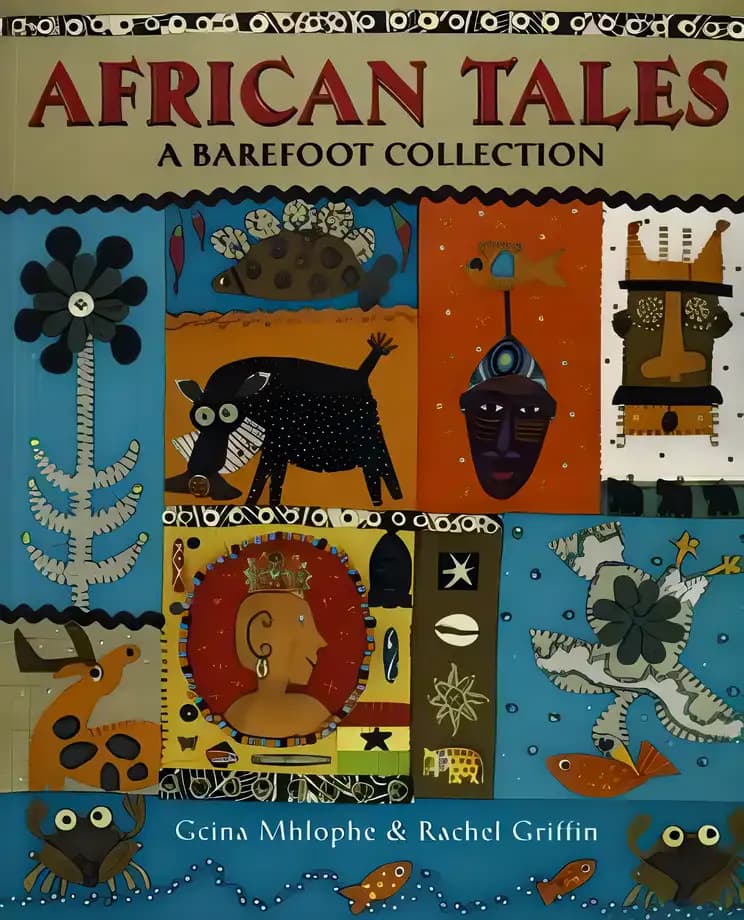
African Tales: A Barefoot Collection
illustrations by
on Goodreads (52)
What’s inside...
Written by internationally acclaimed Xhosa storyteller, Gcina Mhlophe, and illustrated with hand-sewn artwork, each of these eight tales comes with an introduction to the country's customs and culture. The stories are from Ethiopia, Ghana, Lesotho, Malawi, Namibia, Senegal, Sudan and Swaziland. Included in Smithsonian Magazine's Notable Books for Children list in 2009!
Age
9-10
Length
96 pages
Text complexity
Discussion points
What did you learn about the different cultures presented in the stories?
Which tale was your favorite and why?
How do the characters' choices in the stories teach us about courage and wisdom?
Can you think of a time when you acted like one of the characters from the tales?
What is one thing you would do if you were in the setting of your favorite story?
Tip: Role play these questions
Encourage your child to express their thoughts on the story’s setting, and relate it to their own experiences.
Ask your child to draw their favorite scene or character, then describe why they chose it.
Discuss the morals and lessons from each story, emphasizing how they can be applied in everyday life.
Create a fun quiz for your child based on the characters and their adventures to reinforce memory and understanding.
Play a storytelling game where you and your child alternate adding parts to a story, inspired by the tales in the book.
Key lessons
Example Lesson: The importance of kindness and generosity
Explanation: Through various stories, children see characters being rewarded for their kindness and generosity towards others.
Real-World Application: Children can apply these traits by sharing with their peers and helping family members, fostering a positive community spirit.
Example Lesson: Respect for diversity and cultural heritage
Explanation: The book introduces children to a variety of African cultures through its stories, promoting an appreciation and respect for different backgrounds.
Real-World Application: Children can learn to embrace and celebrate cultural differences in their classrooms and neighborhoods, enhancing social harmony.
Example Lesson: Value of perseverance and problem-solving
Explanation: Characters in the stories often face challenges that they overcome through determination and clever thinking.
Real-World Application: Children are encouraged to not give up when facing difficulties in school or in personal tasks and to think creatively to find solutions.
Example Lesson: Understanding consequences of actions
Explanation: Stories illustrate how characters' choices lead to certain outcomes, teaching children about accountability.
Real-World Application: This helps children think before they act and consider the possible repercussions of their actions in various aspects of life.
Example Lesson: Importance of storytelling in preserving history
Explanation: The book uses storytelling to pass down traditional African folklore, showing how stories can preserve cultural history and lessons.
Real-World Application: Children can be inspired to learn more about their own heritage and to keep alive their family and cultural stories through oral and written forms.