
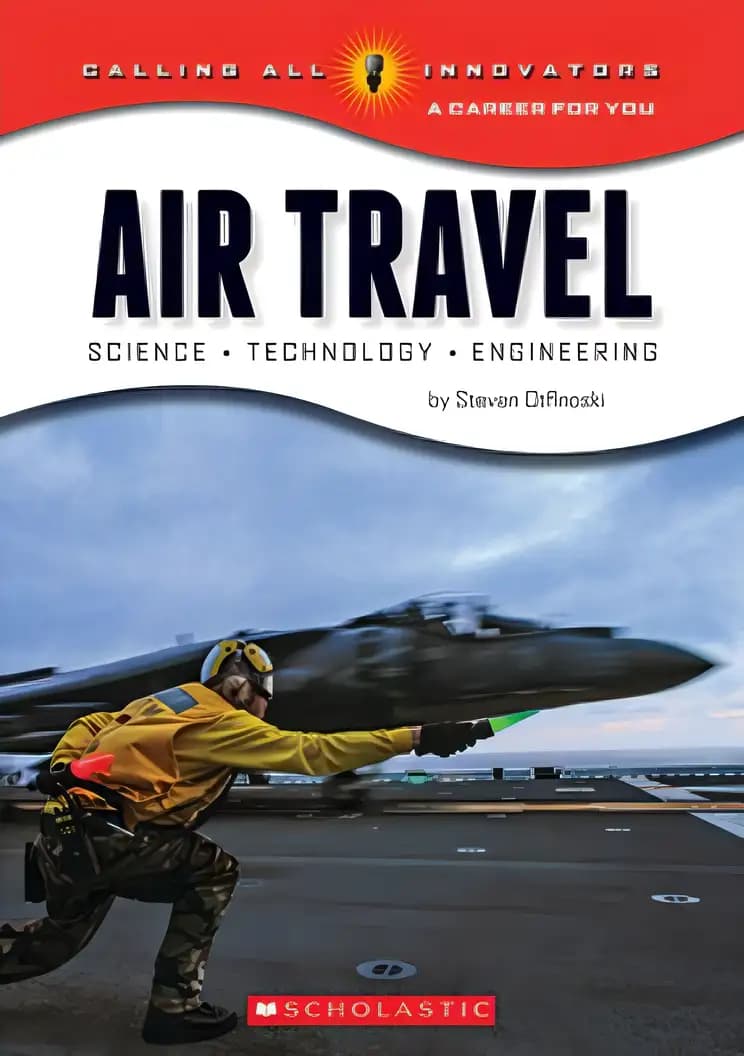
Air Travel: Science, Technology, Engineering (Calling All Innovators: A Career for You)
Calling All Innovators: A Career For You Series
on Goodreads (5)
What’s inside...
Trace the history of commercial air travel and discover how it has developed from the early 20th century to become one of the world's most crucial transportation methods. Learn how today's engineers and scientists are revolutionizing the industry and explore opportunities to build a career in this dynamic field. Suitable for students in Grades 5-8, the 'Calling All Innovators' series helps readers understand complex texts and identify key details supporting the main idea.
Series reading
Non-Sequential
Age
10-13
Length
64 pages
Text complexity
Discussion points
What do you think was the most surprising invention mentioned in the book about air travel?
How do you think the technology in airplanes has changed how people experience the world?
Can you think of any other technologies that might be influenced by advancements in air travel engineering?
What kind of skills do you think a person needs to become an innovator in the field of air travel?
If you could invent something new for airplanes, what would it be and why?
Tip: Role play these questions
Encourage your child to express their thoughts by asking them to draw or describe an invention for future air travel.
Use examples from the book to discuss how science, technology, engineering, and math (STEM) are interconnected in the development of air travel.
Help them make connections between the book and the real world by discussing recent news about space travel or new airplane technology.
Promote critical thinking by asking your child what they would do differently if they were an engineer working on air travel technologies.
Reinforce learning and curiosity by visiting a local museum with an aviation exhibit or watching a documentary on the history of air travel together.
Key lessons
Example Lesson: Understanding teamwork in engineering
Explanation: The book details the collaborative efforts required among various engineers and scientists to achieve successful air travel advancements.
Real-World Application: Children learn the value of cooperation and working with others to achieve common goals, both in school projects and family activities.
Example Lesson: Innovation and creativity
Explanation: The narrative explores how creative thinking and innovation have propelled the aviation industry forward, highlighting key inventors and innovations.
Real-World Application: Kids are encouraged to apply creative thinking to solve problems and innovate, whether in their play, studies, or daily challenges.
Example Lesson: Perseverance and problem-solving
Explanation: By examining the historical challenges faced in the field of aviation, the book teaches readers about the persistence needed to overcome obstacles.
Real-World Application: This lesson helps children understand the importance of persistence in their own lives, encouraging them to keep trying despite difficulties in any endeavor.
Example Lesson: Understanding technology and its impacts
Explanation: The book educates on how various technologies in aviation were developed and how they impact our world today.
Real-World Application: Children learn to appreciate and critically think about how technology affects their lives and the environment, fostering responsible usage and awareness.