
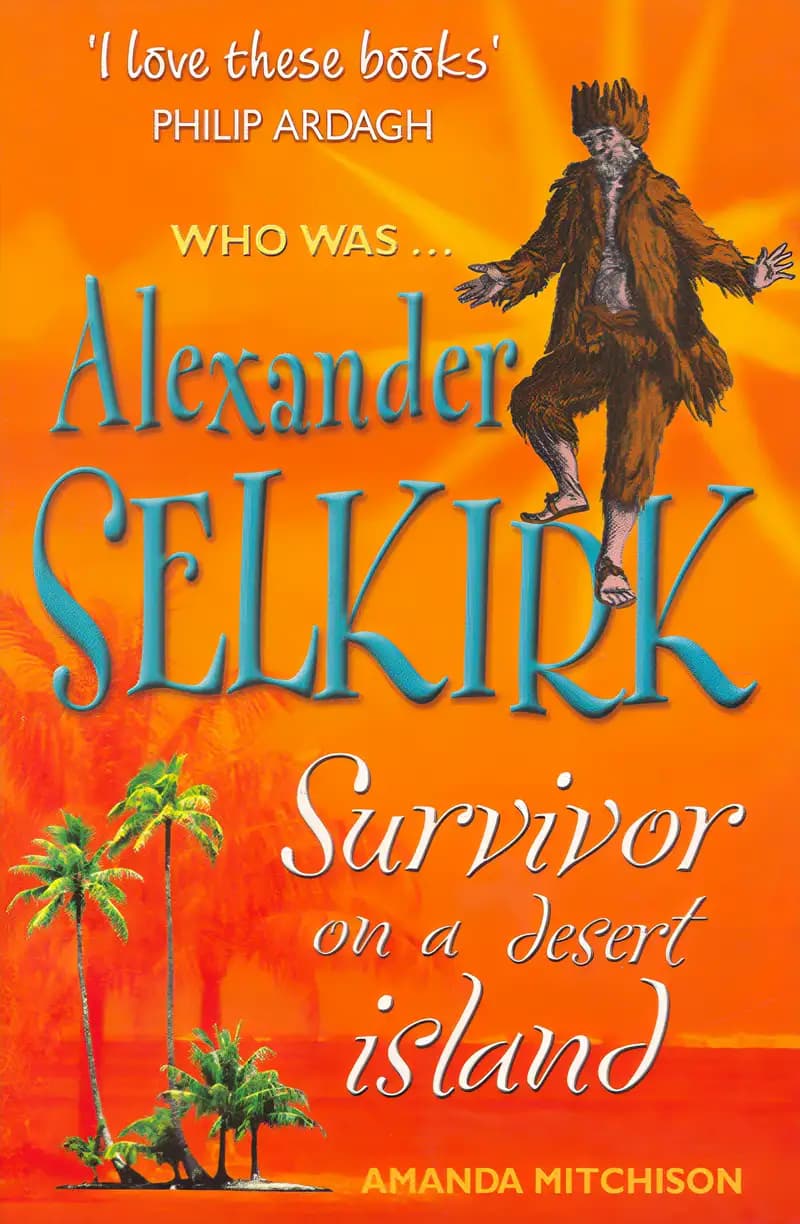
Alexander Selkirk: Survivor on a Desert Island (Who Was...?)
Who Was . . . ? Series, Who HQ Now
on Goodreads (14)
What’s inside...
This is the story of Alexander Selkirk, a Scottish mariner and adventurer, who was rescued after spending four years alone on a Pacific island. The narrative explores how Selkirk ended up stranded in 1705 and his subsequent fight for survival, revealing the true story behind the legendary character Robinson Crusoe. Recommended for ages 10 and up.
Series reading
Non-Sequential
Age
8-12
Length
160 pages
Text complexity
Character compass
Alexander Selkirk
Captain Thomas Stradling
Discussion points
How do you think Alexander Selkirk felt when he was alone on the island? What would you have done in his place?
What are some ways Alexander survived on the island? Discuss if those survival skills would be useful today.
Alexander used his time on the island to reflect on his life. What are some things you think about when you have time alone?
How did the experience on the island change Alexander? What changes do you notice in yourself when you overcome a challenge?
Tip: Role play these questions
Encourage your child to imagine themselves in Alexander Selkirk’s shoes, fostering empathy and enhancing their understanding of the story.
Discuss the practical skills showcased in the book, relating them to skills that are valuable in modern times such as resourcefulness and resilience.
Use reflective questions to connect the past and present, helping your child draw parallels between the lessons in the book and their own life experiences.
Highlight the transformation of Alexander through his ordeal to help your child understand the personal growth that comes through overcoming difficulties.
Key lessons
Example Lesson: Resilience and adaptability
Explanation: The story of Alexander Selkirk showcases how he learned to adapt to his environment in order to survive alone on a desert island for several years. His ability to make tools, find food, and create shelter illustrates these qualities.
Real-World Application: Children can learn that being adaptable and resilient can help them overcome challenges they face at school or in social settings.
Example Lesson: Resourcefulness and problem-solving
Explanation: Throughout the book, Selkirk demonstrates resourcefulness by using the materials available on the island to sustain himself. This includes building a shelter and crafting hunting tools.
Real-World Application: Children can apply the lesson of using available resources to solve problems, whether it's creatively using school supplies or finding ways to play with limited toys.
Example Lesson: Independence and self-reliance
Explanation: Alexander Selkirk's story is a powerful testament to the human spirit's ability to rely on oneself in the face of solitary conditions. He managed all aspects of his survival alone.
Real-World Application: Kids can be encouraged to develop their own independence, such as by completing homework assignments on their own or taking on new responsibilities at home.
Example Lesson: Appreciation of nature and solitude
Explanation: Selkirk’s unique situation brought him into close connection with nature, finding solace and sustenance from his surroundings away from societal noise.
Real-World Application: This can remind children to appreciate quiet moments and the natural environment around them, potentially leading to activities like bird watching, hiking, or gardening.
Example Lesson: The value of perseverance
Explanation: Despite the harsh conditions and loneliness, Selkirk did not give up hope. His persistence in face of adversities underlined the entire narrative.
Real-World Application: This lesson teaches children the importance of persisting through difficult situations, whether that means continuing to study a tough subject or improving skills in a sport or art.