
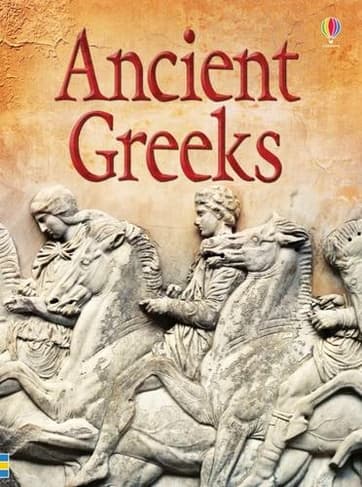
Ancient Greeks: (Beginners)
Usborne Big Subjects For Beginners Series
on Goodreads (53)
What’s inside...
A fascinating exploration into the life and times of the Ancient Greeks, designed for young readers embarking on their first journey into history. A guide for beginner readers to Ancient Greece and the lives of its citizens. Find out how far the Greek Empire spread, how it was governed, what people wore, ate and did for fun, learn about some of the most famous philosophers, mathematicians and medics of the age and about how the Empire declined. The UK National History Curriculum for key stage two states that children should study 'Ancient Greece - a study of Greek life and achievements and their influence on the western world'. Part of the Usborne Beginners series, which introduces children to a diverse range of non-fiction topics including trains, volcanoes, bears, astronomy, the Aztecs, wolves, ships and living in space. A new edition, now featuring a photographic cover - previously published as ISBN 9780746074855.
Series reading
Non-Sequential
Age
8-12
Length
32 pages
Text complexity
Discussion points
What are some differences and similarities between our lifestyle and that of the ancient Greeks?
How do you think the inventions and discoveries of the ancient Greeks have impacted our world today?
What did you find most interesting about the gods and goddesses that the ancient Greeks believed in?
Can you think of any stories or movies that are influenced by ancient Greek culture?
Tip: Role play these questions
Start by sharing your own curiosity about ancient Greek culture to spark your child's interest. Use the illustrations in the book to point out specific elements of ancient Greek life, like their clothing or architecture, making it more relatable and engaging. Encourage your child to compare what they've learned to their own experiences and knowledge, fostering deeper understanding and retention. Lastly, emphasize the relevance of ancient Greece to modern society to make the discussion more tangible.
Key lessons
Example Lesson: The importance of curiosity and learning
Explanation: The book illustrates how Ancient Greeks were pioneers in various fields such as philosophy, mathematics, and science, showing the value they placed on knowledge and inquiry.
Real-World Application: Children can be encouraged to ask questions, explore different subjects, and value education as a tool for understanding the world around them.
Example Lesson: The concept of democracy and civic responsibility
Explanation: Through discussions of Ancient Greek political systems, particularly democracy, the book highlights the role of citizens in decision-making and governance.
Real-World Application: Children learn the importance of participating in group decisions and understand the basics of fairness and justice in community settings.
Example Lesson: The significance of mythology and storytelling
Explanation: By introducing Greek mythology, the book explores how myths were used to explain natural phenomena and human behavior.
Real-World Application: Children can develop their creative thinking and storytelling skills, while also gaining an appreciation for literature and ancient cultures.
Example Lesson: Resilience in facing challenges
Explanation: The book recounts tales of Greek heroes and their quests, emphasizing their determination and resilience despite difficulties.
Real-World Application: This can inspire children to face personal challenges with courage and to not easily give up when encountering obstacles.