
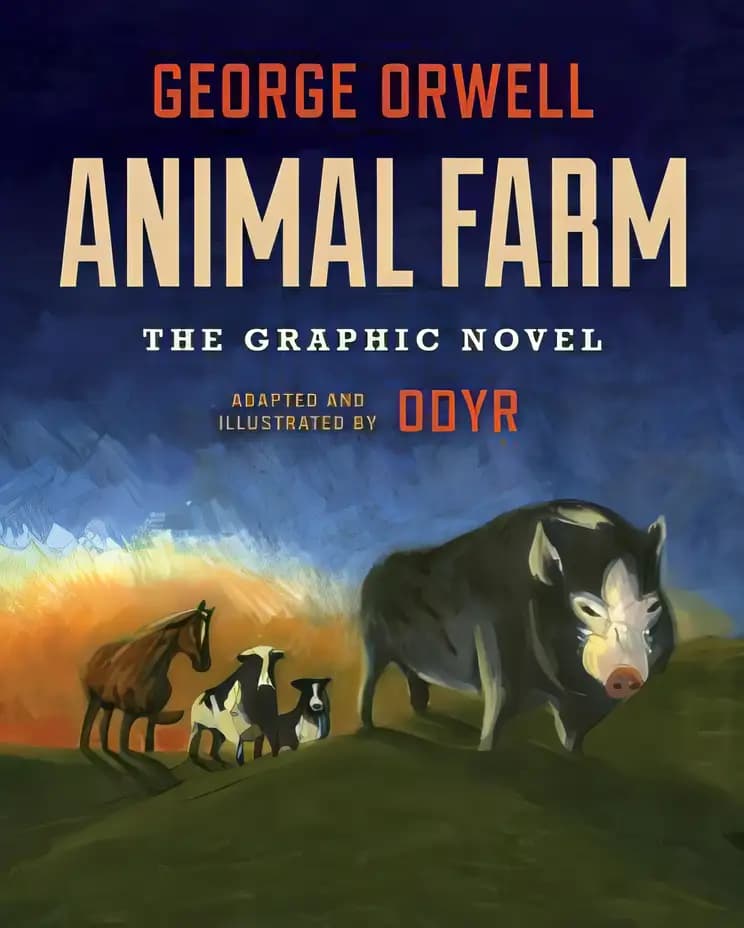
Animal Farm: The Graphic Novel
Animal Farm Series
What’s inside...
Animal Farm: The Graphic Novel is a visual adaptation of George Orwell's original novel, 'Animal Farm.' The story is an allegory about a group of farm animals who rebel against their human farmer, hoping to create a society where animals can be equal, free, and happy. However, the rebellion is betrayed as the pigs, led by Napoleon, become the new tyrants, mirroring the very human oppressors they sought to overthrow. The graphic novel follows the same narrative, illustrating the rise and fall of the animal's revolution and the corruption of power through vivid and engaging artwork. It serves as a powerful commentary on the nature of power, politics, and the cyclical patterns of history.
Series reading
Non-Sequential
Age
13-17
Length
176 pages
Text complexity
Character compass
Snowball
Mollie
Clover
Benjamin
Boxer
Squealer
Mr. Jones
Napoleon Bonaparte
Discussion points
What do you think the farm animals represent in the story?
How do the animals’ actions and decisions affect their lives on the farm?
Why do you think some animals have more power than others?
What did you learn about leadership and fairness from this story?
How would you have acted differently if you were one of the animals on the farm?
Tip: Role play these questions
Before starting the discussion, provide a brief summary of the story to refresh your child’s memory.
Encourage your child to express their thoughts and feelings about the book’s events, even if they differ from yours.
Ask follow-up questions based on your child's responses to delve deeper into their understanding.
Relate the themes of the book to real-life scenarios your child might understand, like fairness in games or taking turns.
Praise your child for their insights and encourage them to think critically about the story's deeper meanings.
Key lessons
Example Lesson: Power and Corruption
Explanation: The story delves into how power can corrupt individuals when the pigs, who lead the farm, begin to abuse their power for personal gain.
Real-World Application: This teaches children the importance of integrity and the dangers of exploiting power. It encourages them to practice fairness and accountability in their daily interactions.
Example Lesson: The Importance of Education
Explanation: The pigs manipulate the other animals due to their lack of education. This highlights how knowledge is power and the perils of ignorance.
Real-World Application: Children learn the value of education and are encouraged to seek knowledge to make informed decisions and resist manipulation.
Example Lesson: Social Equality
Explanation: The animals on the farm initially strive for a society where all animals are equal, which helps illustrate the concept of social equality.
Real-World Application: This can prompt discussions with children about fairness, justice, and the importance of treating everyone with respect regardless of their status.
Example Lesson: The Role of Leadership
Explanation: The story shows how leadership can be used for both positive change and personal gain, emphasizing the effects of good vs. bad leadership.
Real-World Application: Children can apply this by understanding and recognizing the qualities of good leadership and striving to embody them in group situations.