
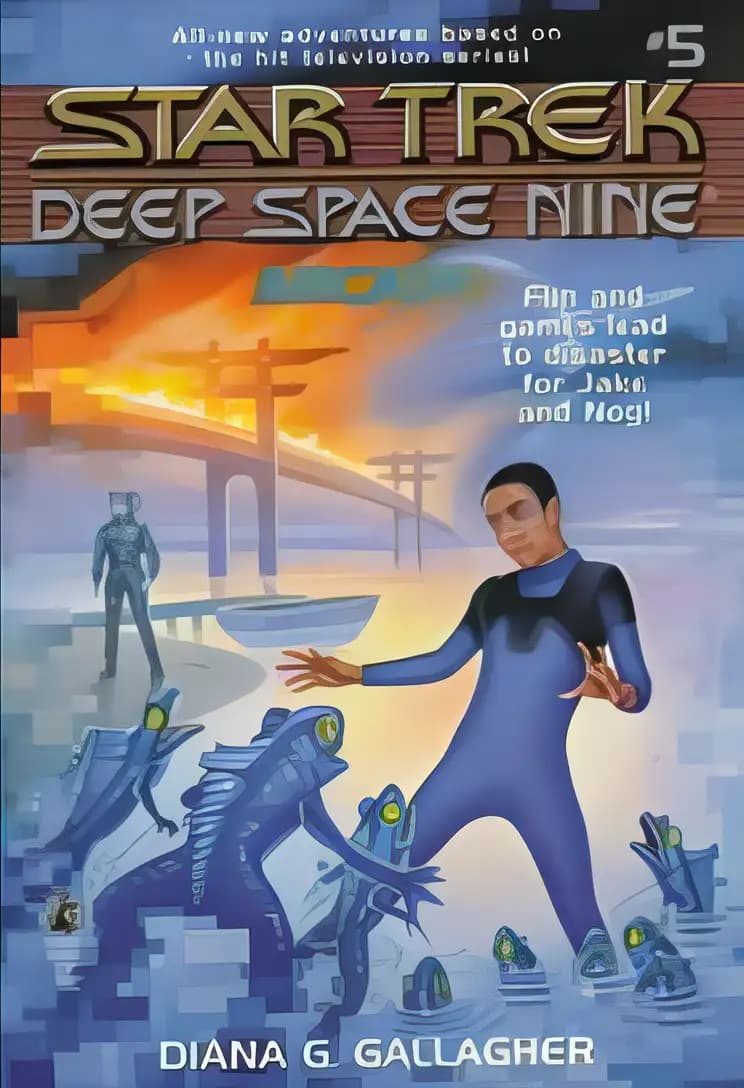
Arcade (Star Trek Deep Space Nine)
#5 of 9 in Star Trek: Deep Space Nine - Young Adult Series
What’s inside...
Participating in a virtual reality game called the Zhondran Crystal Quest, Jake and Nog learn that their success is pivotal to a lucrative Ferengi-Zhondran business deal and find themselves pitted against an all-too-real Borg. There's a new player on the Promenade: a Ferengi shop-owner, Bokat. His Games Bazaar specializes in hard-to-find virtual reality computer games. He approaches Jake Sisko and Nog with a tempting offer to play a hot new game called the Zhodran Crystal Quest. No non-Zhodran player has ever won this game, but then Jake and Nog have the best scores on all the other games at the Games Bazaar. And Bokat is willing to bet on their ability to win the game, and—as a result—win Bokat a lucrative business deal with the Zhodrans. But soon, kids all over the station are falling into comas, their minds trapped in an ever-changing game. Suddenly, it's up to Jake to go into the game and rescue them. If he wins, so does the Federation. If he loses, he'll be trapped forever in a deadly game with a very real Borg!
Character compass
Jake Sisko
Odo
Nog
Benjamin Sisko
Bokat
Discussion points
What did you think about the way the characters solved problems in the story? Can you think of different ways they might have approached their challenges?
If you were in the virtual world of the game like the characters, what kind of adventure would you hope to experience?
Which character did you relate to the most and why?
How did the characters' actions influence the world around them in the story?
What lessons do you think the story teaches about friendship and teamwork?
Tip: Role play these questions
Encourage your child to imagine themselves in the story, enhancing comprehension and empathy. Ask them to relate situations in the book to their own experiences to deepen the personal connection. Praise their insights and ideas to boost their confidence in expressing thoughts. Discuss the emotions of different characters and the outcomes of their actions to foster emotional intelligence.
Key lessons
Example Lesson: Teamwork and Collaboration
Explanation: In 'Arcade,' characters must work together to solve complex problems and overcome challenges on the space station.
Real-World Application: Children learn the importance of cooperating with others, whether in group projects at school or in team sports, to achieve common goals.
Example Lesson: Problem-solving Skills
Explanation: The book portrays characters using their intellect and resources to navigate through the game scenarios, emphasizing strategic thinking and planning.
Real-World Application: This encourages children to think critically and creatively when faced with obstacles, enhancing their ability to solve problems in academic and social settings.
Example Lesson: Resilience and Perseverance
Explanation: As characters face setbacks within the virtual reality scenarios, they learn to persist and not give up easily, showcasing the value of grit.
Real-World Application: Children are inspired to adopt a resilient mindset, understanding that persistence is key to overcoming difficulties in learning and personal endeavors.
Example Lesson: Ethical Decision Making
Explanation: The characters often face moral dilemmas requiring them to choose between right and wrong, emphasizing the importance of ethics.
Real-World Application: This helps children develop a strong moral compass, guiding them to make ethical decisions in their daily interactions with peers and adults.
Example Lesson: Curiosity and Lifelong Learning
Explanation: Through exploring the Arcade, characters display a thirst for knowledge and an eagerness to explore unknown territories.
Real-World Application: This promotes a love for learning and exploration that can be applied to educational pursuits, encouraging children to remain curious and engaged learners throughout their lives.