
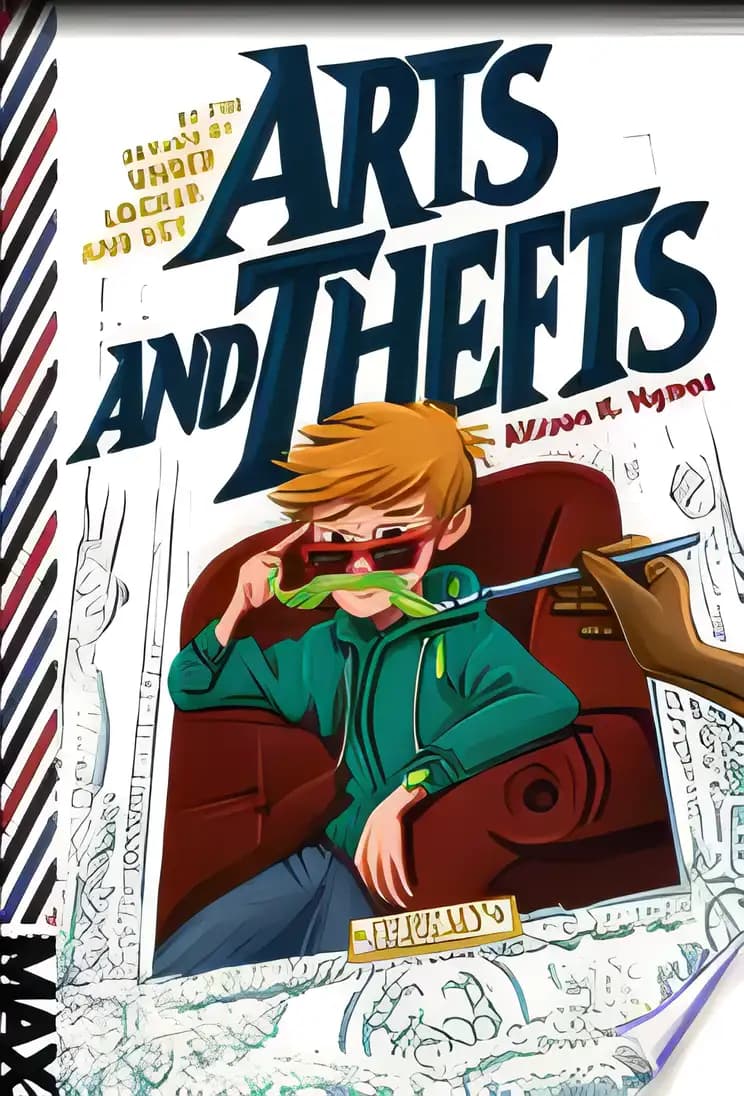
Arts and Thefts (MAX)
#2 of 14 in Max Series
on Goodreads (84)
What’s inside...
Middle school retrieval specialist Jeremy Wilderson must team up with preteen private detective Becca Mills once again to solve his most mind-boggling case yet in this action-packed MAX novel. Ahh, summer vacation! Jeremy Wilderson, Scottsville Middle School's first (and only) retrieval specialist, is enjoying a slower-than-usual season of retrieving (NOT stealing) lost objects in order to help the under thirteen population of Scottsville. But crime doesn't take a vacation! And when sabotage strikes Scottsville's event of the year—the Summer Art Show—threatening to ruin the burgeoning painting career of Jeremy’s best friend, Case, it’s up to Jeremy to figure out what’s going on. Of course, his archrival Becca Mills, who just happens to think Jeremy, Case, and their friend Hack are involved in the crime, is also looking into it. Jeremy has only a few precious hours to stop the sabotage before more contest entries—and kids’ dreams—are slashed and burned. But Jeremy’s specialty is retrieval—not detective work! The only solution is to team up with Becca to solve the case, something Jeremy’s not exactly thrilled to do. Not to mention, he has to keep his alliance with Becca a secret from Case and Hack, who will disown him if they see him working with the enemy. Somewhere between being stuck inside an air vent and slathered in red paint, Jeremy has to wonder: is he in over his head?
Character compass
Jeremy Wilderson
Hack Jordan
Becca Mills
Discussion points
What do you think Max learned about friendship and trust throughout the story?
How did Max’s perception of right and wrong evolve from the beginning to the end of the book?
Why is it important to respect other people's belongings?
If you were in Max’s shoes, how would you handle the situation differently?
What are the consequences of stealing, based on what happened in the story?
Tip: Role play these questions
Start the conversation with a positive tone, and express genuine interest in your child's opinions about the book.
Encourage your child to think critically by asking them how they would feel if they were in the main character’s place.
Discuss the importance of honesty and integrity, drawing parallels to real-life situations to make the conversation more relatable.
Praise your child for their insights and contributions to the discussion to boost their confidence and encourage further dialogue.
Use examples from the book to talk about the impact of actions on others, emphasizing empathy and understanding.
Key lessons
Example Lesson: Honesty is the best policy
Explanation: In 'Arts and Thefts', the protagonist learns the hard way that dishonesty leads to complicated situations and mistrust. When the truth is revealed, it mends relationships and restores peace.
Real-World Application: Children can apply this lesson by being honest in their everyday interactions, which will help them build trust and strong relationships with family and friends.
Example Lesson: The importance of teamwork
Explanation: Throughout the book, characters must work together to solve mysteries, demonstrating how collaboration can lead to success even in difficult situations.
Real-World Application: This lesson teaches children to value cooperation in group projects at school or in sports, emphasizing that collective effort often yields better results than working alone.
Example Lesson: Resilience in the face of challenges
Explanation: The protagonist faces numerous setbacks while trying to solve the mystery but persists until the end. This highlights the importance of perseverance and resilience.
Real-World Application: Children learn to not give up when faced with difficulties, whether it's completing a tough homework assignment or resolving a conflict with a peer.
Example Lesson: Empathy and understanding others
Explanation: Characters in the story learn to understand different perspectives, which helps resolve conflicts and deepen friendships.
Real-World Application: This can help children appreciate the feelings and viewpoints of others, enhancing their social interactions and empathy.
Example Lesson: The impact of actions on others
Explanation: The story shows how one character's actions affect others, teaching the protagonist to consider the consequences of their actions.
Real-World Application: This encourages children to think about how their behaviors could positively or negatively influence the people around them.