
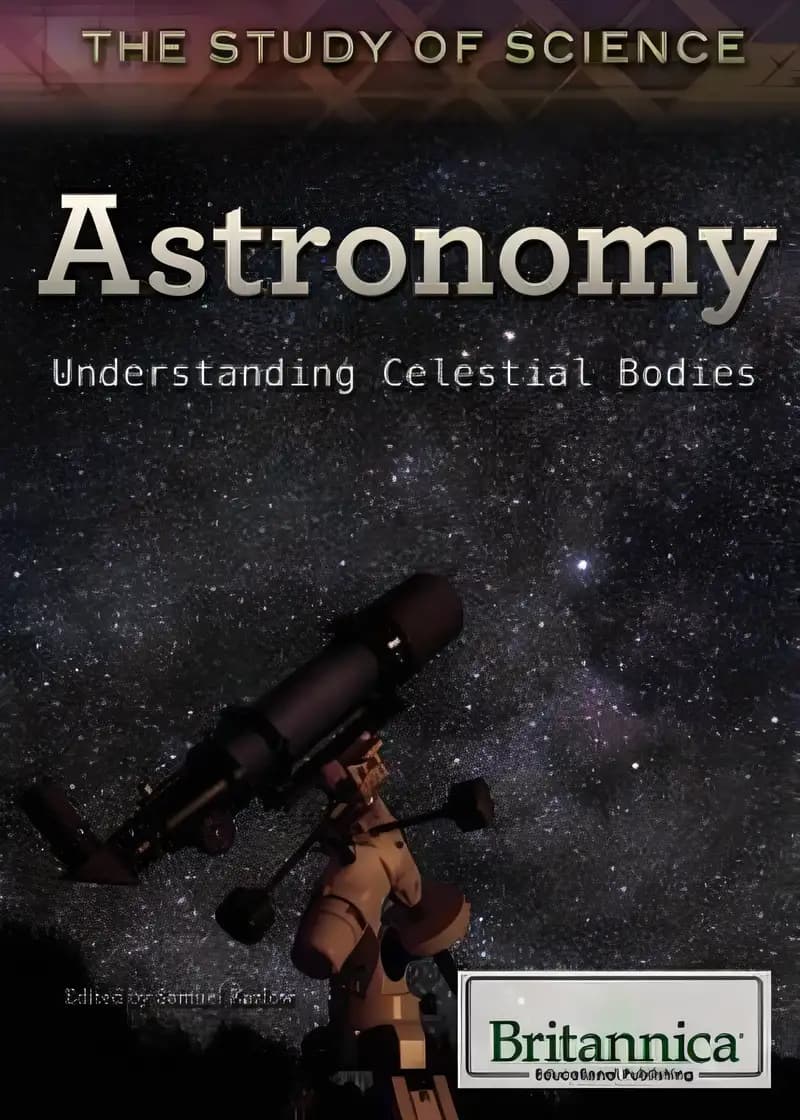
Astronomy: Understanding Celestial Bodies (The Study of Science, 5)
#5 in The Study Of Science Series
on Goodreads (6)
What’s inside...
This book provides an engaging and up-to-date presentation of fundamental astronomy facts and principles. It explains the nature of celestial bodies such as planets, dwarf planets, stars, moons, asteroids, and comets, and examines the tools and techniques used by modern astronomers, including high-tech telescopes, spectroscopy, and computer modeling. Enhanced with illuminating images, it serves as an ideal introduction to astronomy for a variety of readers.
Discussion points
What do you think it would be like to live on another planet?
How do stars form and what makes them different from each other?
Can you imagine creating your own solar system? What would you include in it?
Why do you think it's important for us to study space and celestial bodies?
Tip: Role play these questions
Encourage your child to express their thoughts and use their imagination about space; reassure them there are no right or wrong answers.
Use the illustrations in the book to help explain complex concepts and make them more relatable.
Relate the discussion to real-life experiences, such as visiting a planetarium, to make the subject matter more tangible.
Praise their curiosity and efforts to understand the concepts, fostering a positive learning environment.
Key lessons
Example Lesson: Curiosity and Exploration
Explanation: The book introduces children to the vast universe and the science of astronomy, fostering curiosity about the stars, planets, and other celestial bodies.
Real-World Application: Children can apply this lesson by exploring and questioning the natural world around them, enhancing their observational skills and interest in science.
Example Lesson: Scientific Method
Explanation: Through clear explanations and engaging activities, the book demonstrates how scientists use observations, hypotheses, and experiments to learn about the universe.
Real-World Application: This can encourage children to adopt a systematic approach to solving problems and conducting experiments, even in everyday tasks.
Example Lesson: Patience and Persistence in Learning
Explanation: Astronomy requires careful observation and dedication. The book highlights these aspects, teaching children the value of patience and persistence in gaining knowledge.
Real-World Application: Children learn the importance of persistence in their educational journey and are encouraged to maintain focus and dedication in all areas of learning.
Example Lesson: Respect for Nature and the Universe
Explanation: The book emphasizes the beauty and complexity of the cosmos, promoting a sense of respect for natural phenomena and the universe as a whole.
Real-World Application: This can lead to environmentally conscious behavior and an appreciation for the intricate systems that exist in nature.