
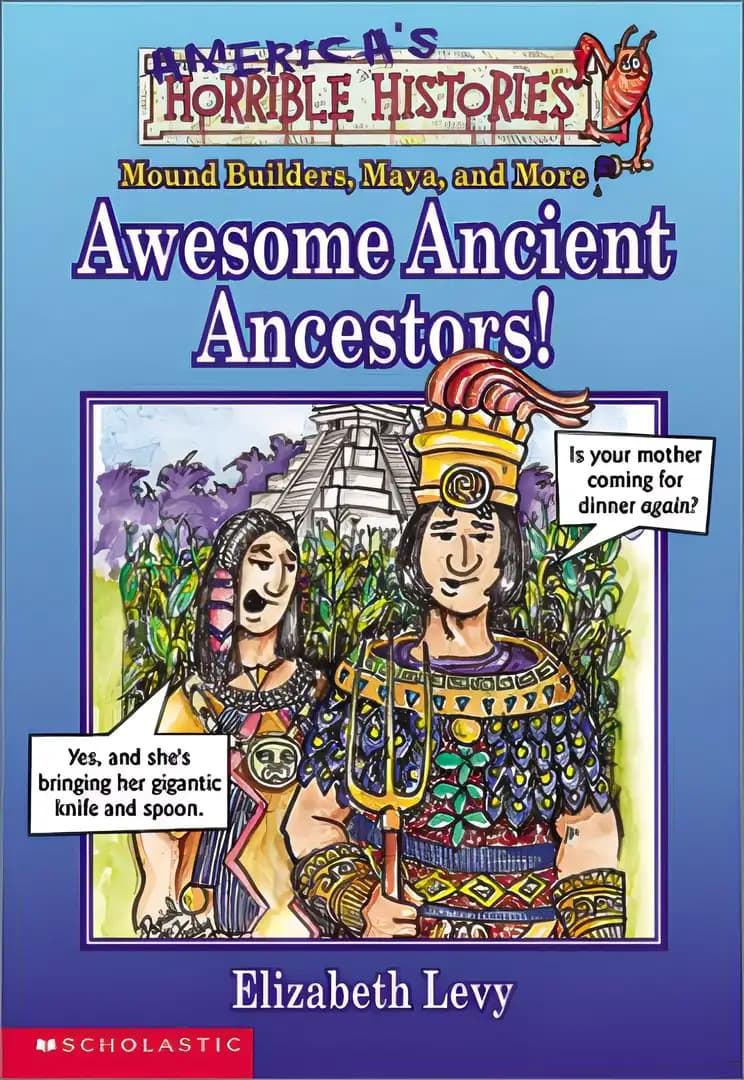
Awesome Ancient Ancestors (America's Horrible Histories, 2)
#2 in America's Funny But True History Series
What’s inside...
Introduces the earliest humans to live in North America, and discusses hunters and gatherers, prehistoric art, the Olmecs, the Mound Builders, the Maya, the cliff-dwellers of the Southwest, and the city of Cahokia.
Discussion points
What do you think life was like for children in ancient times compared to your life today?
Why do you think people in ancient cultures did things differently than we do now?
Can you imagine what it would be like to meet someone from an ancient civilization? What would you ask them?
How do you think the discoveries and inventions of ancient people have influenced our world today?
What was the most surprising or interesting fact you learned about ancient ancestors from this book?
Tip: Role play these questions
Encourage your child to compare their daily life with that of children in ancient times, focusing on differences in chores, schooling, and play.
Discuss the reasons behind different customs and traditions in ancient times, highlighting the influence of environment and available resources.
Prompt your child to think creatively by imagining a conversation with an ancient ancestor. This can help develop empathy and historical perspective.
Explore together how ancient innovations affect our lives today, fostering an appreciation for history and its ongoing impact.
Invite your child to express which fact about ancient civilizations intrigued them the most and why, encouraging them to delve deeper into that topic.
Key lessons
Example Lesson: Understanding historical perspectives
Explanation: The book portrays various aspects and events of Ancient American history, helping children grasp how historical contexts shape societies.
Real-World Application: Children can learn to appreciate diverse cultures and understand the significance of history in shaping modern society.
Example Lesson: Importance of critical thinking
Explanation: Through exploring myths and facts about America’s past, the book encourages children to differentiate between evidence-based history and folklore.
Real-World Application: This skill helps children question information critically, fostering a habit of seeking truth and evidence in daily life.
Example Lesson: Learning from past mistakes
Explanation: The book highlights historical errors and their consequences, teaching children the importance of learning from past missteps.
Real-World Application: Kids can apply this understanding by recognizing their own mistakes and those of others as learning opportunities rather than failures.
Example Lesson: Value of resilience and innovation
Explanation: Stories of survival and adaptation underline how past communities triumphed over challenges through resilience and innovation.
Real-World Application: Children can be inspired to face their own challenges with a positive attitude and creative thinking.
Example Lesson: Developing cultural sensitivity
Explanation: By exposing readers to the different traditions and lifestyles of ancient ancestors, the book fosters a sense of respect and appreciation for what makes cultures unique.
Real-World Application: This lesson is crucial in helping children navigate and thrive in our diverse global society by promoting understanding and respect for differences.