
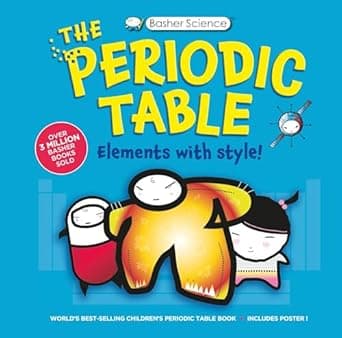
Basher Science: The Complete Periodic Table
Basher Science Series
What’s inside...
Basher Science: The Complete Periodic Table is a lively, cartoon-style tour of all 118 elements, presented as a cast of quirky characters. Written by educator Adrian Dingle and series editor Dan Green, the book explains where each element is found, its history of discovery, everyday uses, and key scientific facts. Grouped by chemical families and prefaced with a concise introduction to atomic structure, the volume helps readers visualise chemistry through memorable illustrations, bite-sized text blocks, and quick-fire fact boxes. Whether it’s playful Hydrogen the prima donna or industrious Iron, the book turns abstract science into an engaging narrative that supports STEM learning for middle-grade readers.
Series reading
Non-Sequential
Age
7-14
Length
192 pages
Text complexity
Discussion points
Which element’s personality surprised you the most?
How would everyday life change without Copper or Silicon?
Why do you think inert gases prefer ‘keeping to themselves’?
What new element would you invent and what would it do?
Tip: Role play these questions
Create flashcards of favourite element characters.
Relate elements to household items—find real examples.
Compare historical discovery stories to modern inventions.
Key lessons
Example Lesson: Curiosity fuels learning
Explanation: Elements invite readers to ask questions about their properties.
Real-World Application: Kids feel encouraged to investigate how things work at home or school.
Example Lesson: Scientific knowledge is collaborative
Explanation: Multiple discoverers and cultures are credited for new elements.
Real-World Application: Children value teamwork on class projects.
Example Lesson: Safety first in experimentation
Explanation: Reactive elements emphasise lab precautions.
Real-World Application: Students remember to wear goggles and follow rules during science labs.
Example Lesson: Every element has a purpose
Explanation: Profiles link each element to real-world uses.
Real-World Application: Kids recognise the relevance of school science to everyday life.