
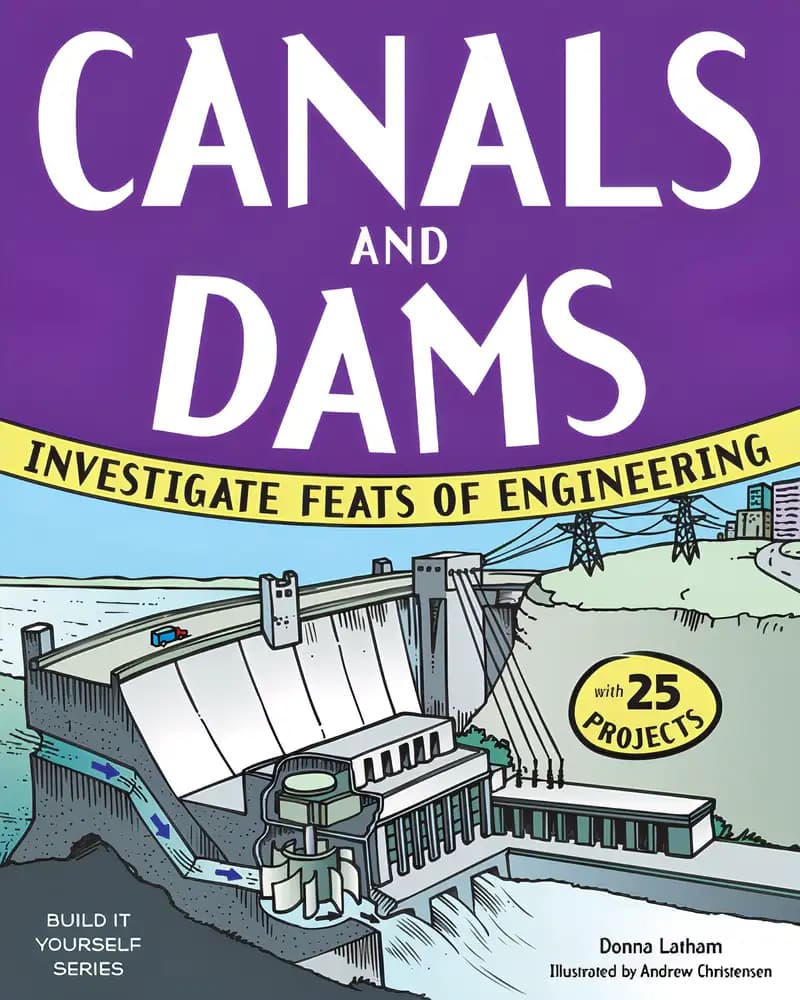
Canals and Dams: Investigate Feats of Engineering with 25 Projects (Build It Yourself)
What’s inside...
Canals and Dams: Investigate Feats of Engineering invites children ages 9 and up to explore the innovation and physical science behind the amazing waterways and barriers our world depends on. Trivia and fun facts illustrate engineering ingenuity and achievements from ancient aqueducts to the Suez Canal and the Hoover Dam. Readers will discover that engineers and builders alike put their lives on the line to advance civilization, experiencing triumphs and tragedies in building big. Through dazzling success and heartbreaking failure, they developed increasingly sophisticated tools and building methods.Activities and projects encourage children to explore the engineering process and to try, try again through trial and error. They'll engage in hands-on explorations of buoyancy, Newton's third law of motion, and forces that push and pull structures. They'll create a paper-cup zip line, build an arch, and simulate a tsunami, while experimenting with gravity, hydroponics, and velocity. In Canals and Dams: Investigate Feats of Engineering, children will gain an appreciation for the important field of engineering as they develop their own building skills.
Why read this book
- Explores engineering through interactive projects and concepts.
- Encourages problem-solving and critical thinking.
- Enhances understanding of real-world applications of science.
- Ideal for hands-on learning and family activities.
Age
9-12
Length
128 pages
Text complexity
Discussion points
What do you think would happen if we didn't have dams or canals? How would that change our lives?
Can you think of a creative project that could help improve our water systems, inspired by what you read in the book?
How do engineers solve problems when building large structures like dams and canals? What steps do you think they take?
Why do you think it's important for us to learn about engineering feats such as canals and dams?
Tip: Role play these questions
Encourage your child to express their ideas by asking them how they would design a dam or canal.
Relate the topics in the book to real-life examples, perhaps discussing a local dam or canal and its impact on your community.
After reading the book, propose a simple hands-on project, such as building a small model of a canal or dam, to help consolidate their understanding.
Highlight the problem-solving aspect of engineering by discussing different challenges engineers might face and asking your child how they might tackle them.
Key lessons
Example Lesson: Problem-solving skills
Explanation: Through exploring the engineering challenges associated with canals and dams, children learn how to approach complex problems, brainstorm solutions, and evaluate outcomes.
Real-World Application: Children can use these problem-solving approaches in their own projects and challenges, whether it's building a model, planning an event, or resolving a conflict with peers.
Example Lesson: Importance of teamwork
Explanation: The book highlights how large engineering feats require the collaboration of many professionals. It emphasizes the role of teamwork in achieving common goals.
Real-World Application: This can translate to children understanding the value of cooperative learning and working together in group settings like classrooms or sports teams.
Example Lesson: Sustainability awareness
Explanation: Projects in the book discuss the environmental impact of building canals and dams and the importance of sustainable engineering solutions.
Real-World Application: Children can apply this awareness to everyday activities, like recycling or conserving water, understanding their role in environmental stewardship.
Example Lesson: Historical significance
Explanation: The book covers the history and evolution of canals and dams, showing how engineering solutions have adapted over time.
Real-World Application: Children learn to appreciate history and its impact on modern life, realizing that many of today's methods and structures have roots in the past.
Example Lesson: Creative thinking
Explanation: With 25 hands-on projects, the book encourages readers to think creatively and innovatively to build their own models of engineering solutions.
Real-World Application: This encourages children to engage in creative thinking in other aspects of life, helping them become inventive problem solvers and thoughtful creators.