
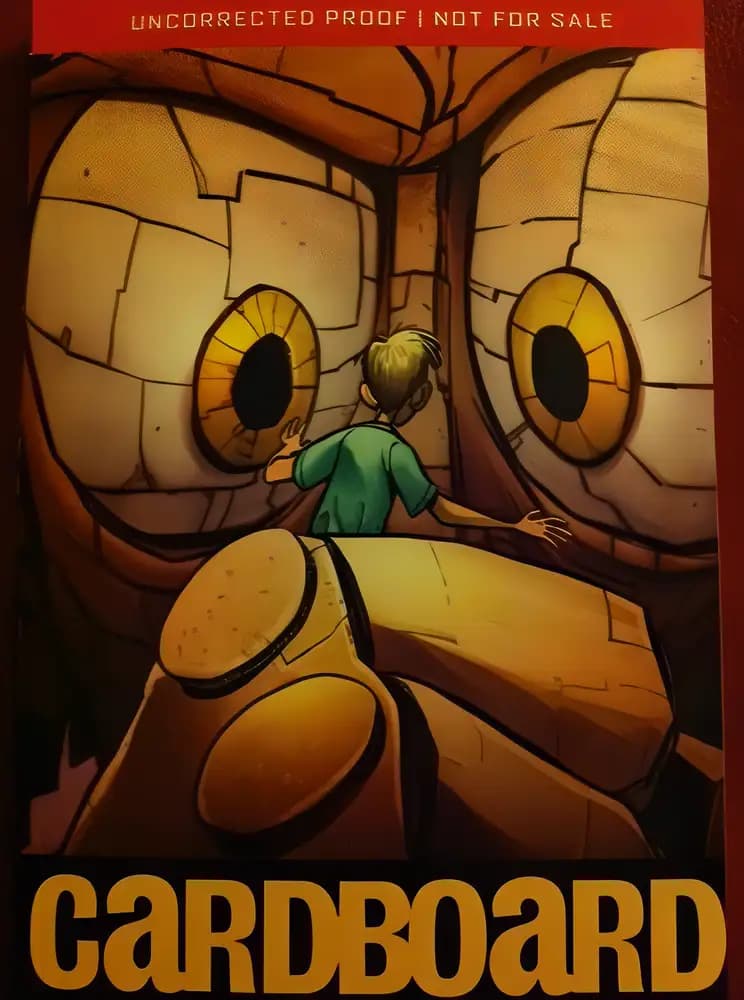
Cardboard
#1 of 1 in Cardboard Series
on Goodreads (14,559)
What’s inside...
When cardboard creatures come magically to life, a boy must save his town from disaster. Cam's down-and-out father gives him a cardboard box for his birthday and he knows it's the worst present ever. So to make the best of a bad situation, they bend the cardboard into a man-and to their astonishment, it comes magically to life. But the neighborhood bully, Marcus, warps the powerful cardboard into his own evil creations that threaten to destroy them all!
Character compass
Cam
Bill
Mike
Gideon
Marcus
Discussion points
How do you think Cam felt when he first saw the cardboard man come to life, and why?
In what ways did the cardboard creations change Cam and his father’s life?
What does this story teach us about creativity and the importance of imagination?
Can you think of a time when you felt like Marcus, wanting something someone else had? How did you handle it?
What would you have built if you were given some magical cardboard? Why?
Tip: Role play these questions
Encourage your child to imagine deeply by asking them to visualize their own cardboard creation and describe it in detail.
Link themes from the book, like creativity and jealousy, to real-life scenarios your child might relate to, enhancing empathy and understanding.
Discuss the evolution of Cam and his father’s relationship, prompting your child to explore the significance of teamwork and support in achieving goals.
Use the story as a springboard to discuss the value of materials—what makes something valuable or precious? Is it rarity, usefulness, or the joy it brings?
Highlight the message of redemption and second chances, asking your child how they think people can change for the better.
Key lessons
Example Lesson: Creativity and Resourcefulness
Explanation: In 'Cardboard,' characters transform simple cardboard boxes into elaborate inventions, showcasing the power of imagination and creativity.
Real-World Application: Children can learn to use everyday objects in innovative ways, boosting their creative thinking and problem-solving skills.
Example Lesson: The importance of family bonds
Explanation: The story highlights the relationship between a father and his son as they work together on their cardboard creations, emphasizing the value of family collaboration and support.
Real-World Application: Children are encouraged to engage in activities with family members, fostering stronger emotional connections and cooperation.
Example Lesson: Overcoming adversity
Explanation: Characters in 'Cardboard' face challenges and conflicts, but they find ways to overcome these obstacles, teaching resilience and perseverance.
Real-World Application: This lesson can inspire children to face difficulties with determination and to seek solutions, rather than giving up when faced with challenges.
Example Lesson: Consequences of actions
Explanation: The book explores how the misuse of the magical cardboard has negative effects, illustrating the consequences of one’s actions.
Real-World Application: Children learn the importance of considering the potential outcomes of their actions and making responsible decisions.
Example Lesson: Empathy and understanding
Explanation: As characters in the book interact, they learn to see situations from others' perspectives, fostering empathy and understanding.
Real-World Application: This lesson can encourage children to be considerate and empathetic towards others in their daily interactions, enhancing their social skills and emotional intelligence.