
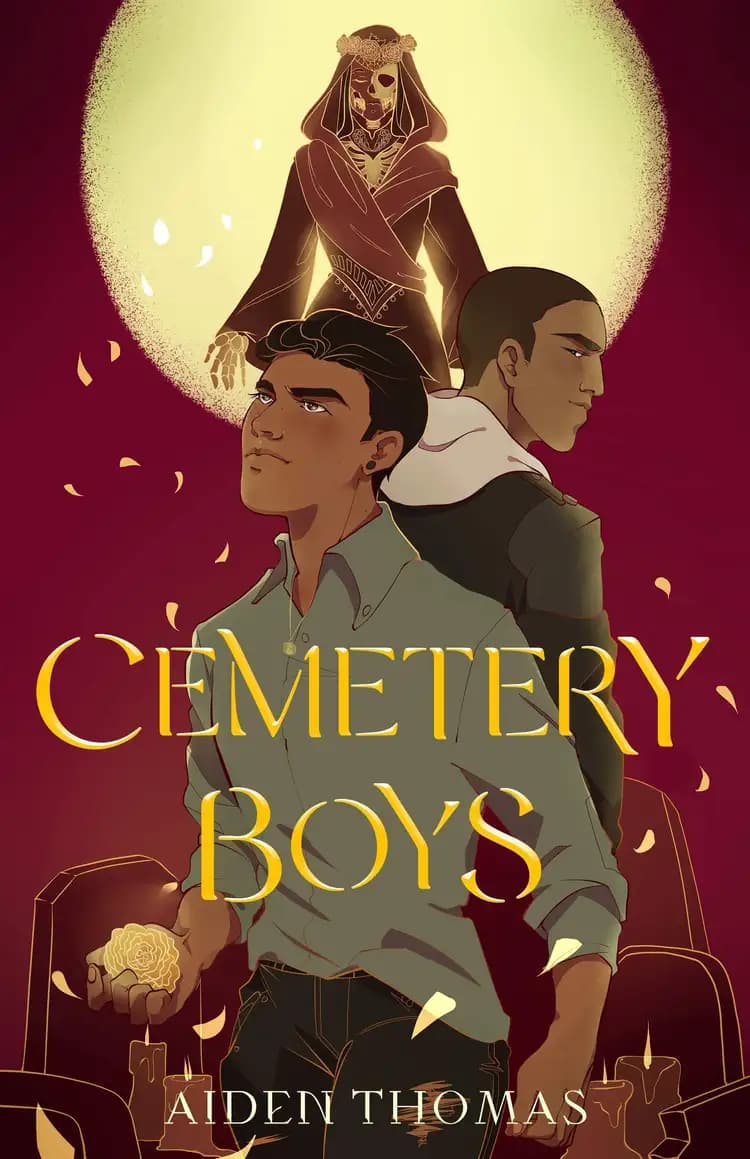
Cemetery Boys
#1 of 2 in Cemetery Boys Series
on Goodreads (101,853)
What’s inside...
Yadriel has summoned a ghost, and now he can’t get rid of him. When his traditional Latinx family has problems accepting his gender, Yadriel becomes determined to prove himself a real brujo. With the help of his cousin and best friend Maritza, he performs the ritual himself, and then sets out to find the ghost of his murdered cousin and set it free. However, the ghost he summons is actually Julian Diaz, the school’s resident bad boy, and Julian is not about to go quietly into death. He’s determined to find out what happened and tie up some loose ends before he leaves. Left with no choice, Yadriel agrees to help Julian, so that they can both get what they want. But the longer Yadriel spends with Julian, the less he wants to let him leave.
Character compass
Yadriel
Maritza
Julian Diaz
Enrique
TíO Catriz
Discussion points
How did Yadriel’s journey towards self-acceptance influence his relationships with his family and friends?
What role do tradition and culture play in shaping the characters in the story?
Can you relate to the struggles faced by any of the characters? How?
How do the themes of acceptance and belonging evolve throughout the book?
Tip: Role play these questions
Start the conversation by sharing your own thoughts on the book's themes, making it a two-way exchange. Encourage your child to express their opinions and feelings about the characters and their decisions. Link discussions to real-life scenarios, enhancing empathy and understanding. Reinforce the importance of diversity and acceptance, bridging connections to their experiences or current events.
Key lessons
Example Lesson: Acceptance of personal identity
Explanation: In 'Cemetery Boys', the protagonist, Yadriel, is a transgender boy struggling for acceptance within his traditional Latinx family. His journey highlights the importance of embracing personal identity despite societal and cultural challenges.
Real-World Application: Children can learn the importance of accepting themselves and others, understanding that everyone has the right to be true to who they are. This helps in nurturing an inclusive environment at school and in other social settings.
Example Lesson: Importance of family and community
Explanation: The narrative underscores the protagonist's deep-rooted desire to be recognized and accepted by his family, showing how integral family and community are in one’s personal development.
Real-World Application: Children can learn to value and contribute to their family and community, understanding that these relationships provide support and shape their own identities.
Example Lesson: Courage to stand up for oneself
Explanation: Yadriel's determination to prove himself as a brujo to his family demonstrates the courage it takes to stand up for oneself and one's beliefs, even when faced with opposition.
Real-World Application: This lesson can inspire children to advocate for themselves in situations where they feel marginalized or misunderstood, be it in school or among peers.
Example Lesson: Empathy and understanding different perspectives
Explanation: Through interactions with various characters who have distinct backgrounds and experiences, the story promotes understanding and empathy among diverse groups.
Real-World Application: Children can apply this by showing empathy towards classmates and friends who may have different life experiences, fostering a culture of kindness and respect.
Example Lesson: Consequences of actions
Explanation: As Yadriel and his friends undertake a mission to find out the truth about a mysterious death, they learn that every action has consequences. This theme is woven throughout their adventures, offering a moral backbone to the story.
Real-World Application: This teaches children to think about the outcomes of their actions and to make responsible decisions, understanding that their actions affect not only themselves but also those around them.