
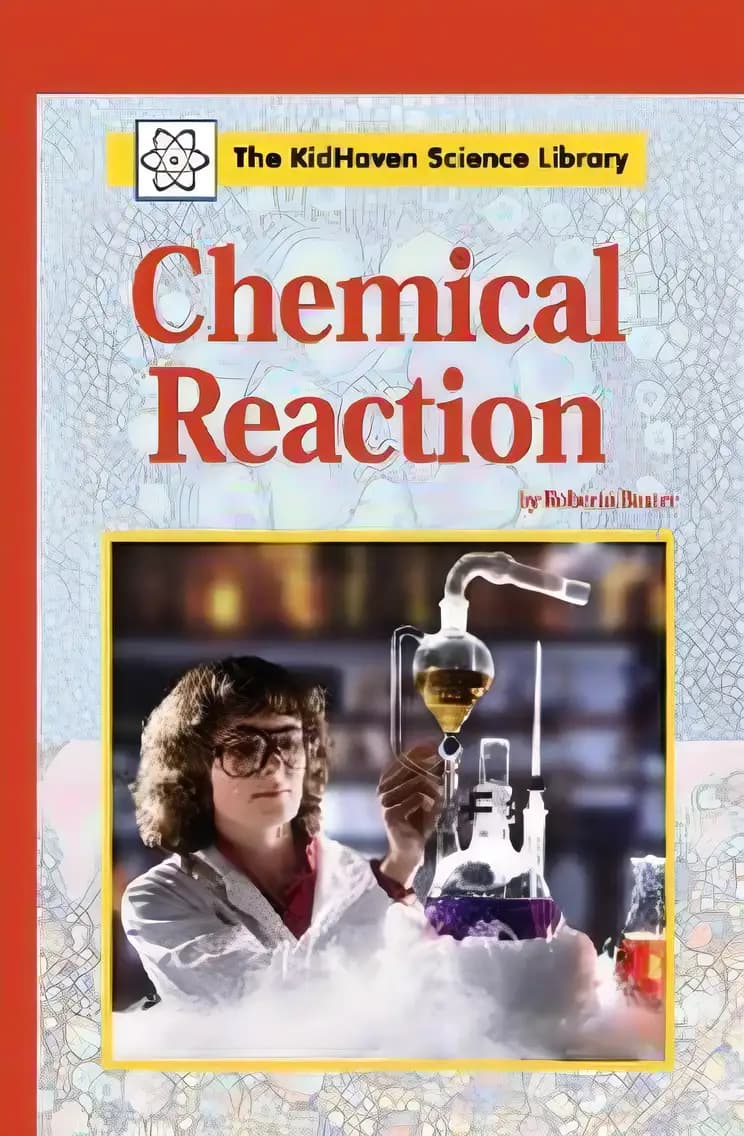
Chemical Reaction (The KidHaven Science Library)
#3 in Kidhaven science library Series
What’s inside...
This book introduces young readers to the concept of chemical reactions, explaining the science behind how substances interact to form new compounds. Through engaging examples and clear explanations, the author, Roberta Baxter, makes complex chemical principles accessible to children. The book covers topics such as the types of chemical reactions, the role of catalysts, and the importance of chemical reactions in everyday life. It also includes experiments and activities to help kids explore and understand chemical reactions firsthand. Chemical reactions happen when atoms exchange or share electrons and form molecules. This book explains how chemicals react and describes different types of reactions from acid-base interactions and reactions with oxygen to photosynthesis and digestion. Also covered is the future of chemical reactions in space and in computers.
Discussion points
What do you think happens when different chemicals mix together?
Can you think of a time when you noticed a chemical reaction in real life? What was it like?
Why do you think understanding chemical reactions is important?
How do you think scientists use chemical reactions to help us in everyday life?
Tip: Role play these questions
Start by asking your child what they already know or think about chemical reactions to gauge their prior knowledge and build from there.
Relate the discussion to everyday life, perhaps by talking about baking or the changing colors in fall, to make the concept of chemical reactions more tangible.
Encourage your child to ask questions and express their thoughts throughout the conversation to foster an interactive dialogue.
Use illustrations or experiments from the book as visual aids to help explain more complex ideas.
Key lessons
Example Lesson: Understanding cause and effect
Explanation: The book explains chemical reactions by showing how different substances react together to cause an observable effect.
Real-World Application: Encourages children to think analytically about the consequences of actions or choices in daily life, understanding that every action has a reaction.
Example Lesson: Fostering curiosity about science
Explanation: Roberta Baxter introduces complex scientific concepts in an accessible way, sparking interest and curiosity about science among young readers.
Real-World Application: This curiosity can lead children to explore more about the world around them, ask questions, and engage in scientific thinking and problem-solving.
Example Lesson: Importance of safety in experimentation
Explanation: The book stresses the importance of safety measures when conducting experiments, illustrating the use of protective gear and controlled environments.
Real-World Application: Teaches children the importance of safety and precautionary measures, which they can apply in school experiments or even while handling household items that require care.
Example Lesson: Building patience and observation skills
Explanation: Chemical reactions may take time to occur, and the book encourages observing these changes patiently to understand the process fully.
Real-World Application: Helps children develop patience and keen observation skills which are beneficial in educational settings and in personal growth.