
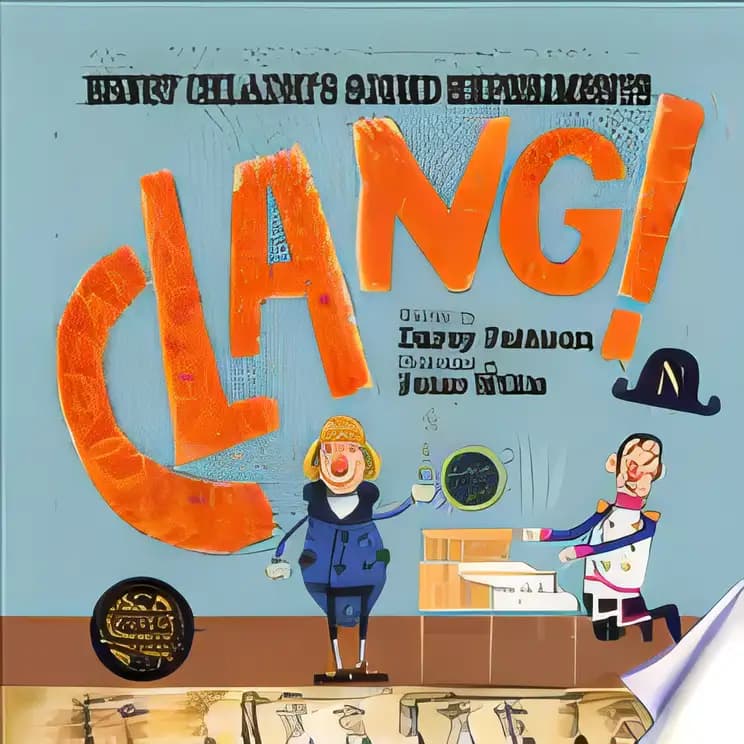
Clang!: Ernst Chladni's Sound Experiments (Moments in Science)
Moments in Science Series
What’s inside...
CLANG! ERNST CHLADNI'S SOUND EXPERIMENTS is an elementary science picture book that follows the story of Ernst Chladni, known as the Father of Acoustics, who entertained Europeans with his science experiments during a three-year road trip. In 1809, his scientific endeavors caught the attention of French Emperor Napoleon Bonaparte, leading to an exciting meeting at the Tuliere Palace. This story highlights Chladni's challenges in balancing entertainment and research, and showcases international scientific collaboration. The book has been recognized as a 2019 NSTA Outstanding Science Trade Book and has received positive reviews for making the concept of sound and sound waves engaging and fun to learn.
Series reading
Non-Sequential
Age
5-12
Length
34 pages
Text complexity
Character compass
Ernst Chladni
Discussion points
What do you think made Ernst Chladni interested in sound experiments?
How do you think the different patterns were formed by the sand on the plates in the experiments?
Why is it important to keep experimenting and exploring, like Chladni did?
What other experiments do you think could be done with sound?
How do you feel when you hear different kinds of sounds and what do they make you think of?
Tip: Role play these questions
Encourage your child to express their thoughts after reading by asking them how the book made them feel, and what was the most surprising thing they learned.
Relate the sound experiments in the book to everyday sounds at home or outside, asking your child to describe what they hear and imagine why those sounds occur.
Suggest conducting simple sound experiments, like using different objects to create sounds, which can help make the connection to Chladni's work more tangible.
Discuss the persistence and curiosity displayed by Chladni, and ask your child about a time they tried multiple times to succeed at something.
Use the illustrations in the book as a visual aid to discuss the science of sound, asking your child to draw their own interpretation of sound waves.
Key lessons
Example Lesson: Curiosity and exploration are keys to learning
Explanation: Ernst Chladni's engaging experiments with sound in 'Clang!' demonstrate a whimsical approach to exploring scientific principles.
Real-World Application: Children can embrace curiosity by trying simple science experiments at home or school, fostering a love for learning and critical thinking.
Example Lesson: Perseverance in the face of adversity
Explanation: The narrative showcases Chladni's determination as he faces and overcomes the challenges throughout his research process.
Real-World Application: This can inspire children to persist in solving difficult problems or mastering new skills, be it in academics, sports, or personal hobbies.
Example Lesson: Importance of communication and sharing knowledge
Explanation: Chladni's success not only lies in his discoveries but in his efforts to share his findings, highlighting the importance of communication in science.
Real-World Application: Children learn the value of sharing information and ideas, whether it's helping a classmate understand a concept or presenting in a class project.
Example Lesson: Creativity in problem-solving
Explanation: The book illustrates Chladni's use of creative methods to visualize sound, emphasizing that creativity is not confined to the arts.
Real-World Application: Children are encouraged to think outside the box and use creativity in their daily problem solving, whether it’s building a model, writing a story, or organizing their room.
Example Lesson: Observation and attention to detail
Explanation: Through Chladni's meticulous experiments with sound patterns, the story underlines the importance of careful observation and attention to detail.
Real-World Application: Kids can practice being more observant in their daily activities, helping to boost their academic performance and attentive skills.