
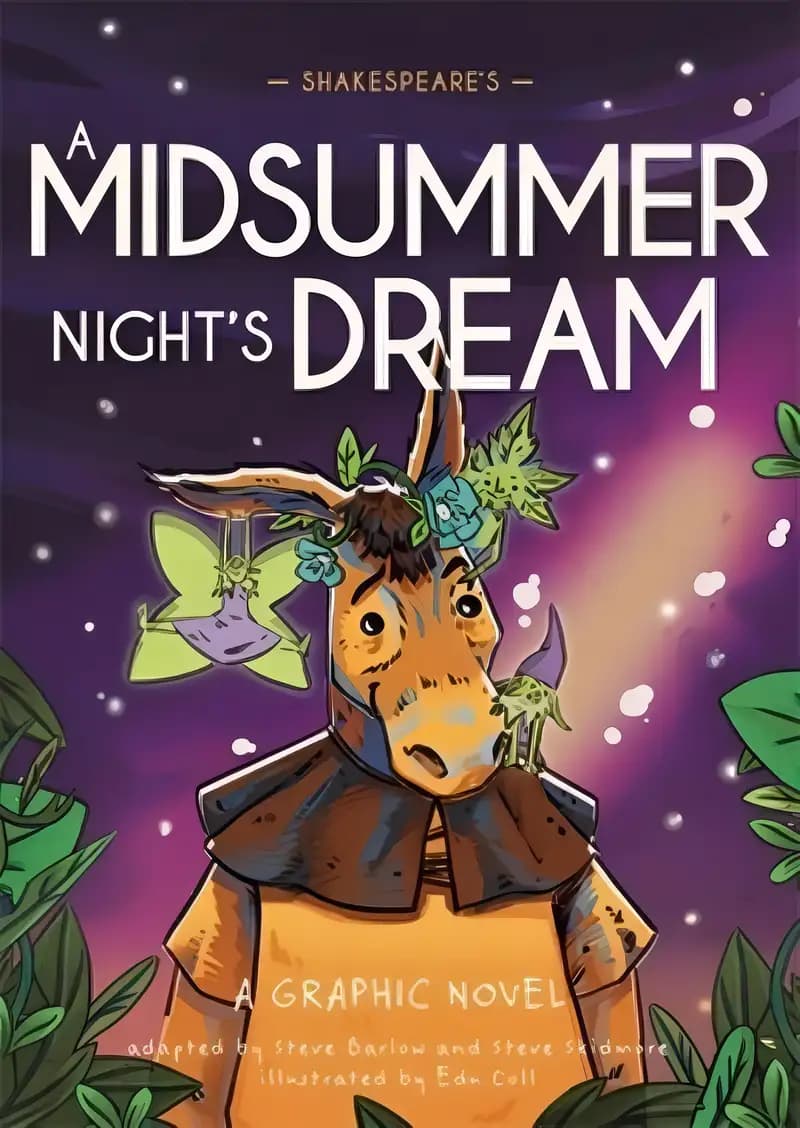
Classics in Graphics: Shakespeare's A Midsummer Night's Dream
#3 in Graphic Classics Series
What’s inside...
Classics in Graphics: A Midsummer Night's Dream is a graphic novel adaptation of Shakespeare's play, tailored for children aged 10 and up. Authored by Steve Skidmore and Steve Barlow and illustrated by Edu Coll, the book brings the magical fantasy to life with comic delight. It features dyslexia-friendly design and simplified text to make Shakespeare's themes accessible. The series also includes other Shakespeare plays and provides additional materials to enhance understanding and enjoyment.
Character compass
Puck
Helena
Hermia
Titania
Nick Bottom
Demetrius
Lysander
Egeus
Oberon
Discussion points
What do you think was the most magical part of the story and why?
How do you think the characters felt when they were under the love spell?
If you could give advice to one of the characters in the play, what would you say and why?
Do you think it is important to forgive others like the characters did in the end? Why or why not?
Which character would you like to be friends with and what would you do together?
Tip: Role play these questions
Start by sharing your own impressions of the story and ask your child what they thought about the book.
Use expressive reading to bring the characters to life and help your child connect with the narrative.
Encourage your child to draw their favorite scene or character from the book and explain their choice.
Link themes from the book to real-life situations to help your child apply the story's lessons.
Praise your child for their insights and ideas during the discussion to boost their confidence and engagement.
Key lessons
Example Lesson: The importance of empathy and understanding
Explanation: In A Midsummer Night's Dream, characters often find themselves in misunderstandings and conflicts that could be resolved with empathy. For example, the mix-ups caused by the love potion highlight how easily feelings can be hurt.
Real-World Application: Children can learn to consider others' feelings and perspectives, helping them build stronger, empathetic relationships with friends and family.
Example Lesson: The value of resolving conflicts peacefully
Explanation: Throughout the play, characters learn to resolve their differences and misunderstandings without resorting to violence or hatred. This is evident when Oberon and Titania reconcile and when the lovers' relationships are ultimately restored.
Real-World Application: This teaches children the importance of talking through disagreements and finding peaceful solutions, which is a crucial skill in both school and within the family.
Example Lesson: Imagination and creativity
Explanation: Shakespeare's play is a fantastical world full of magical elements which stimulates the imagination. The presence of fairies, spells, and mystical happenings make it a rich ground for creative thinking.
Real-World Application: Encouraging children to engage in creative play can enhance their cognitive development and problem-solving skills. Reading such imaginative stories can inspire them to think innovatively in their own lives.
Example Lesson: Consequences of actions
Explanation: The use of the love potion shows how actions, even when well-intentioned, can lead to unforeseen consequences. Puck’s mistakes with the potion create chaos among the characters.
Real-World Application: Children can learn the importance of thinking through their decisions, understanding that their actions impact others, and learning from their mistakes.