
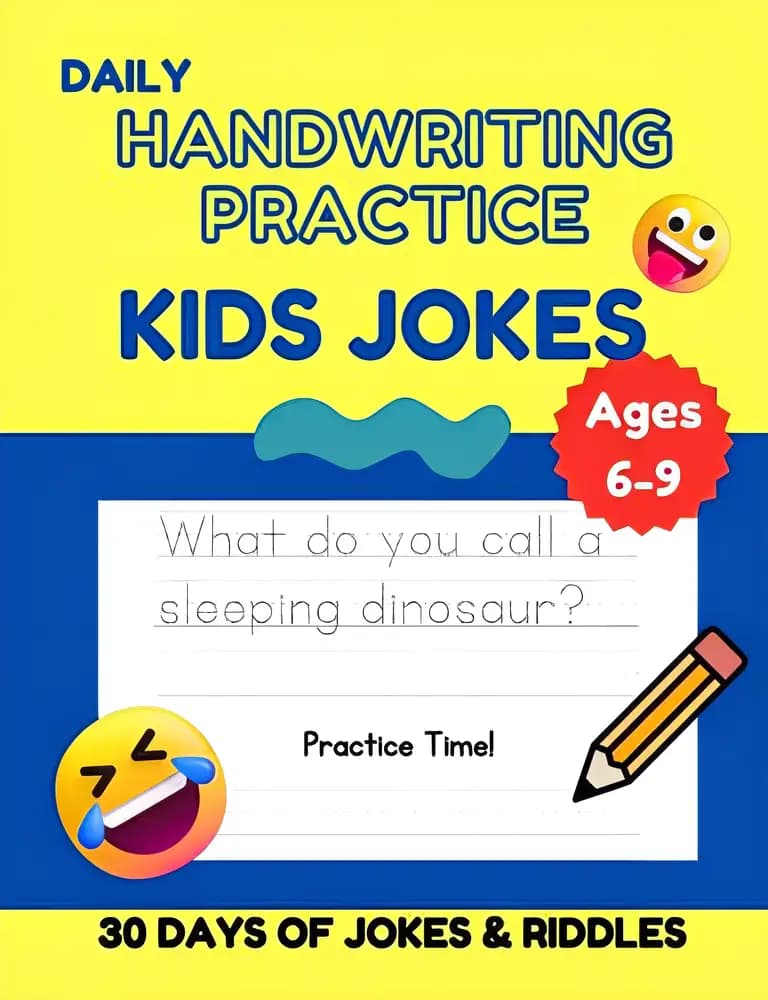
Daily Handwriting Practice Kids Jokes - Tracing Letters and Forming Sentences
on Goodreads (1)
What’s inside...
Daily Handwriting Practice Kids Jokes is a fun and engaging way for kids aged 6 to 9 to improve their handwriting skills through jokes. Each exercise includes hilarious jokes that kids can trace while learning proper letter formation and building confidence in their writing ability. This book is perfect for use at home or in the classroom and provides a more enjoyable alternative to traditional handwriting methods.
Age
6-9
Length
62 pages
Text complexity
Discussion points
Which joke in the book did you find the funniest and why?
How do you think the characters felt when they heard the jokes?
Can you think of a time when a joke made you feel better?
What can we learn from sharing jokes with friends and family?
How do you create your own joke using the letters we practiced today?
Tip: Role play these questions
Laugh along with the jokes, showing your child that humor can be shared and enjoyed together.
Ask your child to explain why a joke is funny, which can help deepen their understanding of language and social cues.
Encourage your child to share the jokes they learned with other family members, promoting their confidence in reading and public speaking.
Discuss the feelings associated with the jokes, such as surprise or joy, to enhance emotional intelligence and empathy.
Create a 'joke of the day' routine where your child practices writing and then tells a new joke they wrote, reinforcing handwriting skills and creative thinking.
Key lessons
Example Lesson: Improvement in Handwriting Skills
Explanation: The book provides daily tracing exercises that help children practice letter formation which improves their handwriting.
Real-World Application: Better handwriting can lead to clearer communication in school assignments and personal projects.
Example Lesson: Understanding of Sentence Structure
Explanation: Children learn to form sentences through guided practice, enhancing their grasp on syntax and grammar.
Real-World Application: Improved sentence structure aids in effective communication, both verbally and in written form, in everyday interactions.
Example Lesson: Development of a Sense of Humor
Explanation: The use of jokes in the practice material makes learning enjoyable and helps develop a child's sense of humor.
Real-World Application: A good sense of humor can enhance social interactions and help in building relationships with peers.
Example Lesson: Enhancement of Cognitive Skills
Explanation: Tracing letters and forming sentences require focus and memory, which are crucial cognitive skills.
Real-World Application: Strengthened cognitive skills are essential for problem-solving and learning new information in all subjects.
Example Lesson: Boost in Self-confidence
Explanation: Mastering handwriting and enjoying humor in learning provides a sense of accomplishment, boosting a child’s self-esteem.
Real-World Application: Higher self-confidence encourages children to take on new challenges and engage more actively in their learning process.