
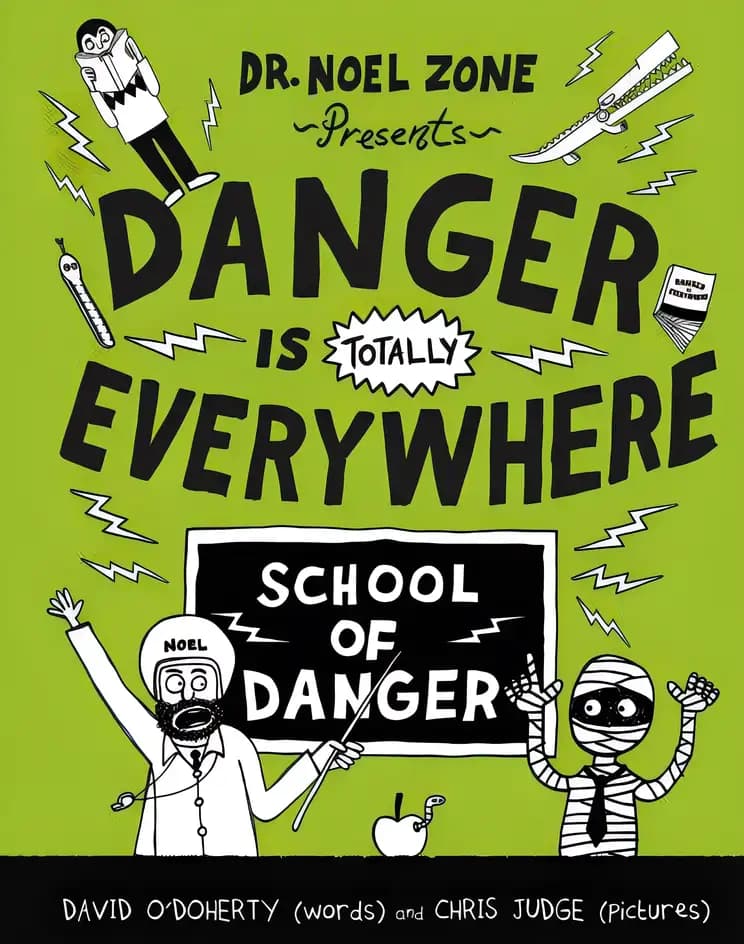
Danger Is Totally Everywhere: School of Danger (Danger Is Everywhere, 3)
#3 in Danger is Everywhere! Series
What’s inside...
In 'School of Danger', Dr. Noel Zone, the world's greatest (and only) DANGEROLOGIST, returns with his third handbook, focusing on the dangers lurking in schools. After an incident with his Danger Mobile, Dr. Zone joins the teaching staff of a local school, where he educates readers on how to navigate dangers in classrooms, lunchrooms, and gymnasiums. This humorous guide is filled with art, silly acronyms, and recurring characters, providing readers with both laughter and tips on becoming a Level 3 DANGEROLOGIST.
Character compass
Docter Noel Zone
Discussion points
What do you think Doctor Noel Zone would do if he was at our house?
How can we identify and stay safe from dangers like Doctor Noel Zone?
What was the funniest danger you noticed in the book, and why did it make you laugh?
How do you think the idea of danger changes from the beginning to the end of the story?
If you could invent a safety gadget for Doctor Noel Zone, what would it be and how would it work?
Tip: Role play these questions
Let your child lead the conversation. Listen to their ideas about danger and safety, validating their feelings and thoughts.
Use humor from the book to make the conversation light and fun. This approach can help your child feel comfortable sharing their thoughts.
Relate the fictional dangers in the book to real-life scenarios in a playful way, encouraging critical thinking about safety in everyday life.
Ask your child to draw or list out the 'most dangerous' things from their day and discuss why they perceived them as such, relating back to Doctor Noel Zone's perspective.
Encourage imagination by asking your child to come up with their own funny safety rules or danger alerts inspired by the book.
Key lessons
Example Lesson: Embracing Change
Explanation: The protagonist faces various unexpected situations in school, teaching children the importance of adapting to new environments and challenges.
Real-World Application: Children can apply this when they encounter new activities in school or changes in their daily routines, helping them to adjust and find positive outcomes.
Example Lesson: Creativity and Problem Solving
Explanation: The characters often come up with imaginative solutions to avoid dangers, demonstrating the value of thinking outside the box.
Real-World Application: This encourages children to engage in creative thinking during playtime or class projects, enhancing their problem-solving skills.
Example Lesson: The Importance of Friendship
Explanation: Throughout the book, teamwork and friendships play a crucial role in overcoming obstacles, showing how collaboration and supporting each other are essential.
Real-World Application: Children learn to value their friends and the importance of working together, which can be applied in group tasks or shared responsibilities at school.
Example Lesson: Understanding and Managing Fear
Explanation: The characters often face their fears, providing a narrative on how to acknowledge and cope with different fears.
Real-World Application: This lesson helps children understand that it's okay to be afraid and teaches ways to manage their fears effectively, whether it's trying out for a school play or sleeping alone in the dark.
Example Lesson: Humor as a Coping Mechanism
Explanation: The book uses humor to deal with dangerous scenarios, illustrating how laughter can lighten difficult or frightening situations.
Real-World Application: Children can use humor to cope with their own challenges, easing stress and building resilience in tough times.