
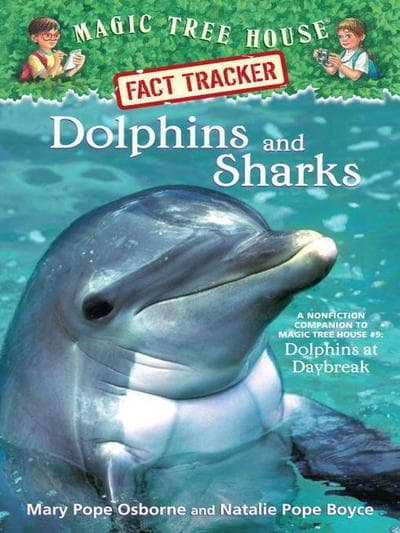
Dolphins and Sharks: A Nonfiction Companion to Magic Tree House #9: Dolphins at Daybreak (Magic Tree House (R) Fact Tracker)
Magic Tree House Series
What’s inside...
Magic Tree House Research Guides are now Magic Tree House Fact Trackers! Track the facts with Jack and Annie! When Jack and Annie got back from their adventure inMagic Tree House #9: Dolphins at Daybreak,they had lots of questions. Did dolphins ever live on land? How do dolphins communicate? How do sharks hunt for food? Which sharks are the most dangerous? Find out the answers to these questions and more as Jack and Annie track the facts. Filled with up-to-date information, photos, illustrations, and fun tidbits from Jack and Annie, the Magic Tree House Fact Trackers are the perfect way for kids to find out more about the topics they discovered in their favorite Magic Tree House adventures.
Series reading
Non-Sequential
Age
7-10
Text complexity
Discussion points
What differences and similarities did you notice between dolphins and sharks while reading this book?
How do dolphins communicate with each other, and can you think of ways humans do something similar?
Why do you think sharks are often misunderstood? What can we learn about them from this book that might change our perspective?
Can you imagine what it would be like to explore the ocean like the characters in Magic Tree House? What would you be most excited to see?
What is one new fact about dolphins or sharks you learned from this book that surprised you?
Tip: Role play these questions
Begin your discussion by sharing your own curiosity about the ocean and its creatures to spark your child’s interest. Use the illustrations and descriptions in the book to help visualize the scenes, enhancing the learning experience. Praise your child for each new fact they learn or insight they gain, which encourages their enthusiasm and confidence in sharing. Connect the book’s contents to real-world situations or upcoming events, like a visit to an aquarium, to make the discussion relevant and timely. Lastly, encourage empathy by discussing the importance of marine life conservation and what humans can do to help protect ocean habitats.
Key lessons
Example Lesson: Respect for marine life
Explanation: The book provides detailed information about dolphins and sharks, showcasing their roles in the marine ecosystem and emphasizing the importance of respecting and protecting these creatures.
Real-World Application: Children can be encouraged to participate in local beach clean-ups or learn more about marine conservation, fostering a sense of responsibility towards aquatic wildlife.
Example Lesson: The value of research and learning
Explanation: As a nonfiction companion to a fictional story, this book emphasizes the importance of factual accuracy and the thrill of learning new things about real-world topics.
Real-World Application: This can inspire children to conduct their own research projects at school or explore topics of interest at the library, nurturing a lifelong love for learning.
Example Lesson: Critical thinking about natural habitats
Explanation: By comparing the lives of dolphins and sharks, the book encourages readers to think critically about how different species adapt to their environments and why those habitats must be preserved.
Real-World Application: Children can apply this understanding by discussing or writing about local wildlife and habitats as part of their science curriculum, enhancing their analytical skills.
Example Lesson: Understanding ecosystem interdependence
Explanation: The book explains the food chains and relationships between different marine animals, highlighting the interdependence within ecosystems.
Real-World Application: This lesson can help children understand the impact of human actions on the environment and promote eco-friendly practices in their daily lives, like recycling and proper waste disposal.