
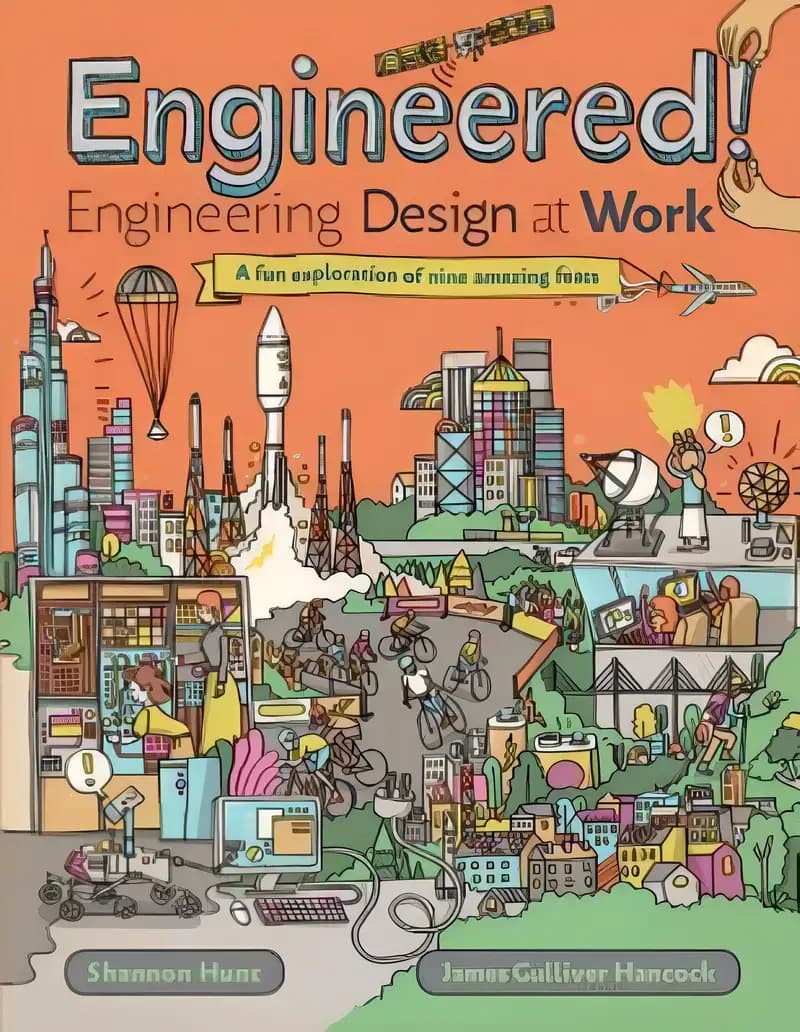
Engineered!: Engineering Design at Work
What’s inside...
In 'Ask an Engineer,' author Shannon Hunt explores how engineers tackle real-life problems with inventive solutions. Covering nine different scenarios, from landing a rover on Mars to saving caribou from extinction, each solution is rooted in a unique field of engineering. The book details a seven-step engineering design process, using icons to guide readers through each step. It also features sidebars, engineer biographies, and illustrations by James Gulliver Hancock, providing a comprehensive introduction to the diverse applications of engineering. This book serves as an excellent resource for encouraging STEM education and is ideal for grades three to seven, aligning with the Next Generation Science Standards.
Age
8-12
Length
48 pages
Text complexity
Discussion points
What do you think is the most exciting invention mentioned in the book, and why?
How do engineers solve problems? Can you think of a problem you would like to solve?
What steps do engineers take to design something new, and how do they test their designs?
Can you imagine what our world might look like in the future with new inventions?
Which engineering field interests you the most, like aerospace, software, or environmental?
Tip: Role play these questions
Start by asking your child to describe their favorite part of the book, using this as a springboard into deeper discussion topics.
Relate the engineering challenges in the book to everyday problems they encounter or hear about, to make the content more relatable.
Encourage your child to draw or build their version of an invention they found interesting. Discuss the features and functionality of their creation.
After reading, watch videos or do simple experiments related to the engineering concepts discussed to reinforce their understanding.
Pose hypothetical questions like 'What would happen if this invention never existed?' to encourage critical thinking and imagination.
Key lessons
Example Lesson: Problem-solving through design thinking
Explanation: Engineered! showcases various engineering feats, teaching children how to approach problems methodically and creatively.
Real-World Application: Children learn to tackle everyday challenges at school or home with innovative solutions, enhancing their analytical and creative thinking skills.
Example Lesson: Teamwork and collaboration
Explanation: The book highlights the importance of collective brainstorming and teamwork in accomplishing complex engineering projects.
Real-World Application: This promotes cooperative play and learning in group settings, teaching kids the value of working together to achieve common goals.
Example Lesson: Perseverance in the face of setbacks
Explanation: Various stories within the book show engineers encountering and overcoming unexpected challenges, emphasizing the importance of persistence.
Real-World Application: Children are encouraged to persist through difficulties in their own projects and learning processes, fostering resilience.
Example Lesson: Innovation and creativity
Explanation: Engineered! illustrates how thinking outside the box leads to breakthroughs in engineering, reinforcing the value of innovative thinking.
Real-World Application: Kids apply creativity to their play or academic tasks, learning that unconventional approaches can solve problems.
Example Lesson: Understanding and applying scientific principles
Explanation: The book details how foundational scientific concepts are crucial in engineering, making these principles relatable and understandable.
Real-World Application: Children can apply basic science knowledge in practical experiments at school or in everyday phenomena, promoting a deeper understanding and curiosity for science.