
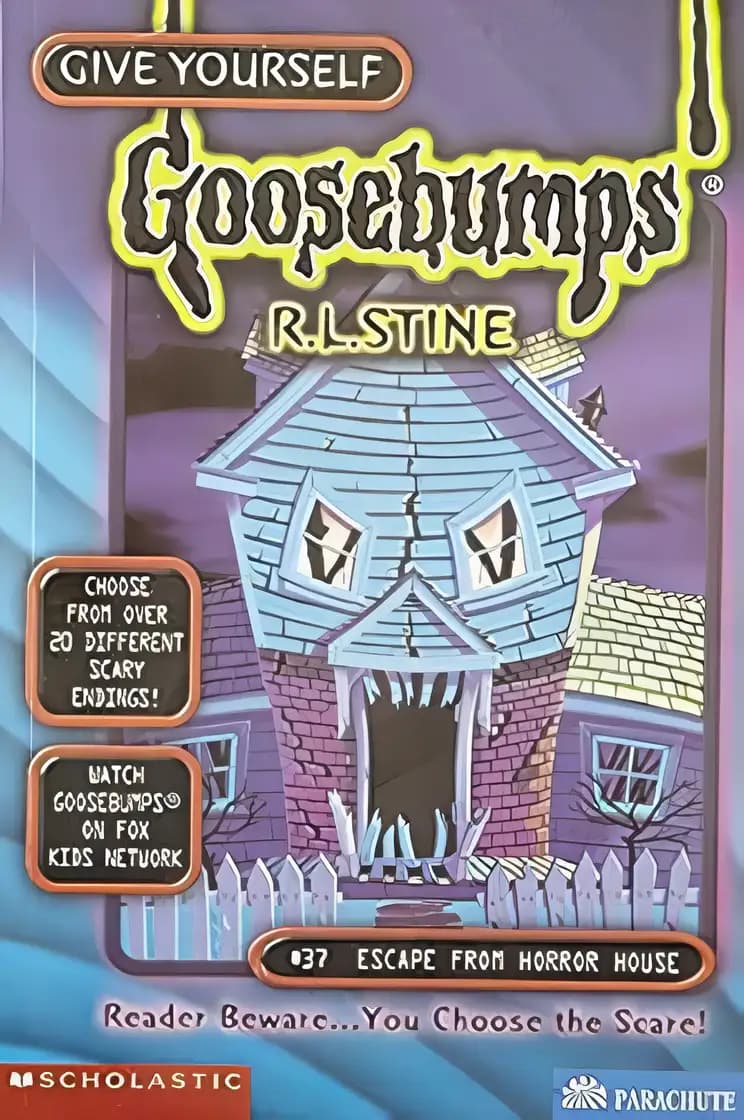
Escape from Horror House (Give Yourself Goosebumps, No 37)
#37 of 55 in Goosebumps Series
on Goodreads (234)
What’s inside...
After things begin to move on their own and strange writings appear on the wall, it becomes apparent that a poltergeist has moved into the house, in an interactive story with over twenty endings.
Discussion points
What choices would you make if you were in the same situation as the characters in 'Escape from Horror House'?
How did the characters’ decisions affect their adventures? Can you think of any consequences?
Which part of the story was the most thrilling for you, and why?
If you could change one part of the story, what would it be and how would it change the outcome?
What lessons do you think the characters learned by the end of their journey?
Tip: Role play these questions
Start the conversation by sharing your own thoughts on the book to create an open environment.
Encourage your child to describe their favorite parts or characters, and ask why they found them particularly engaging or relatable.
Discuss the moral and ethical choices made by the characters, relating them to real-life scenarios to deepen understanding.
Use creative prompts, such as drawing a scene or writing an alternative ending, to make the discussion interactive and engaging.
Validate all of your child’s thoughts and opinions to encourage free expression and critical thinking.
Key lessons
Example Lesson: Problem-solving skills
Explanation: Throughout 'Escape from Horror House', the protagonist encounters various challenges that require quick thinking and decision-making to navigate through the spooky scenarios.
Real-World Application: Children can learn to assess situations and make informed decisions quickly, helping them handle school tasks or social situations effectively.
Example Lesson: Consequences of choices
Explanation: The book features a 'choose-your-own-adventure' style that teaches that different choices lead to different outcomes, some better than others.
Real-World Application: This encourages children to think about the potential consequences of their actions in real life, promoting responsibility.
Example Lesson: Courage in facing fears
Explanation: The characters in the story often face eerie and scary situations, demonstrating bravery as they confront these fears head-on.
Real-World Application: Children are encouraged to face their own fears, whether it’s trying out for a school play, standing up to a bully, or sleeping alone in the dark.
Example Lesson: Importance of curiosity
Explanation: The reader’s choices often involve exploring unknown areas or engaging with mysterious characters, highlighting the role of curiosity in discovery and learning.
Real-World Application: Fostering a curious mindset can lead children to become lifelong learners, always eager to acquire new knowledge and skills.