
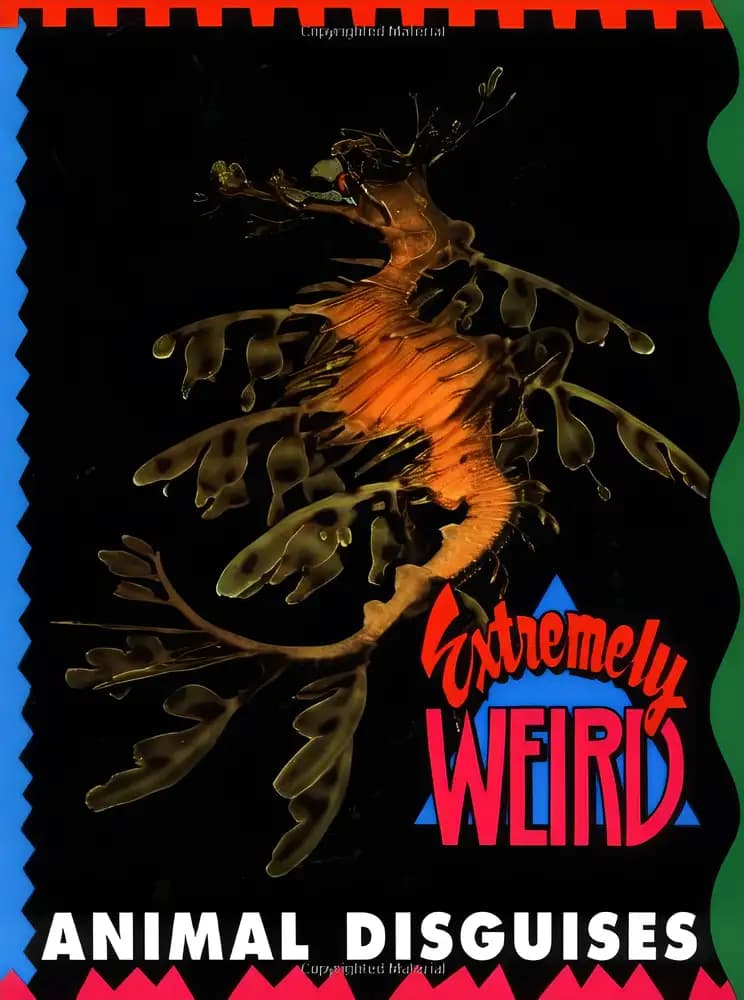
Extremely Weird Animal Disguises
Extremely weird Series
illustrations by
What’s inside...
Describes the physical characteristics and behavior of such unusually disguised animals as the Malayan leaf insect, the stonefish, the Brazilian rainbow boa, and the Honduran white bat.
Series reading
Non-Sequential
Age
8-12
Length
32 pages
Text complexity
Discussion points
What do you think is the most interesting disguise an animal uses in the book, and why?
How do animals' disguises help them survive in their environment?
Can you think of a time when you used a disguise or pretended to be something else?
Why do you think the author chose these particular animals to talk about?
If you could create a new animal disguise, what would it look like and what would it do?
Tip: Role play these questions
Encourage your child to compare and contrast different animal disguises mentioned in the book, discussing the benefits and drawbacks of each.
Relate the topic to a personal experience or familiar story where characters use disguises, linking the content to something the child already understands.
Ask your child to draw their favorite disguised animal from the book and explain why they chose that particular one.
After reading, engage in a creative activity where you both come up with a new animal and think about what kind of disguise it would have to help it survive.
Praise your child’s responses and insights to boost their confidence and interest in discussing more about the book and its themes.
Key lessons
Example Lesson: Adaptation Skills
Explanation: The book showcases various animals that use disguises as a survival mechanism. This illustrates adaptability in the face of challenges.
Real-World Application: Children can learn the importance of adapting to new situations, whether it's moving to a new school or learning new subjects.
Example Lesson: Creativity and Innovation
Explanation: Animals in the book use creative methods to disguise themselves from predators. This showcases the power of innovative thinking.
Real-World Application: Encourages children to think outside the box and come up with creative solutions in their daily challenges and play.
Example Lesson: Importance of Camouflage
Explanation: The book explains how animals blend into their environment to protect themselves, teaching the concept of camouflage.
Real-World Application: Kids can apply this concept by learning how to observe and blend into different social settings, making new friends or respecting others’ boundaries.
Example Lesson: Understanding Nature’s Diversity
Explanation: Through exploring different animals and their unique disguises, children discover the vast diversity in nature.
Real-World Application: This lesson can foster appreciation and respect for different cultures and environments in the real world.
Example Lesson: Observation Skills
Explanation: By observing how animals disguise themselves, children can enhance their attention to detail.
Real-World Application: Improves children's observational skills, helping them in educational settings like spotting differences or similarities, critical for learning processes.