
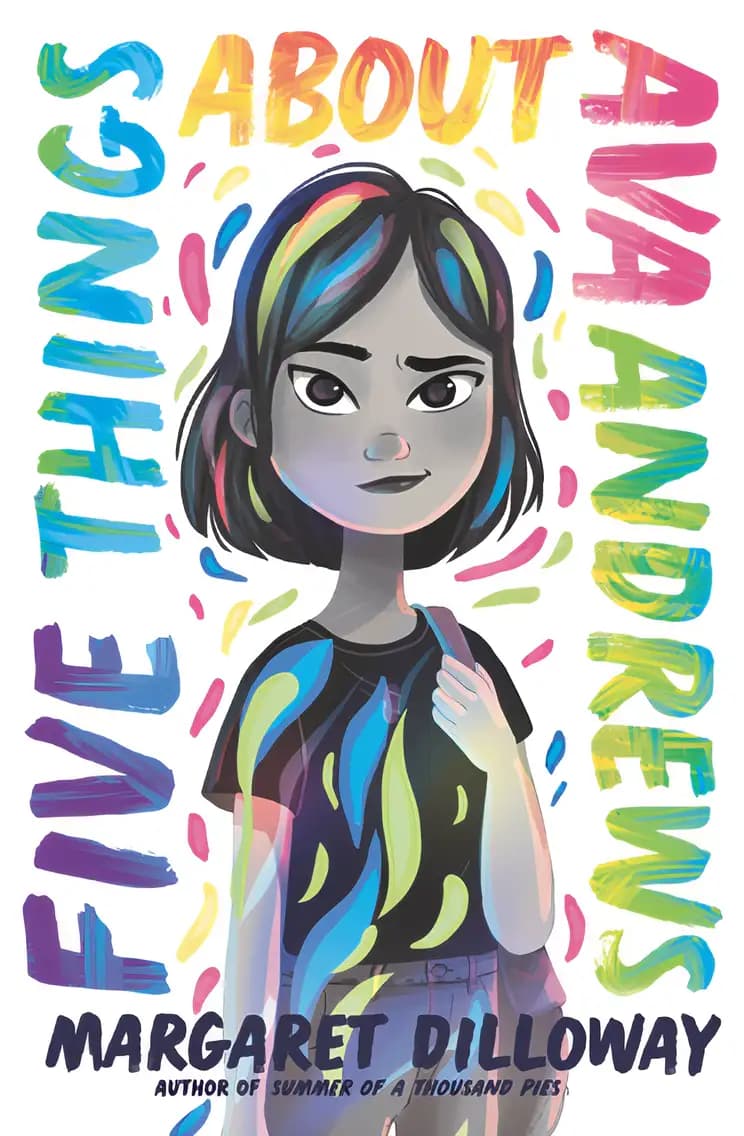
Five Things About Ava Andrews
on Goodreads (693)
What’s inside...
A story about a shy eleven-year-old who learns to manage her anxiety through improv classes—and discovers her activist voice. Eleven-year-old Ava Andrews has a Technicolor interior with a gray shell. On the inside, she bubbles with ideas and plans. On the outside, everyone except her best friend, Zelia, thinks she doesn’t talk or, worse, is stuck-up. What nobody knows is that Ava has invisible disabilities: anxiety and a heart condition. Ava hopes middle school will be a fresh start, but when Zelia moves across the country and Ava’s Nana Linda pushes her to speak up about social issues, she withdraws further. So Ava is shocked when her writing abilities impress her classmates and they invite her to join their improv group, making up stories onstage. Determined to prove she can control her anxiety, she joins—and discovers a whole new side of herself, and what it means to be on a team. But as Ava’s self-confidence blossoms, her relationship with Zelia strains, and she learns that it isn’t enough just to raise your voice—it’s how and why you use it that matters.
Age
8-12
Length
320 pages
Text complexity
Character compass
Ava Andrews
Discussion points
How did Ava's challenges with her health make you feel, and what does it teach us about empathy and understanding?
Ava learns to express herself through art and advocacy. What are some ways you like to express yourself?
Discuss Ava's friendships in the story. How do her friends support her, and why is it important to have supportive friends?
What did you learn about courage and standing up for what you believe in from Ava's experiences?
Ava faces some bullying in the story. How does she handle it, and what would you do in a similar situation?
Tip: Role play these questions
Encourage your child to relate personal experiences to Ava’s, fostering a deeper connection with the character and themes.
Discuss the importance of empathy by asking your child to consider how they would feel in Ava’s situations, promoting emotional intelligence.
Reinforce the value of self-expression by discussing different ways people can share their thoughts and feelings, just like Ava uses art.
Highlight the concept of advocacy by talking about how Ava stands up for what she believes in, and ask your child about causes they think are important.
Address bullying by discussing Ava's responses and brainstorming appropriate ways to deal with similar challenges.
Key lessons
Example Lesson: Importance of Self-Expression
Explanation: Ava Andrews, the protagonist, learns to express herself through her passion for cartooning despite her struggles with anxiety and her introverted nature.
Real-World Application: Children can learn to find their own forms of expression, like drawing or writing, to communicate their feelings and thoughts confidently.
Example Lesson: Value of Friendship
Explanation: As Ava makes new friends, she experiences how true friends support each other in difficult times, helping her overcome personal challenges.
Real-World Application: Children can understand the importance of building supportive friendships and being there for others, fostering empathy and cooperation.
Example Lesson: Courage to Stand Up for What is Right
Explanation: Ava confronts bullies and stands up against a local development project that threatens her community, showcasing bravery and integrity.
Real-World Application: Children learn the significance of standing up for their beliefs and the impact they can have on their community, encouraging active citizenship and moral courage.
Example Lesson: Dealing with Change
Explanation: Throughout the book, Ava navigates various changes, including her health issues and shifting dynamics in her friendships and family.
Real-World Application: This lesson guides children on how to adapt to changes in life gracefully, understanding that change is a natural and manageable part of life.
Example Lesson: Importance of Seeking Help
Explanation: Ava learns to seek help when dealing with her anxiety and health problems, understanding that asking for help is a sign of strength, not weakness.
Real-World Application: Children can learn that it’s okay to ask for help when they're struggling, whether it’s with schoolwork, health issues, or emotional challenges.