
on Goodreads (3)
What’s inside...
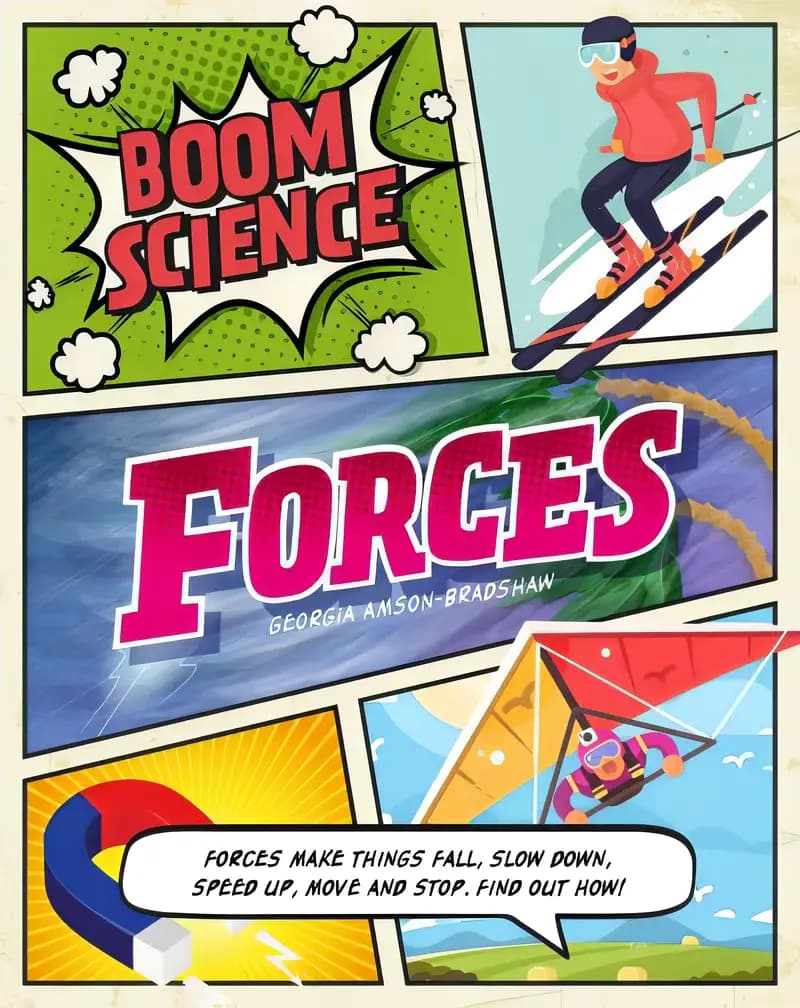
This essential KS2 series for children aged 7 and up covers key science topics such as air resistance, magnetism, and gravity in a quick-fire, energetic way. Each spread begins with a headline that succinctly summarizes the scientific information to follow, while attractive illustrations and light-hearted elements like jokes and cartoons engage young readers. The book encourages comprehension through direct explanations, visual aids, and interactive features such as riddles, pop quizzes, and simple experiments, making the concepts relatable and understandable for both classroom learning and everyday life. Anyone who learns about the force of gravity in our lives has probably wondered what it's like to be weightless. In this volume, readers can find out the incredible impact gravity and other forces, such as magnetism, have on their life every day. Each chapter gives an accessible overview of the topic and then invites readers to dive deeper with relatable photographs, diagrams, sidebars, and fun facts. Through riddles, pop quizzes, and simple experiments, the book encourages readers to engage with the information they're learning in order to understand it better for both class and life on Earth.
Series reading
Non-Sequential
Age
9-11
Length
32 pages
Text complexity
Discussion points
What are some examples of forces you noticed today? How did they affect things around you?
Can you think of a time when you used force to accomplish something? What happened?
How do you think understanding forces can help people in everyday life or in jobs they might have?
Why do you think it’s important to know about different types of forces like gravity or friction?
If you could invent a machine that uses a type of force, what would it do and how would it work?
Tip: Role play these questions
Before reading, ask your child what they already know about forces to activate their prior knowledge.
While reading, pause on pages with interesting illustrations or concepts and ask your child to explain what they see and how it relates to forces.
Relate the concepts in the book to real-life situations your child encounters, such as playing on a seesaw or sliding down a slide, to deepen understanding.
After reading, encourage your child to demonstrate what they’ve learned by experimenting with pushing and pulling toys.
Praise your child’s efforts to engage with the material, highlighting both their understanding and curiosity.
Key lessons
Example Lesson: Understanding Basic Physics Concepts
Explanation: Through engaging explanations and vibrant illustrations, 'Forces' simplifies concepts like gravity, friction, and magnetic forces, making them accessible and understandable.
Real-World Application: Children can apply these principles to everyday activities, such as understanding why objects fall down instead of floating away (gravity) or why they slide down slides quickly (friction).
Example Lesson: Importance of Inquiry and Curiosity
Explanation: 'Forces' encourages children to ask questions and explore how and why things work, fostering a scientific mindset.
Real-World Application: This can be applied in real life as children experiment with different objects to see how forces act on them, enhancing their problem-solving skills and curiosity.
Example Lesson: Critical Thinking and Analysis
Explanation: The book provides scenarios and examples that require children to think critically and analyze how different forces interact in varied situations.
Real-World Application: Kids can use these skills to make predictions and test their ideas about forces, which is essential not just in science, but in daily decision making.
Example Lesson: Learning Through Observation
Explanation: By observing illustrated examples of forces in action, children learn to connect theoretical knowledge with real-world observations.
Real-World Application: This lesson encourages children to be more observant about how everyday objects move and interact, enhancing their learning through day-to-day experiences.
Example Lesson: Teamwork in Learning
Explanation: The book suggests activities that kids can do with others, promoting collaborative learning and the sharing of ideas about forces.
Real-World Application: This encourages cooperative play and learning, where children can work together to explore concepts, discuss their observations, and learn from each other.