
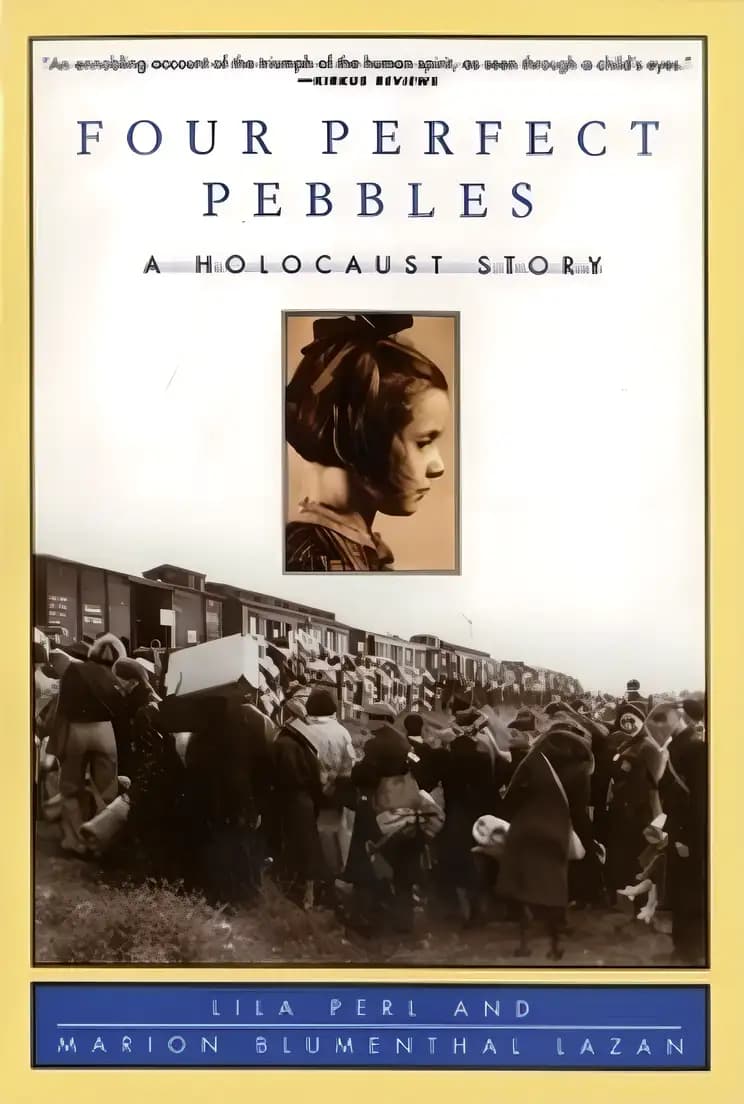
Four Perfect Pebbles: A True Story of the Holocaust
Avon Camelot Book S. Series
on Goodreads (6,979)
What’s inside...
The memoir 'Four Perfect Pebbles' by Marion Blumenthal Lazan recounts the harrowing years of the Blumenthal family during Nazi Germany. Despite the horror and hardship they endured, the family's story is also one of courage, hope, and survival. This twentieth-anniversary edition includes new material by the author, additional photographs, an epilogue, a reading group guide, and more, enriching the already devastating and powerful narrative of a childhood shaped by historical atrocities.
Series reading
Non-Sequential
Age
11-12
Length
144 pages
Text complexity
Character compass
Marion Blumenthal
Albert Blumenthal
Ruth Blumenthal
Walter Blumenthal
Discussion points
How do you think Marion felt during her experiences, and what would you have done in her situation?
What does this story teach us about hope and resilience?
Why is it important to remember and learn about events like the Holocaust?
How did Marion’s family support each other, and what does this tell us about the strength of family bonds?
Can you think of a time when you faced a big challenge and how you overcame it?
Tip: Role play these questions
Set a comfortable environment for discussion, perhaps reading together in a quiet space.
Encourage your child to express their feelings and thoughts, validating their emotions as they reflect on Marion’s story.
Connect the story’s themes to personal experiences or current events to make the conversation more relatable.
Highlight the importance of history and learn together about the Holocaust to provide context for the story.
Discuss the resilience and strength shown by individuals like Marion and relate it to qualities they can develop themselves.
Key lessons
Example Lesson: Resilience in the face of adversity
Explanation: The protagonist, Marion Blumenthal Lazan, showcases immense resilience and hope while enduring the harsh conditions of the Holocaust.
Real-World Application: Children can learn to maintain hope and strength even during challenging times, understanding that adversity can be overcome with perseverance.
Example Lesson: The importance of family
Explanation: Throughout the story, the bond between Marion and her family provides crucial emotional support and aids in their survival, highlighting the strength found in familial relationships.
Real-World Application: Children can appreciate and rely on their family ties, understanding the value of supporting and caring for each other in both good and bad times.
Example Lesson: Empathy and compassion
Explanation: Marion's story evokes a deep understanding and empathy for the suffering of others, encouraging readers to be mindful of the hardships faced by people around the world.
Real-World Application: Children can apply empathy in their daily interactions, promoting kindness and understanding towards peers who may be experiencing difficulties.
Example Lesson: Historical awareness
Explanation: The book provides factual insights into the events of the Holocaust, educating children on significant historical events and the consequences of hatred and prejudice.
Real-World Application: Children can become informed, conscientious citizens who understand the importance of learning history to ensure such atrocities are never repeated.
Example Lesson: Hope and optimism
Explanation: Despite the dire circumstances, Marion never loses hope for a better future, a theme that resonates throughout the book.
Real-World Application: Children can learn to remain optimistic and forward-looking, using hope as a tool to navigate and improve their own futures.