
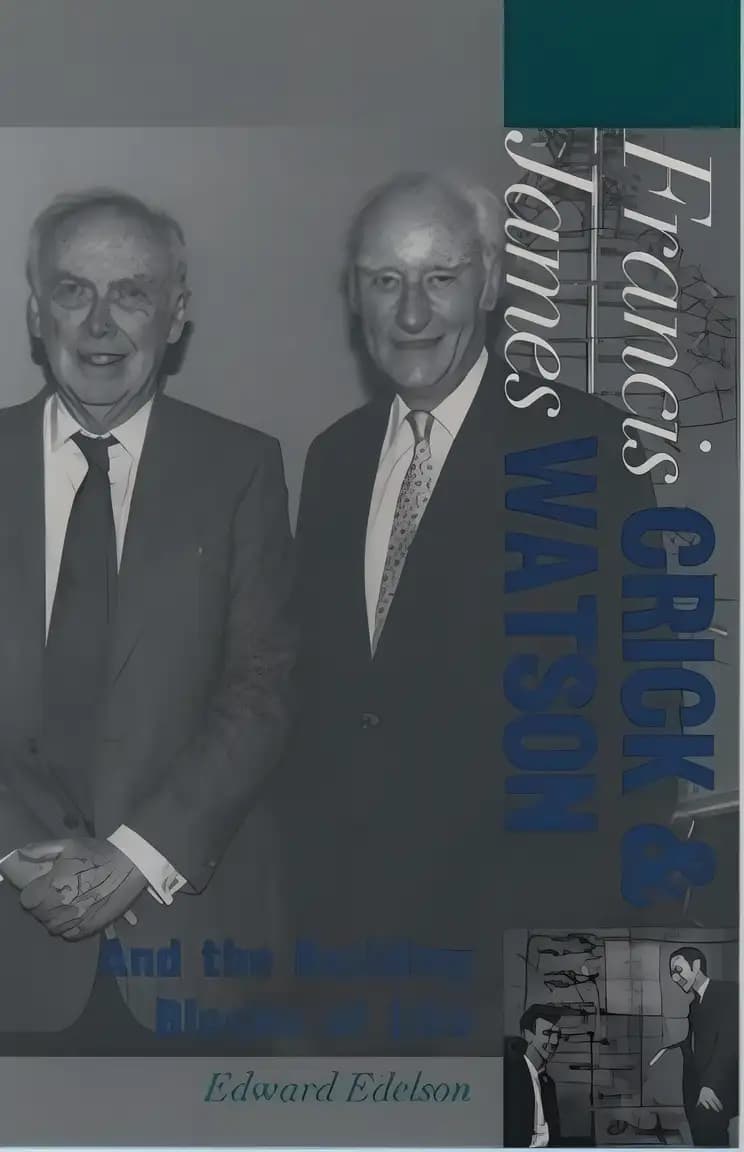
Francis Crick and James Watson: And the Building Blocks of Life (Oxford Portraits in Science)
Oxford Portraits In Science Series
on Goodreads (39)
What’s inside...
Edward Edelson's biography highlights the collaborative effort between James Watson and Francis Crick in uncovering the structure of DNA, a breakthrough that established the basis of molecular biology and led to advances such as early detection of genetic diseases and animal cloning. The book is part of the Oxford Portraits in Science series, aimed at young adults and presenting scientific biographies that explore both the personal traits and scientific achievements of its subjects, enriched with photographs, illustrations, and accessible technical information.
Series reading
Non-Sequential
Age
12-18
Length
112 pages
Text complexity
Character compass
James Watson
Francis Crick
Rosalind Franklin
Maurice Wilkins
Discussion points
What do you think motivated Watson and Crick to explore the structure of DNA?
How do you think their discovery has impacted our understanding of human biology?
Can you imagine what challenges they might have faced during their research?
Why do you think teamwork was important for Watson and Crick’s success?
If you could ask Watson and Crick one question, what would it be?
Tip: Role play these questions
Start the conversation by sharing a fun fact about DNA to pique your child’s interest.
Encourage your child to think critically by asking them how they would approach a big scientific question.
Relate the story to current events or recent scientific discoveries to make the discussion relevant.
Praise your child for insightful comments or interesting questions to encourage their participation.
Use simple analogies to explain complex topics discussed in the book.
Key lessons
Example Lesson: Perseverance and Dedication
Explanation: The story showcases how Crick and Watson dedicated themselves to solving the structure of DNA, despite numerous challenges.
Real-World Application: Children can learn the importance of staying committed to their goals, whether in academics, sports, or personal projects, even when faced with difficulties.
Example Lesson: Teamwork and Collaboration
Explanation: The discovery of DNA’s structure was made possible through the collaborative efforts of Crick, Watson, and other scientists like Rosalind Franklin.
Real-World Application: This teaches children the value of working together and respecting others’ contributions, skills that are vital in group projects and community involvement.
Example Lesson: Critical Thinking and Problem Solving
Explanation: The book details the scientific process and how Crick and Watson used critical thinking to form and test hypotheses about DNA.
Real-World Application: Children can apply these skills in their studies, developing hypotheses in science projects or solving complex problems in maths.
Example Lesson: Curiosity and the Quest for Knowledge
Explanation: Crick and Watson's relentless pursuit of understanding the molecular structure of DNA highlights the power of curiosity.
Real-World Application: Encourages children to ask questions and seek out answers about the world around them, fostering a lifelong love of learning.
Example Lesson: Ethical Responsibility
Explanation: The book touches on the ethical dimensions of scientific research, including the controversy regarding the use of Rosalind Franklin’s data.
Real-World Application: It sensitizes children to the importance of ethical conduct in all areas of life, including respecting others' work and giving credit where it’s due.