
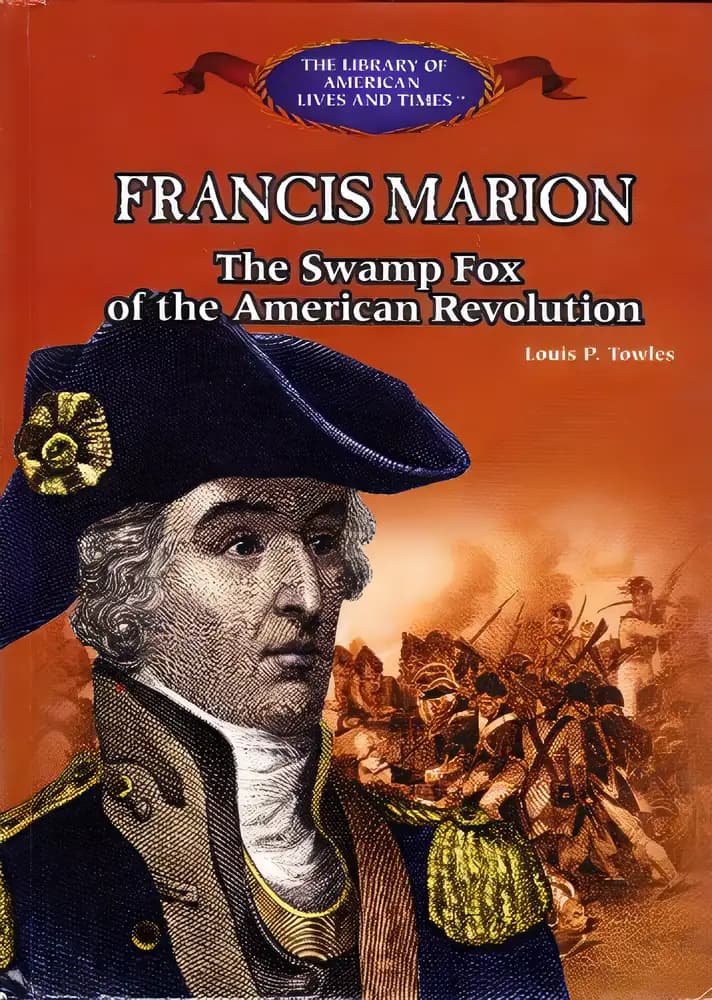
Francis Marion: The Swamp Fox of the American Revolution (The Library of American Lives and Times)
The Library Of American Lives And Times Series
What’s inside...
Discusses the life and career of Francis Marion, who was nicknamed the 'Swamp Fox' based on the strategy he used of hiding in the swamps to surprise attack British troops during the Revolutionary War.
Series reading
Non-Sequential
Age
9-12
Length
112 pages
Text complexity
Character compass
Francis Marion
Discussion points
What qualities make Francis Marion a hero in the story?
How do Francis Marion's strategies during the American Revolution show his intelligence and resourcefulness?
Why do you think people referred to Francis as 'The Swamp Fox'?
How did Francis Marion's actions impact the outcome of the American Revolution?
What would you have done if you were in Francis Marion's position during the war?
Tip: Role play these questions
Start the conversation by sharing what you found interesting about Francis Marion and ask your child what caught their attention in the book.
Encourage your child to think about the qualities of a hero by comparing Francis Marion with modern-day heroes.
Discuss the moral and ethical decisions made by Marion during the war, prompting your child to think about what they would have done in similar situations.
Highlight the significance of strategy and clever thinking, both in historical contexts and in everyday life, to help your child connect the dots.
Ask your child to draw parallels between the teamwork depicted in the book and instances where they have to work as part of a team (school projects, sports, etc.).
Key lessons
Example Lesson: Resilience in the face of adversity
Explanation: Francis Marion, known as the Swamp Fox, showcases remarkable resilience by utilizing guerrilla warfare tactics against the British during the American Revolution, despite being heavily outnumbered.
Real-World Application: Children can learn to persevere through challenges in their own lives, understanding that obstacles can be overcome with determination and innovative thinking.
Example Lesson: Importance of strategic thinking
Explanation: The book highlights Marion’s tactical genius in evading capture and disrupting British plans, demonstrating the effectiveness of adaptability and forethought in critical situations.
Real-World Application: Kids can apply strategic thinking in problem-solving tasks at school or in planning their activities, learning the value of forethought and adaptability.
Example Lesson: Leadership and teamwork
Explanation: Marion's ability to lead and inspire his militia group, fostering teamwork and a shared vision among diverse groups of people, is a central theme.
Real-World Application: Children can be encouraged to take lead in group projects and value each team member's input to achieve common goals, mirroring Marion’s leadership style.
Example Lesson: Moral integrity
Explanation: Despite the harsh conditions of war, Marion maintained a code of conduct that earned him respect from friends and foes alike; his moral integrity never wavered.
Real-World Application: This lesson teaches children the importance of sticking to one's principles and behaving ethically, even in difficult situations.
Example Lesson: Creativity and innovation
Explanation: Marion’s unconventional warfare methods were revolutionary at the time and showed his ability to think creatively to solve problems.
Real-World Application: Encourages children to think outside the box and come up with creative solutions in their daily challenges and play.