
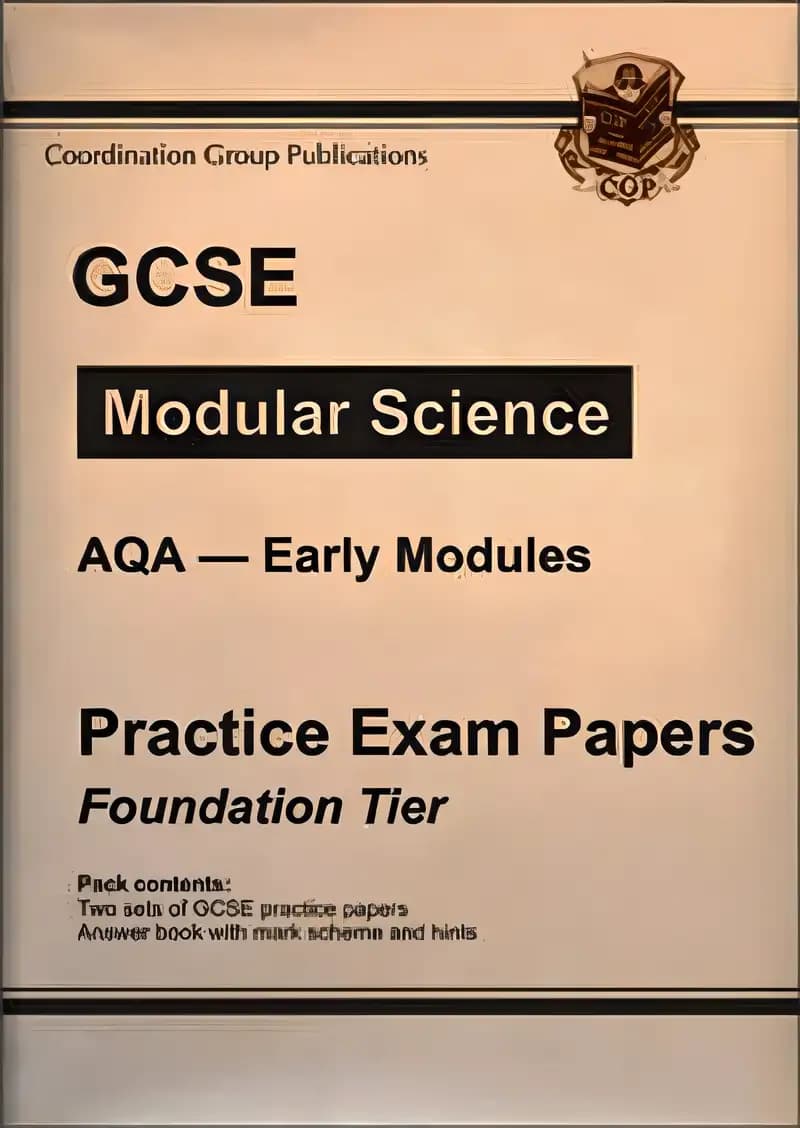
GCSE AQA Modular Science Practice Papers: Early Modules Foundation
What’s inside...
GCSE Modular Science, AQA - Early Modules, Practice Exam Papers - Foundation
Why read this book
- Tailored for foundational GCSE science understanding.
- Boosts exam confidence with practical practice papers.
- Aligns with AQA Modular Science specifications.
- Promotes academic discipline and focus.
Age
14-16
Length
112 pages
Text complexity
Discussion points
What did you find most interesting about the science concepts discussed?
How do you think the experiments mentioned in the book can be applied in real life?
Can you explain why understanding these foundational modules is important for future scientific learning?
Which scientific principle would you like to explore further and why?
How do you feel about your ability to solve the practice papers provided in the book?
Tip: Role play these questions
Encourage your child to relate the scientific concepts to everyday phenomena, which will enhance comprehension and retain interest.
Discuss the relevance of each module in practical situations, possibly conducting simple related experiments at home to deepen understanding.
Praise efforts in tackling complex subjects and encourage a growth mindset towards learning challenging material.
Use the practice papers within the book as a cooperative activity, where you can prompt thought and guide understanding without giving away the answers.
Show genuine interest in the topics by asking follow-up questions and possibly learning alongside your child.
Key lessons
Example Lesson: Importance of preparation and practice
Explanation: This book provides GCSE students with practice papers that help them prepare for their exams, demonstrating the value of consistent preparation.
Real-World Application: Children learn that regular practice and being well-prepared can help them achieve their goals in school and other areas of life.
Example Lesson: Critical thinking and problem-solving
Explanation: Through challenging science questions, students are encouraged to think critically and solve problems, skills essential in science and beyond.
Real-World Application: Children apply critical thinking to solve everyday problems and make informed decisions, boosting their independence and confidence.
Example Lesson: Understanding scientific concepts
Explanation: The book covers foundational scientific knowledge, helping students grasp basic concepts that are building blocks for more advanced science learning.
Real-World Application: This foundational knowledge helps children understand how the world works, sparking curiosity and fostering a lifelong love of learning.
Example Lesson: Time management
Explanation: By working through practice papers, students learn to manage their time effectively, an essential skill for completing exams within time limits.
Real-World Application: Effective time management can be applied to homework, chores, and recreational activities, helping children balance various aspects of their lives.
Example Lesson: Resilience through challenges
Explanation: Facing tough questions and learning from mistakes made on practice papers teach resilience and the importance of perseverance.
Real-World Application: Children learn to face academic and personal challenges without giving up, understanding that persistence is key to overcoming obstacles.