
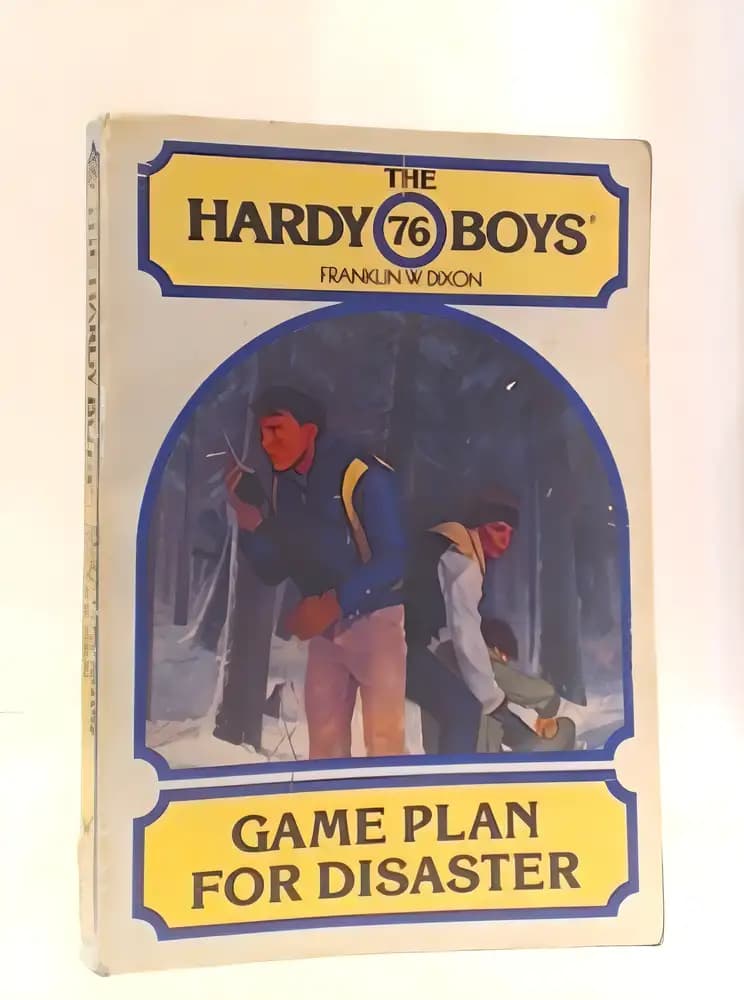
Game Plan for Disaster
#76 of 119 in Hardy Boys Series
What’s inside...
In 'Game Plan for Disaster', Franklin W. Dixon tells the story of brothers Frank and Joe Hardy as they embark on an exciting adventure after a video game prototype is stolen from a friend. As the Hardy boys use their detective skills to track down the thief and recover the stolen game, they also become involved in a parallel investigation into mysterious accidents targeting a college football star. The brothers find themselves ensnared in danger from both cases, showcasing their ability to unravel complicated situations and restore safety.
Character compass
Frank Hardy
Joe Hardy
Discussion points
What do you think Frank and Joe learned about teamwork during their adventures?
How would you handle a situation where you needed to solve a mystery with your friends?
What are some qualities that make Frank and Joe good detectives? Do you think these qualities are important in real life?
How do the characters in the book show courage and quick thinking in tough situations?
If you were part of the story, what would you have done differently in the face of danger?
Tip: Role play these questions
Start the conversation by sharing your own thoughts on the book to create an open, sharing environment.
Encourage your child to relate the book's scenarios to their personal experiences, which can provide deeper insights and connections.
Ask follow-up questions based on your child's responses to delve deeper into their thoughts and feelings about the story.
Discuss the moral and ethical choices characters made in the book to help children understand their importance.
Use praise to reinforce your child’s analytical thinking and express enthusiasm for their ideas to keep them engaged.
Key lessons
Example Lesson: Teamwork and collaboration
Explanation: Throughout the book, characters must work together to solve puzzles and succeed in their mission, highlighting the importance of teamwork.
Real-World Application: Children learn that by collaborating and supporting each other, they can achieve more and solve complex problems in school or during play.
Example Lesson: Critical thinking
Explanation: The protagonists often use logical reasoning and critical thinking to navigate challenges, teaching readers about the value of thoughtful decision-making.
Real-World Application: This encourages children to approach problems thoughtfully and consider multiple solutions, a skill useful in academic settings and everyday decisions.
Example Lesson: Responsibility
Explanation: Characters take responsibility for their actions and their roles in the team, promoting accountability.
Real-World Application: Children can apply this lesson by taking ownership of their chores, homework, and actions, understanding their impact on others.
Example Lesson: Resilience
Explanation: Despite setbacks, the characters persist in their goals, showcasing resilience.
Real-World Application: This teaches children the importance of persevering through difficulties, whether it's finishing a challenging task or managing personal setbacks.
Example Lesson: Integrity
Explanation: The heroes demonstrate honesty and strong moral principles, even when facing difficult choices.
Real-World Application: Children learn the importance of being truthful and maintaining moral integrity in both easy and tough situations.