
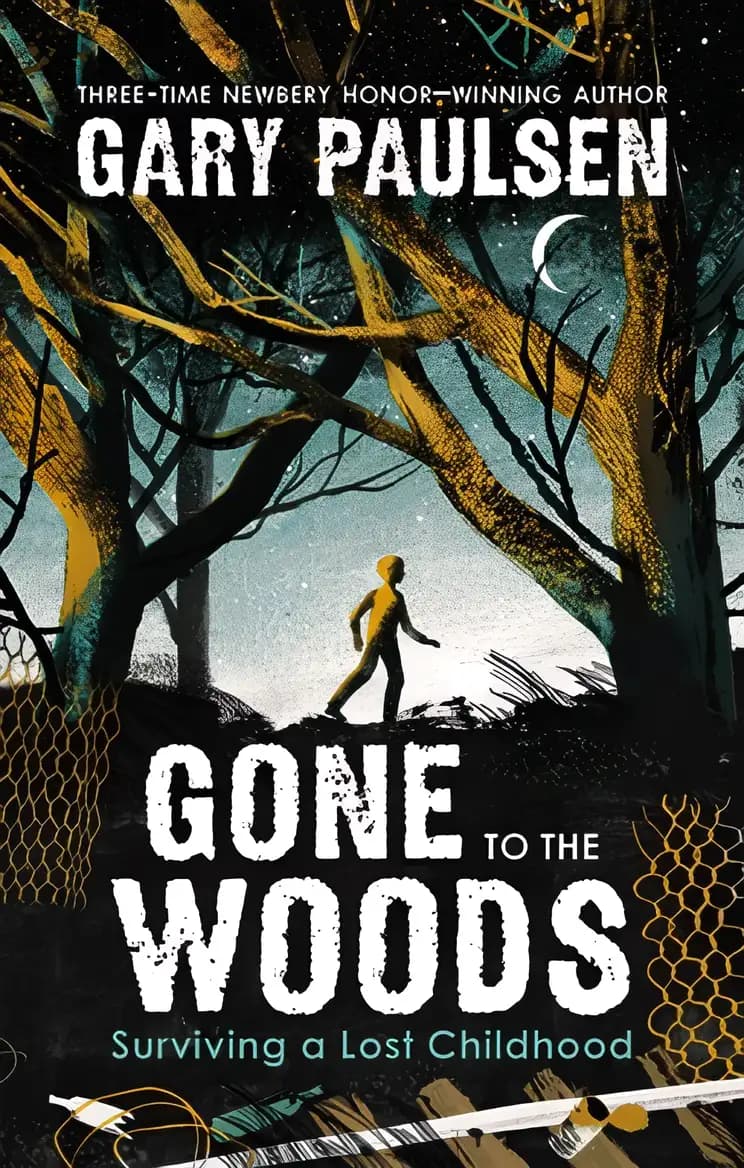
Gone to the Woods: Surviving a Lost Childhood
What’s inside...
In this autobiographical novel, Gary Paulsen recounts his experiences as a boy and young man, surviving in the wilderness and learning to understand nature. His adventures lead him to a profound self-discovery and shape his life as an adult. This mesmerizing memoir from three-time Newbery Honor–winning author Gary Paulsen―whose books have sold over 35 million copies worldwide―gives readers a new perspective on the origins of his blockbuster contemporary classic. The narrative also highlights significant life-altering moments from his turbulent childhood that played pivotal roles in shaping his future, such as escaping a neglectful upbringing, discovering the joy of reading through a librarian, and his enlistment in the Army which helped him find his calling as a storyteller.
Age
10-13
Length
368 pages
Text complexity
Character compass
Gary Paulsen
Gary'S Grandfather
Gary'S Mother
Discussion points
How do you think Gary felt when he was facing challenges in the wilderness? What would you have done in his place?
What does survival mean to you after reading Gary's story?
Which of Gary's experiences in the book did you find most surprising or inspiring? Why?
How do you think the natural environment influenced Gary's character and decisions?
What lessons can we learn from Gary’s journey about courage and resilience?
Tip: Role play these questions
While discussing the book, relate the survival skills Gary learns to everyday challenges children face, emphasizing resilience and adaptability.
Encourage your child to express what they felt about Gary’s adventures and if it changes their view on overcoming difficulties.
Ask your child to draw parallels between Gary’s experiences and any personal experiences of being outdoors or in new, challenging situations.
Discuss the importance of nature in our lives and how it can teach us important life skills, as it did for Gary.
Create a safe, open environment where children feel comfortable sharing their fears and learn how they can confront and overcome them, inspired by Gary's story.
Key lessons
Example Lesson: Resilience in the face of adversity
Explanation: The protagonist, Gary, demonstrates resilience through his survival in challenging circumstances, showcasing strength and adaptability.
Real-World Application: Children can learn to persevere through their personal challenges, whether they're dealing with academic difficulties or social conflicts.
Example Lesson: Self-reliance
Explanation: Gary learns to depend on himself in the wilderness, highlighting the importance of self-sufficiency and problem-solving.
Real-World Application: This lesson can encourage children to develop independence in completing tasks or making decisions without overly relying on others.
Example Lesson: Appreciation for nature
Explanation: The vivid descriptions of the natural surroundings emphasize a deep respect and appreciation for nature.
Real-World Application: Children can be encouraged to explore the natural world around them, fostering a sense of responsibility towards environmental conservation.
Example Lesson: The impact of kindness
Explanation: Throughout his journey, the moments of kindness that Gary experiences have profound impacts on his survival and personal growth.
Real-World Application: This can teach children the importance of being kind to others, as small acts of kindness can significantly impact someone's life.
Example Lesson: Adaptability
Explanation: Gary's constant adjustments to new and difficult situations illustrate the importance of being flexible and adapting to change.
Real-World Application: Children can learn to embrace change and adapt to new situations, such as moving to a new school or dealing with changes in the family.