
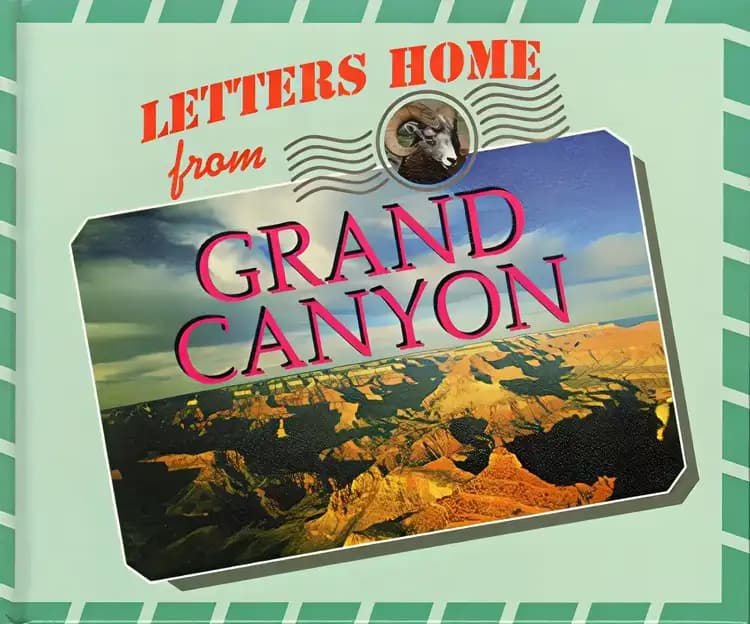
Grand Canyon
Letters home from-- Series
on Goodreads (1)
What’s inside...
Written as a letter sent home by a young person, each volume in this series weaves vital facts and statistics about America's national parks into a first-person narrative. The books aim to stimulate interest in travel, US history, geography, wildlife, conservation, and the environment. In this installment, experience Grand Canyon National Park through the eyes of a young traveler. Included are photos and sections on key locations and attractions such as the South Rim entrance, Mather Point, the descent of the South Wall, the Colorado River, river rafting, Anasazi, ancient Indians, Havasu Canyon/Falls, wildlife, trees and plants, Phantom Ranch, Bright Angel Creek, and the North Rim/Bright Angel Point.
Series reading
Non-Sequential
Age
8-10
Length
32 pages
Text complexity
Discussion points
What did you find most interesting about the Grand Canyon as described in the book?
How do you think the plants and animals adapt to live in the Grand Canyon?
Can you imagine what it would be like to explore the Grand Canyon yourself? What would you want to see the most?
The book talks about the history of the Grand Canyon. What do you think it would have been like to visit the canyon 100 years ago?
Tip: Role play these questions
Encourage your child to describe the Grand Canyon using their own words, fostering a deeper connection and understanding.
Compare the Grand Canyon to local natural landscapes to make the discussion more relatable and engaging.
Ask your child to draw their favorite scene or element from the book which can lead to a more vivid and personalized discussion.
Use the historical aspects of the Grand Canyon discussed in the book to dive into a mini history lesson, sparking curiosity and learning.
Key lessons
Example Lesson: The importance of nature conservation
Explanation: In 'Grand Canyon,' the beauty and ecological significance of the Grand Canyon are highlighted through vivid descriptions and engaging storytelling.
Real-World Application: Children can develop an appreciation for protecting natural landscapes and may be inspired to participate in local conservation efforts or learn more about ecology.
Example Lesson: Curiosity and lifelong learning
Explanation: The protagonist's journey through the Grand Canyon ignites curiosity about geology, history, and science.
Real-World Application: This encourages children to explore and ask questions about the world around them, fostering a love for learning that goes beyond the classroom.
Example Lesson: Resilience and perseverance
Explanation: As the characters face challenges during their exploration, they learn to persevere and overcome obstacles.
Real-World Application: Children are reminded that persistence is key to achieving goals and solving problems, skills applicable in school and life challenges.
Example Lesson: Teamwork
Explanation: The characters must work together to navigate the rugged terrain and solve problems they encounter, showcasing the power of teamwork.
Real-World Application: This can teach children the importance of cooperating with others to achieve common goals, whether in sports, school projects, or family activities.
Example Lesson: Respect for diversity
Explanation: The book touches on the diverse ecosystems within the Grand Canyon as well as its cultural significance to various Indigenous peoples.
Real-World Application: This lesson can help children appreciate cultural diversity and the importance of respecting different perspectives and histories.