
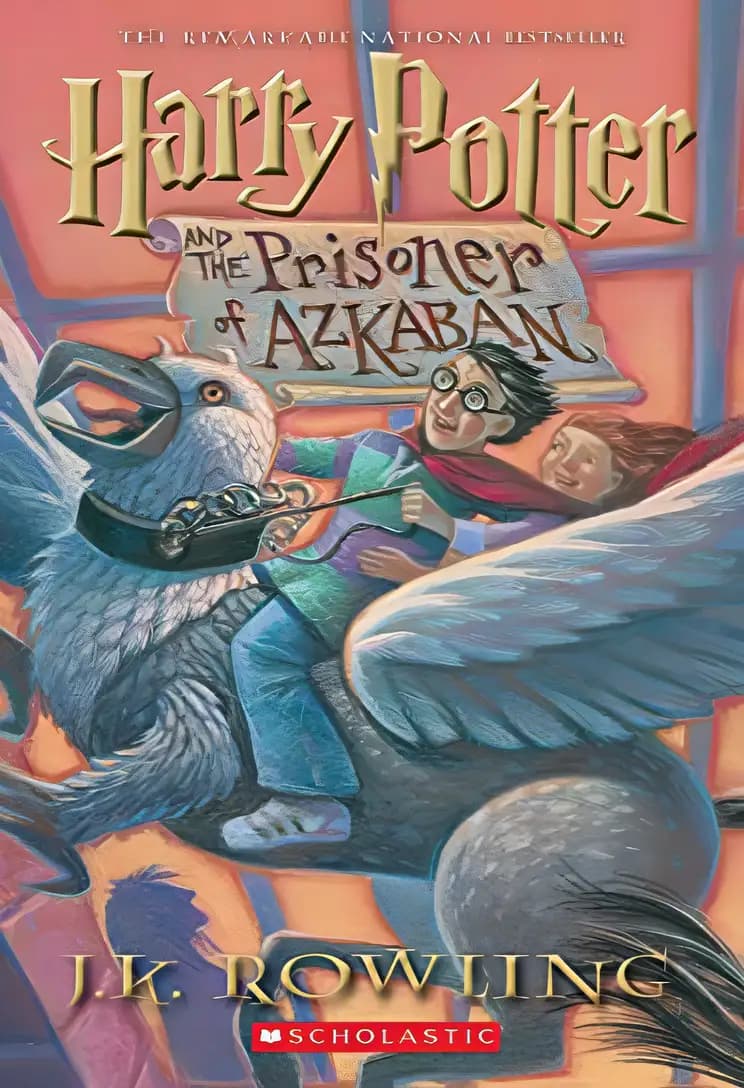
Harry Potter and the Prisoner of Azkaban
#3 of 7 in Harry Potter Series
on Goodreads (4,569)
What’s inside...
Harry Potter's third year at Hogwarts is filled with danger as he learns that the deranged killer Sirius Black has escaped from Azkaban prison and is after him. As Hermione's cat torments Ron's sickly rat, tensions rise among the trio. Dementors are sent to guard the school, and a mysterious new teacher helps Harry learn to defend himself. Meanwhile, Sirius Black's escape from Azkaban is linked to dark events, and suspicions of a traitor within Hogwarts loom.
Character compass
Harry Potter
Hermione Granger
George Weasley
Fred Weasley
Ron Weasley
Albus Dumbledore
Rubeus Hagrid
Remus Lupin
Minerva McGonagall
Severus Snape
Draco Malfoy
Peter Pettigrew
Filius Flitwick
Arthur Weasley
Ernie Prang
Dudley Dursley
Percy Weasley
Colin Creevey
Sirius Black
Marjorie Dursley
Sybil Trelawney
Stan Shunpike
Pansy Parkinson
Vernon Dursley
Pomona Sprout
Molly Weasley
Cornelius Fudge
Poppy Pomfrey
Dean Thomas
Seamus Finnigan
Rolanda Hooch
Katie Bell
Petunia Dursley
Cedric Diggory
Cho Chang
Oliver Wood
Ginny Weasley
Neville Longbottom
Sybill Trelawney
Discussion points
How did Harry's experiences with the Dementors make you feel, and why do you think that is?
In what ways did the characters show bravery, and which acts of courage stood out to you the most?
How can the friendships in the story teach us about trust and loyalty in our own lives?
What lessons can we learn about facing our fears from the way Harry dealt with his challenges?
Tip: Role play these questions
Encourage your child to draw parallels between the characters' adventures and their own experiences.
Discuss the moral implications of the character's choices, promoting empathy and ethical reasoning.
Use the concept of the Patronus as a metaphor to talk about personal strengths and positivity.
Create a supportive environment for open expression, validating your child's thoughts and feelings.
Key lessons
Example Lesson: The importance of empathy and understanding
Explanation: In 'Harry Potter and the Prisoner of Azkaban,' Harry learns the truth about Sirius Black's relationship with his parents, which changes his perception of him entirely. This shift teaches readers that people are not always what they seem.
Real-World Application: Children can learn to appreciate the importance of getting to know someone before forming an opinion, promoting more empathetic interactions in their daily lives.
Example Lesson: The value of loyalty and friendship
Explanation: Throughout the book, Harry, Ron, and Hermione demonstrate unwavering loyalty to each other, even when facing dangerous situations. This loyalty strengthens their friendship and helps them overcome challenges together.
Real-World Application: This lesson encourages children to be supportive and reliable friends in their own lives, understanding the significance of trust and teamwork in building strong relationships.
Example Lesson: The significance of resilience and courage
Explanation: Harry faces various adversities in 'The Prisoner of Azkaban,' including dementors and the revelation of Sirius Black's true story. His bravery in confronting these challenges head-on is a key theme.
Real-World Application: Children are inspired to face their own fears and challenges with courage, understanding that resilience is key to overcoming obstacles.
Example Lesson: The importance of critical thinking and questioning assumptions
Explanation: The plot of 'The Prisoner of Azkaban' revolves around misconceptions and the uncovering of truths, highlighting the need for questioning and critical analysis.
Real-World Application: This teaches children to not take things at face value and encourages them to ask questions and think critically about the information they receive.