
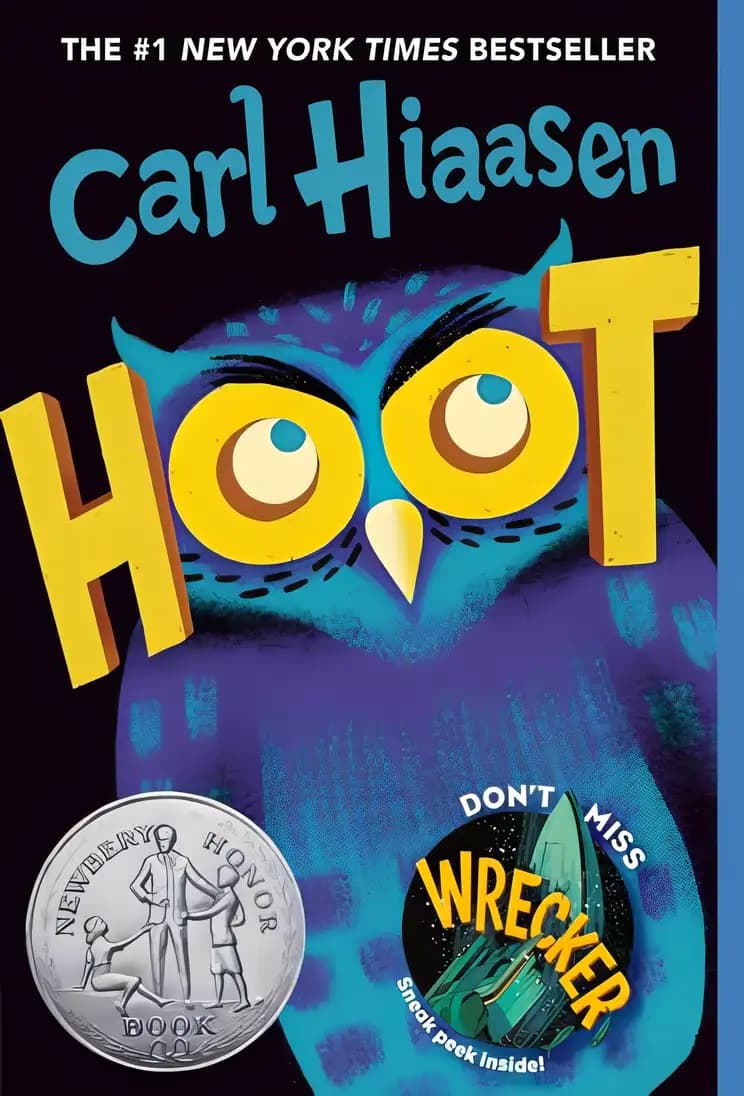
Hoot
on Goodreads (108,746)
What’s inside...
The novel takes place in South Florida, where new arrival Roy makes two oddball friends and a bad enemy, and joins an effort to stop construction of a pancake house which would destroy a colony of burrowing owls who live on the site. This Newbery Honor winner is set in Carl Hiaasen's Florida, where Roy's adventures begin after encountering a bully named Dana Matherson. Observing a shoeless running boy from the school bus, Roy is drawn into a mystery filled with potty-trained alligators, a fake-fart champion, burrowing owls, a renegade eco-avenger, and dangerously sparkling snakes.
Age
9-12
Length
320 pages
Text complexity
Character compass
Roy Eberhardt
Beatrice Leep
Officer David Delinko
Napoleon Bridger (Mullet Fingers) Leep
Mr. Eberhardt
Dana Matherson
Leroy 'Curly' Branitt
Chuck Muckle
Mullet Fingers
Discussion points
What do you think motivated Roy to stand up for the owls and their habitat?
How do the different characters in the book show courage or fear? Can you relate to any of them?
Why is it important to protect wildlife and natural habitats? How does this book inspire you to help?
What would you do if you were in Roy's situation? Would you make the same choices or different ones?
Tip: Role play these questions
Start by sharing your own thoughts about the book’s environmental themes and ask your child for their opinion.
Encourage your child to think about the real-life implications of the story by connecting it to current environmental issues.
Use examples from the book to discuss the importance of taking action and standing up for what you believe in.
Show interest in your child's responses and encourage them to elaborate on their thoughts and feelings about the story.
Key lessons
Example Lesson: Environmental Awareness
Explanation: In 'Hoot', the narrative centers around young protagonists striving to save a burrowing owl habitat from being destroyed by a construction project. This plot teaches children about the importance of environmental conservation.
Real-World Application: Children can apply this lesson by participating in local clean-up events, recycling, and learning more about local wildlife and how to protect it.
Example Lesson: Standing Up For What You Believe In
Explanation: The characters in the book take action against what they believe to be wrong, showcasing courage and determination. This serves as a powerful model for children about the impact of standing firm on their beliefs.
Real-World Application: This can translate to children confidently expressing their opinions or disagreements in school projects or other group settings in a respectful manner.
Example Lesson: Teamwork and Collaboration
Explanation: The success of the characters' plan relies heavily on working together and combining their strengths. This highlights the value of collaboration and teamwork.
Real-World Application: Children can implement this by participating in team sports, group school projects, or collaborative games, learning to value each team member's contributions.
Example Lesson: Empathy and Understanding
Explanation: Throughout the book, characters develop empathy as they understand more about each other's lives and perspectives, particularly through the struggles they face.
Real-World Application: Children can be encouraged to be more open and understanding towards their peers who might be different or are going through tough times.
Example Lesson: Resilience and Perseverance
Explanation: The young protagonists face numerous challenges but remain persistent in their goal to save the owls. This demonstrates the importance of resilience and perseverance.
Real-World Application: This lesson can be applied to a child's everyday life through persisting with challenging subjects at school or continuing to practice a difficult skill in their extracurricular activities.