
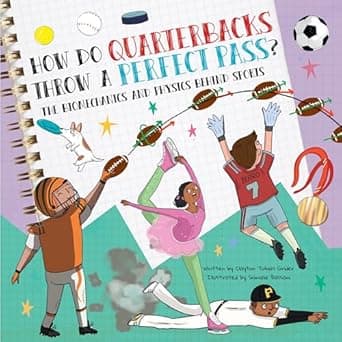
How Do Quarterbacks Throw a Perfect Pass?: The Biomechanics and Physics Behind Sports
How Do Series
What’s inside...
Clayton Grider’s engaging non-fiction title invites young readers onto the gridiron and into the science lab to discover how a seemingly simple forward pass combines bone, muscle, motion, air resistance, and a dash of high-tech data tracking. Using real-world examples from youth leagues, college programs, and the NFL, the book explains force, torque, angles, spiral spin, and aerodynamics in clear, age-appropriate language. Interactive diagrams, short experiments, and athlete interviews show children how science and perseverance work together on every snap, ultimately encouraging them to marvel at both the human body and the laws of physics.
Series reading
Non-Sequential
Age
7-10
Length
32 pages
Text complexity
Discussion points
How does understanding physics change the way you view sports?
Which experiment surprised you the most and why?
How can data tracking help athletes stay safe?
What parallels do you see between quarterback drills and your own hobbies?
Tip: Role play these questions
Throw a soft football together and observe spiral quality.
Pause after diagrams to let children teach you the concept back.
Relate perseverance in sports to schoolwork challenges.
Key lessons
Example Lesson: Knowledge accelerates improvement
Explanation: Quarterbacks refine technique faster once they understand biomechanics.
Real-World Application: Students can use feedback and facts to practice any skill effectively.
Example Lesson: Perseverance beats instant talent
Explanation: Profiles show average athletes succeeding through consistent drills.
Real-World Application: Encourages sticking with challenging homework or music practice.
Example Lesson: Teamwork includes scientists and coaches
Explanation: Physicists, trainers, and players collaborate for peak performance.
Real-World Application: Illustrates that group projects require varied roles and respect.
Example Lesson: Data guides safer play
Explanation: Smart sensors detect fatigue and prevent over-throw injuries.
Real-World Application: Teaches kids to listen to their bodies and use information wisely.