
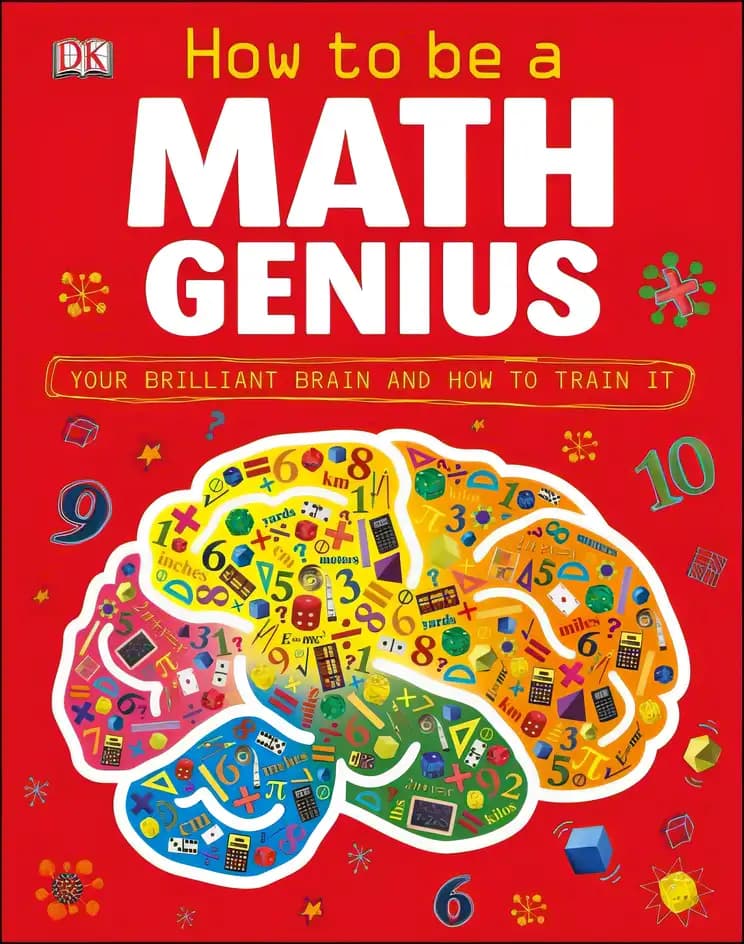
How to Be a Math Genius: Your Brilliant Brain and How to Train It
What’s inside...
Learn how your amazing brain works and give it a power boost with a variety of exciting challenges, puzzles and codes to crack! In this compelling math book, young readers previously daunted by algebra, logic, algorithms, and all things math will discover they are better at it than they thought. The book introduces the wonders of numbers through amazing algebra, puzzling primes, super sequences, and special shapes. Engage in a variety of activities, meet historical mathematical figures, and combine fun with facts in this all-encompassing guide. Whether a novice or a numbers nerd, train your brain to excel with tests, activities, and loads of science project ideas. This educational book opens the world of numbers through understanding your brain, discovering number patterns, exploring magic squares, infinity, and number tricks, making it perfect for any classroom or as a gift to motivate learning math.
Age
10-17
Length
128 pages
Text complexity
Discussion points
What's the most surprising thing you learned about how our brains work with numbers?
Can you think of a fun way to use math in our everyday activities?
Which mathematical genius from the book did you find most interesting and why?
How do you think learning more about math can help us in the future?
If you could invent a new way to solve a math problem, what would it be?
Tip: Role play these questions
Relate the math concepts in the book to everyday tasks such as cooking or shopping to make them more tangible and exciting.
Ask open-ended questions that encourage your child to express their thoughts and connect the material to their personal experiences.
Praise their curiosity and efforts to understand the challenging concepts to boost their confidence in learning math.
Suggest drawing or creating visual aids together that represent various mathematical ideas from the book to make the concepts more clear and enjoyable.
Key lessons
Example Lesson: The power of problem solving
Explanation: The book equips children with strategies to tackle mathematical problems, encouraging them to think critically.
Real-World Application: This ability to problem-solve is applicable in daily life scenarios such as following a recipe or managing time for homework.
Example Lesson: Developing a growth mindset
Explanation: By portraying math challenges as fun and achievable, the book fosters a positive attitude towards learning and growth.
Real-World Application: A growth mindset helps children approach all learning opportunities with enthusiasm and resilience, whether in academics, sports, or arts.
Example Lesson: Understanding the relevance of math in the real world
Explanation: Through various examples, the book demonstrates how math is integral to everyday activities and various careers.
Real-World Application: Children can relate their math skills to tasks such as budgeting their allowance or measuring ingredients while cooking, enhancing their practical life skills.
Example Lesson: Encouragement of curiosity and exploration
Explanation: This book invites readers to explore and experiment with different mathematical concepts, stimulating curiosity.
Real-World Application: Fostering curiosity can lead children to explore other STEM fields and encourage lifelong learning and exploration.