
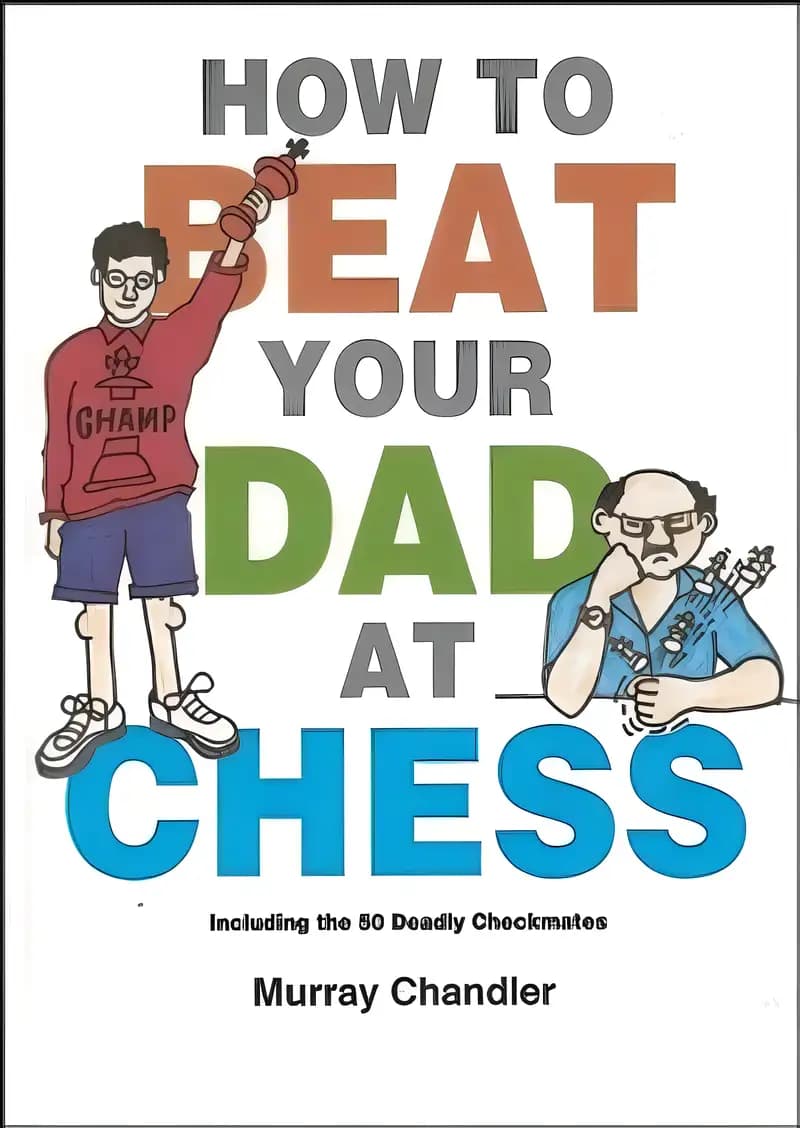
How to Beat Your Dad at Chess (Chess for Kids)
Chess For Kids Series
on Goodreads (508)
What’s inside...
This is a chess book for everyone, from eight to eighty, beginner to master. In a clear, easy-to-follow format it explains how the best way to beat a stronger opponent (be it a friend, clubmate - or Dad!) is by cleverly forcing checkmate. Delightful and instructive positions from real games are used to show the 50 Deadly Checkmates that chess masters use to win their games. For the beginner, simply learning the checkmating ideas and enjoying the examples will help develop the tactical skills needed to carry out attacks, combinations and sacrifices. For the advanced player, many of these checkmating ideas will come as a revelation, having never been categorized before. Experts agree that pattern-recognition is vital to success in chess, and this book provides a wealth of valuable patterns. 'How to Beat Your Dad at Chess' makes improving easy and fun, and is full of helpful explanations and practical advice on how to approach chess games with confidence - and success. Grandmaster Murray Chandler finished second in the World Cadet Championship in 1976, ahead of Garry Kasparov, whom he defeated in their individual game. He remains to this day one of the few players in the world with a 100% score against Kasparov. He was a key member of the England team that won the silver medals in Chess Olympiads three times during the 1980s, and went on to captain the team in 1994. He is a former proprietor and Editor-in-Chief of the British Chess Magazine and the author of several bestselling chess books.
Series reading
Non-Sequential
Age
8-13
Length
128 pages
Text complexity
Discussion points
What is one new chess strategy you learned from this book?
How does it feel when you make a smart move in chess?
Do you think playing chess can help you make better decisions in other areas of your life?
How do you think practicing chess could help improve your problem-solving skills?
Tip: Role play these questions
As your child discusses chess strategies, show genuine interest and ask them to explain how each move works.
Encourage your child to set up a chess board and demonstrate the new techniques they've learned, offering praise for their understanding and skills.
Relate strategies from the chess game to real-life scenarios to help your child see the practical applications of strategic thinking.
Celebrate improvements in your child's chess abilities, reinforcing that perseverance and practice are key to mastering new skills.
Key lessons
Example Lesson: Strategic Thinking
Explanation: The book provides various chess tactics and strategies, teaching children how to think several moves ahead.
Real-World Application: Children learn to anticipate outcomes and plan accordingly in daily situations, enhancing their problem-solving skills.
Example Lesson: Patience and Perseverance
Explanation: Learning and mastering the complex game of chess requires patience and dedication, as illustrated through the gradual skill development portrayed in the book.
Real-World Application: Children apply these virtues by persistently working through challenges at school or when learning new skills.
Example Lesson: Sportsmanship
Explanation: The book emphasizes the importance of gracious winning and losing, reflecting the respectful attitude chess players should maintain.
Real-World Application: This lesson helps children handle wins and losses gracefully in sports and other competitive environments.
Example Lesson: Concentration and Focus
Explanation: Chess demands high levels of focus to predict and counter opponents' moves, a skill that is consistently highlighted throughout the book.
Real-World Application: Children can transfer this enhanced focus to academic studies and other activities that require sustained attention.
Example Lesson: Analytical Skills
Explanation: The book encourages breaking down complex chess problems into manageable parts, fostering analytical thinking.
Real-World Application: This skill aids children in deconstructing complex problems in mathematics, science, and critical thinking tasks.