
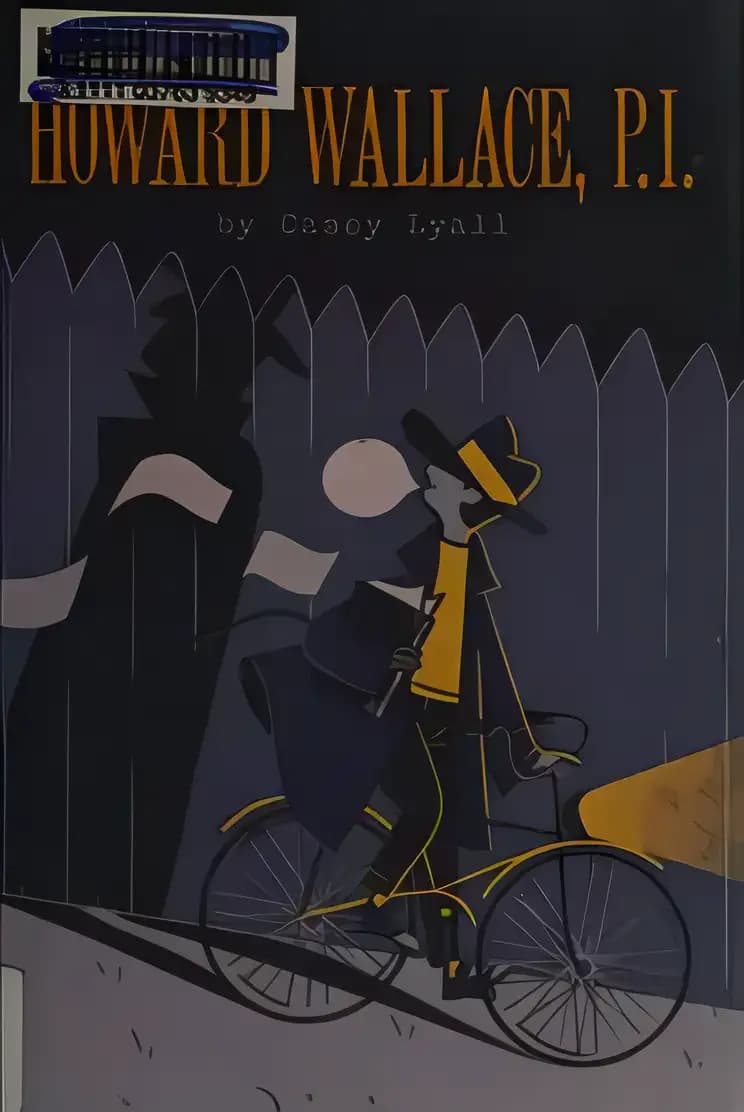
Howard Wallace, P.I.
#1 in Howard Wallace, P.I. Series
on Goodreads (522)
What’s inside...
';Lyall's debut is a winner.' Publishers Weekly';What's with the get-up? Is that the company uniform or something?' ';This? All P.I.s wear a trench coat.' ';Dude, that's a brown bathrobe.' I shrugged and straightened out my sleeves. ';First rule of private investigation, Ivy: work with what you've got.'Twelve-year-old Howard Wallace lives by his list of rules of private investigation. He knows more than anyone how to work with what he's got: a bathrobe for a trench coat, a makeshift office behind the school equipment shed, and not much elseleast of all, friends. So when a hot case of blackmail lands on his desk, he's ready to take it on himself . . . until the new kid, Ivy Mason, convinces him to take her on as a junior partner. As they banter through stakeouts and narrow down their list of suspects, Howard starts to wonder if having Ivy as a sidekickand a friendis such a bad thing after all.Named a Book Riot middle-grade book for the summer with special recommendation for reluctant readers! Winner of the Red Cedar Book Award for Fiction!
Character compass
Howard Wallace
Ivy Mason
Miles Fletcher
Discussion points
What qualities make Howard Wallace a good detective? How do you think these qualities help him solve mysteries?
If you were to assist Howard Wallace in a case, what role would you want to play and why?
How do the relationships between Howard and the other characters develop throughout the story? What do these relationships teach us about friendship and trust?
What challenges does Howard face and how does he overcome them? Can you relate to any of these challenges in your own life?
How does the setting influence the story? Can you imagine how different the story might be in another setting?
Tip: Role play these questions
Encourage your child to compare and contrast their personality with Howard Wallace's, discussing how their unique traits could also be useful in solving mysteries.
Discuss the moral dilemmas presented in the book and ask your child how they would handle similar situations, reinforcing the importance of ethical decision-making.
Highlight passages that vividly describe the settings and ask your child to visualize and describe their own version. This can enhance their creative and descriptive skills.
After finishing a chapter, pause and predict the next steps in the mystery with your child, encouraging analytical thinking and engagement with the plot.
Conclude your discussions with reflections on the lessons learned from the story, and how these lessons can be applied to your child's everyday experiences.
Key lessons
Example Lesson: The importance of honesty and integrity
Explanation: Howard Wallace, the young detective protagonist, demonstrates honesty and integrity as he solves cases. He adheres to a strong moral code, choosing to do the right thing even when it's difficult.
Real-World Application: Children can apply these values by being truthful and standing by their principles in their daily interactions with family and peers.
Example Lesson: The value of friendship and teamwork
Explanation: Throughout the book, Howard learns to collaborate with his friends to solve mysteries. The story highlights how teamwork can lead to success and problem resolution.
Real-World Application: Children can learn to work cooperatively in group settings such as school projects or sports, understanding that combining efforts can lead to better outcomes.
Example Lesson: Critical thinking and problem-solving skills
Explanation: As a detective, Howard frequently uses critical thinking to analyze clues and solve cases. This promotes a mindset of investigation and logical reasoning.
Real-World Application: Kids can utilize these skills to make thoughtful decisions and solve problems in academic settings or in resolving everyday conflicts.
Example Lesson: The significance of perseverance
Explanation: Howard often faces challenges and setbacks in his detective work, but he persists and does not give up easily, demonstrating resilience.
Real-World Application: This lesson teaches children the importance of persistence in overcoming obstacles, whether in learning new skills or facing personal challenges.