
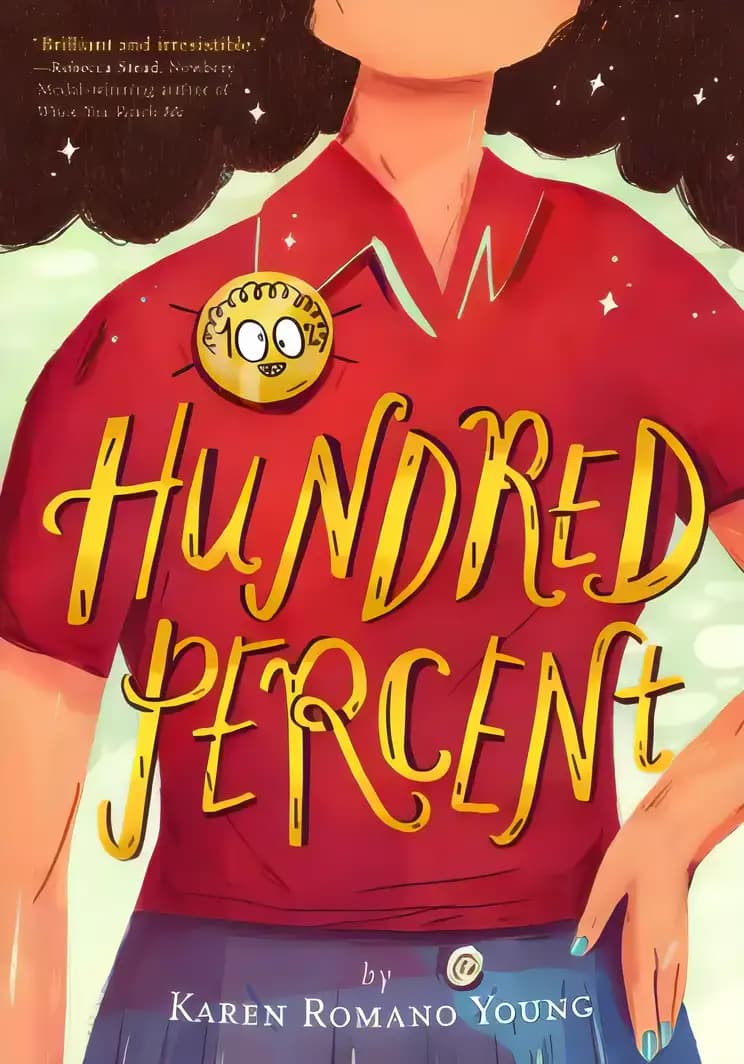
Hundred Percent
on Goodreads (264)
What’s inside...
The last year of elementary school is big for every kid. In this novel, equal parts funny and crushing, utterly honest and perfect for boys and girls alike, Christine Gouda faces change at every turn, starting with her own nickname—Tink—which just doesn't fit anymore. Readers will relate to this strong female protagonist whose voice rings with profound authenticity and absolute novelty, and her year's cringingly painful trials in normalcy—uncomfortable Halloween costumes, premature sleepover parties, crushed crushes, and changing friendships. Throughout all this, Tink learns, what you call yourself, and how you do it, has a lot to do with who you are.
Age
8-12
Length
304 pages
Text complexity
Character compass
Christine "Tink" Gouda
Jackie Irwin
Discussion points
How does Tink's experience at school compare to your own? Can you relate to her feelings and challenges?
What do you think about Tink's friendship with Jackie? How do friendships change as we grow older?
Why do you think Tink feels pressure to figure out who she is? How do you think knowing ourselves helps us in life?
This book explores different types of talents. What talents do you see in yourself and others around you?
How do Tink's relationships with her family influence her throughout the story?
Tip: Role play these questions
Encourage your child to express their feelings about school and friendships, relating them to Tink's experiences.
Discuss the evolution of friendships and the importance of accepting changes, using Tink and Jackie's friendship as a reference point.
Explore the concept of self-identity and discuss how your child perceives themselves and their place in different groups or settings.
Identify and celebrate your child's talents, drawing parallels to the characters in the book to boost their self-esteem and confidence.
Talk about family dynamics and how family support can shape one's confidence and decision-making, reflecting on Tink's interactions with her family.
Key lessons
Example Lesson: Self-acceptance
Explanation: The protagonist, Tink, navigates through her sixth-grade year, learning to accept her unique qualities and the changes within herself.
Real-World Application: Children can learn to appreciate their own uniqueness and embrace personal growth, fostering self-confidence and self-esteem in their everyday interactions.
Example Lesson: Value of friendship
Explanation: Throughout the book, Tink learns the importance of understanding and loyalty in her friendships, even when challenges arise.
Real-World Application: This lesson helps children recognize the significance of supporting and accepting their friends, promoting healthy and supportive relationships.
Example Lesson: Impact of empathy
Explanation: Tink shows empathy towards her classmates and friends, helping her to build stronger connections and resolve conflicts.
Real-World Application: Children are encouraged to practice empathy, enhancing their ability to connect with others and navigate social situations effectively.
Example Lesson: Dealing with change
Explanation: As Tink transitions from childhood to adolescence, she encounters various changes that she learns to cope with constructively.
Real-World Application: This prepares children to handle transitions and changes in their lives, equipping them with the resilience to adapt.
Example Lesson: Expressing oneself
Explanation: Tink discovers her voice through poetry and personal expression, which aids her in dealing with her emotions and conflicts.
Real-World Application: Encourages children to find creative outlets for expression such as art, writing, or music, promoting emotional health and personal discovery.