
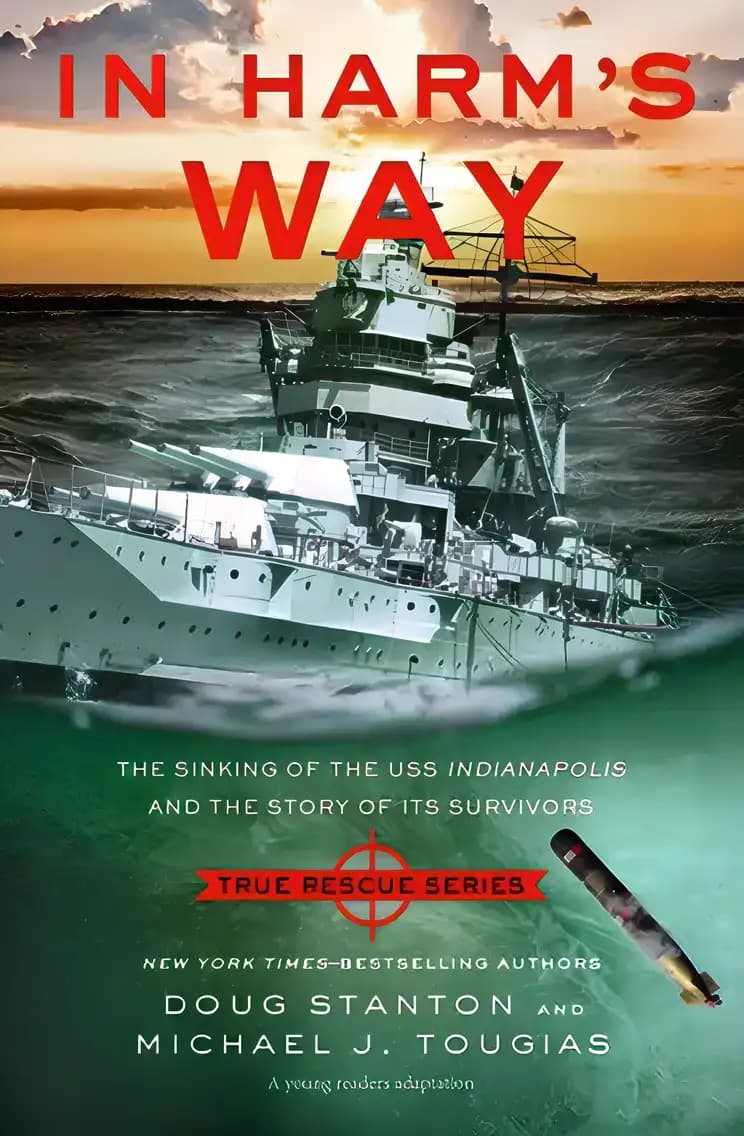
In Harm's Way (Young Readers Edition)
#5 of 6 in True Rescue (Young Readers Editions) Series
on Goodreads (114)
What’s inside...
A young readers edition of Doug Stanton and Michael J. Tougias' New York Times bestseller In Harm’s Way, this riveting World War II account details the greatest maritime disaster in US naval history. On July 30, 1945, the U.S.S. Indianapolis was torpedoed by a Japanese submarine, leading to the death of around 300 men upon impact and casting close to 900 sailors into the Pacific Ocean. These sailors struggled to survive for nearly four days against sharks, hypothermia, and hallucinations before being rescued, with only 316 surviving. The book also explores the subsequent court-martial of the captain and the failures of the navy, providing a masterful account of heroism and survival that is both inspiring and unforgettable.
Character compass
Captain Charles B. Mcvay Iii
Edgar Harrell
Marine Giles Mccoy
Dr. Lewis Haynes
Discussion points
How do you think the crew felt when they were facing such dangerous conditions at sea?
What qualities do you think a person needs to have to be brave and strong in difficult situations like the ones in the book?
Why do you think teamwork was important for the survival of the ship's crew?
Can you think of a time when you had to overcome a difficult situation? What helped you get through it?
Tip: Role play these questions
Encourage your child to put themselves in the shoes of the crew members by asking how they would feel in similar situations.
Discuss the importance of bravery and resilience, and relate those themes to everyday challenges your child might face.
Highlight the significance of teamwork and ask your child about times they had to work together with others to achieve a common goal.
Use examples from the book to talk about problem-solving and critical thinking, asking your child how they would have handled certain challenges presented in the story.
Key lessons
Example Lesson: Bravery in the face of danger
Explanation: The true story details the courageous acts of the Coast Guard during a daring rescue mission, showing the crew facing extreme weather conditions and perilous situations.
Real-World Application: Children can learn to act courageously and make brave choices even in difficult or intimidating scenarios in their own lives.
Example Lesson: Teamwork and cooperation
Explanation: Throughout the rescue operation, the crew members must work together seamlessly to navigate and overcome the challenges they face.
Real-World Application: This teaches children the importance of collaborating and supporting others, skills that are applicable in group projects at school or in team sports.
Example Lesson: Problem-solving under pressure
Explanation: The crew faces various unexpected problems that require quick thinking and innovative solutions, showcasing their ability to adapt and think critically.
Real-World Application: Kids can apply this lesson by learning to stay calm and think clearly when faced with challenges, whether in their academic work or personal decisions.
Example Lesson: Persistence and resilience
Explanation: The story illustrates the crew’s perseverance through setbacks and their unwavering commitment to their mission, despite numerous obstacles.
Real-World Application: Children can be encouraged to persist in their efforts, whether in learning new skills, improving at a sport, or achieving academic goals.
Example Lesson: Moral responsibility
Explanation: The Coast Guard's mission exemplifies a deep sense of duty and responsibility towards saving lives.
Real-World Application: This can inspire children to understand the importance of helping others and taking responsibility in their own actions, whether it's being accountable in small tasks or bigger moral decisions.