
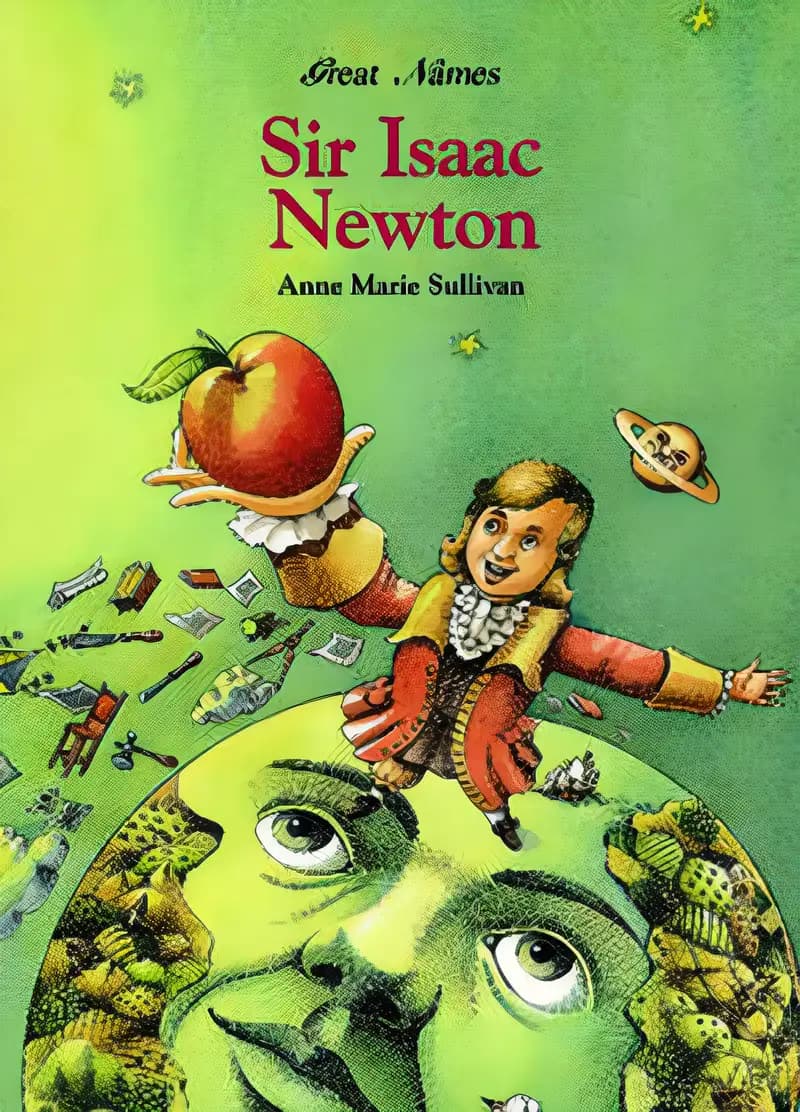
Isaac Newton
Great names Series
on Goodreads (5)
What’s inside...
Chronicles the life of the English scientist whose studies of the natural world led him to discover laws of physics that made possible many of the developments of modern technology.
Series reading
Non-Sequential
Age
8-10
Length
32 pages
Text complexity
Character compass
Isaac Newton
Discussion points
What are some ways Isaac Newton's discoveries still affect our daily lives today?
How do you think curiosity helped Isaac Newton make his discoveries?
If you could ask Isaac Newton one question about his work, what would it be?
Why do you think it’s important to learn about scientists like Isaac Newton?
How do you think Isaac Newton felt when he made his discoveries?
Tip: Role play these questions
Encourage your child to think critically by asking them how they would approach the problems Newton faced.
Relate the story to modern day by discussing current scientific discoveries and the people behind them.
Use everyday examples to explain Newton's laws of motion, such as playing catch (gravity) or riding in a car (inertia).
After reading, ask your child to draw a picture or write a short story about Isaac Newton's adventures in science.
Promote empathy by discussing the challenges Newton faced and how he overcame them.
Key lessons
Example Lesson: Curiosity and lifelong learning
Explanation: The book portrays Isaac Newton's insatiable curiosity and relentless pursuit of knowledge, from his fascination with the natural world to his revolutionary scientific experiments.
Real-World Application: Encourages children to ask questions, explore diverse interests, and appreciate the value of continuous learning in their daily lives.
Example Lesson: Resilience in the face of adversity
Explanation: Newton encountered numerous challenges, including personal losses and professional rivalries. However, his perseverance in overcoming these obstacles is highlighted throughout the narrative.
Real-World Application: Teaches children the importance of resilience, showing them that persistence and determination can help them navigate their own challenges and setbacks.
Example Lesson: The importance of scientific thinking
Explanation: Newton's methodical approach to scientific inquiry and his development of the laws of motion exemplify the importance of critical thinking and structured problem-solving.
Real-World Application: Children learn to approach problems logically and scientifically, enhancing their analytical skills and encouraging a structured approach to challenges in their everyday lives.
Example Lesson: Collaboration and communication
Explanation: The book discusses Newton's interactions with other scientists and how sharing ideas helped advance his theories and the field of science.
Real-World Application: Highlights the importance of teamwork and effective communication, teaching children that collaborating with others can lead to greater achievements and innovations.