
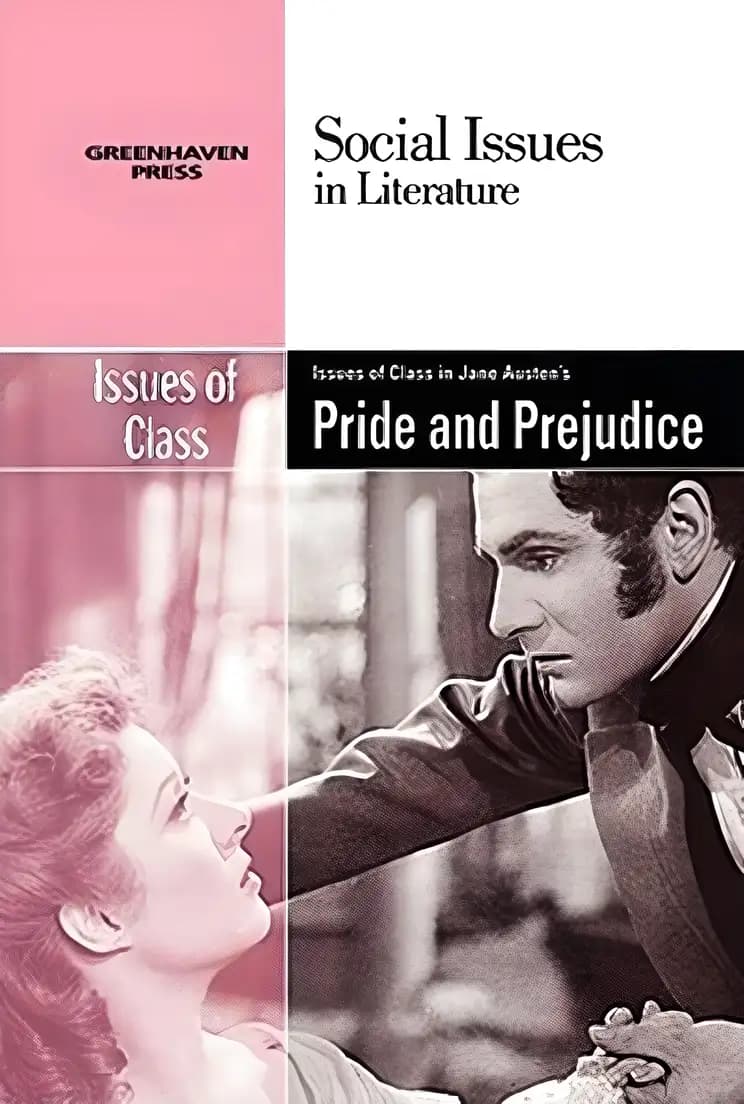
Issues of Class in Jane Austen's Pride and Prejudice (Social Issues in Literature)
Social Issues In Literature Series
on Goodreads (9)
What’s inside...
In 'Issues of Class in Jane Austen's Pride and Prejudice (Social Issues in Literature),' Claudia Durst Johnson explores the complex social hierarchies and class distinctions of early 19th-century England as portrayed in Austen's novel. The book provides a critical analysis of the novel's depiction of class issues, discussing how characters navigate the rigid class system, the impact of wealth and status on personal relationships, and social mobility or lack thereof. Johnson explores how Austen criticizes class prejudices through the narrative and character development and delves into the historical context of the period, offering insights into how the societal norms of Austen's era are reflected and challenged in her work.
Series reading
Non-Sequential
Age
15-17
Length
224 pages
Text complexity
Character compass
Elizabeth Bennet
Fitzwilliam Darcy
Charles Bingley
Charlotte Lucas
Lydia Bennet
Mrs. Bennet
Jane Bennet
Mr. Gardiner
Mr. Bennet
Mrs. Gardiner
William Collins
George Wickham
Lady Catherine De Bourgh
Caroline Bingley
Discussion points
How do the characters in the story show differences in their social classes?
What challenges do Elizabeth and Mr. Darcy face because of their class differences?
Can you think of ways that the characters could have resolved their misunderstandings more effectively?
Why do you think people in the story place so much importance on social class?
How do the characters' actions and attitudes towards class influence their relationships with others?
Tip: Role play these questions
Begin by briefly summarizing the social class system during Jane Austen's time to provide context.
Encourage your child to compare and contrast the lives of different characters based on their social standings.
Ask open-ended questions that allow your child to express their thoughts on class and if it affects their current experiences.
Gauge personal reactions by asking how they would feel in similar social situations as those faced by Elizabeth or Mr. Darcy.
Link discussions to real-life scenarios where social class may influence behavior or decisions to deepen understanding and relevance.
Key lessons
Example Lesson: Understanding social class and its implications
Explanation: The novel discusses the rigid class structures of the 19th century and how characters navigate these social constraints.
Real-World Application: Children can understand how socio-economic backgrounds influence interactions and opportunities, fostering empathy and awareness in social situations.
Example Lesson: The importance of self-improvement
Explanation: Characters like Elizabeth Bennet and Mr. Darcy evolve over the course of the book, learning from their mistakes and misjudgments.
Real-World Application: Encourages children to reflect on their actions, learn from their experiences, and strive for personal growth.
Example Lesson: Gender roles and expectations
Explanation: The book explores the roles and expectations placed on men and women in the 19th century, emphasizing the limitations faced particularly by women.
Real-World Application: Helps children understand gender equality and question traditional gender roles, promoting equal opportunities for everyone.
Example Lesson: The impact of prejudice on personal relationships
Explanation: The story highlights how initial prejudices and misunderstandings between characters lead to conflict and how overcoming these can lead to deeper relationships.
Real-World Application: Teaches children the value of keeping an open mind and not jumping to conclusions about others, which is crucial in building and maintaining friendships.
Example Lesson: Marriage and personal values
Explanation: Marriage is a central theme, where characters make choices between marrying for money or love, reflecting their personal values and societal pressures.
Real-World Application: Encourages children to think about core values and the importance of making life decisions that are true to oneself.